
By Physicians and Scientists for Global Responsibility
January 23, 2026
Global Support for New Zealand Report Calling for Urgent Reset of New Zealand Health Policy: “Reclaiming Health” Sets Out a Path to Reversal, Not Just Management, of Chronic Disease.
A major new report released today by Physicians and Scientists for Global Responsibility New Zealand (PSGRNZ) challenges the foundations of New Zealand’s health policy and dietary guidance, arguing that the country’s escalating burden of chronic metabolic and mental illness is not inevitable and can be reversed.
The report has been sent with an open letter to members of Parliament, New Zealand health agencies, the Auditor-General of New Zealand, and the Mental Health and Wellbeing Commission.
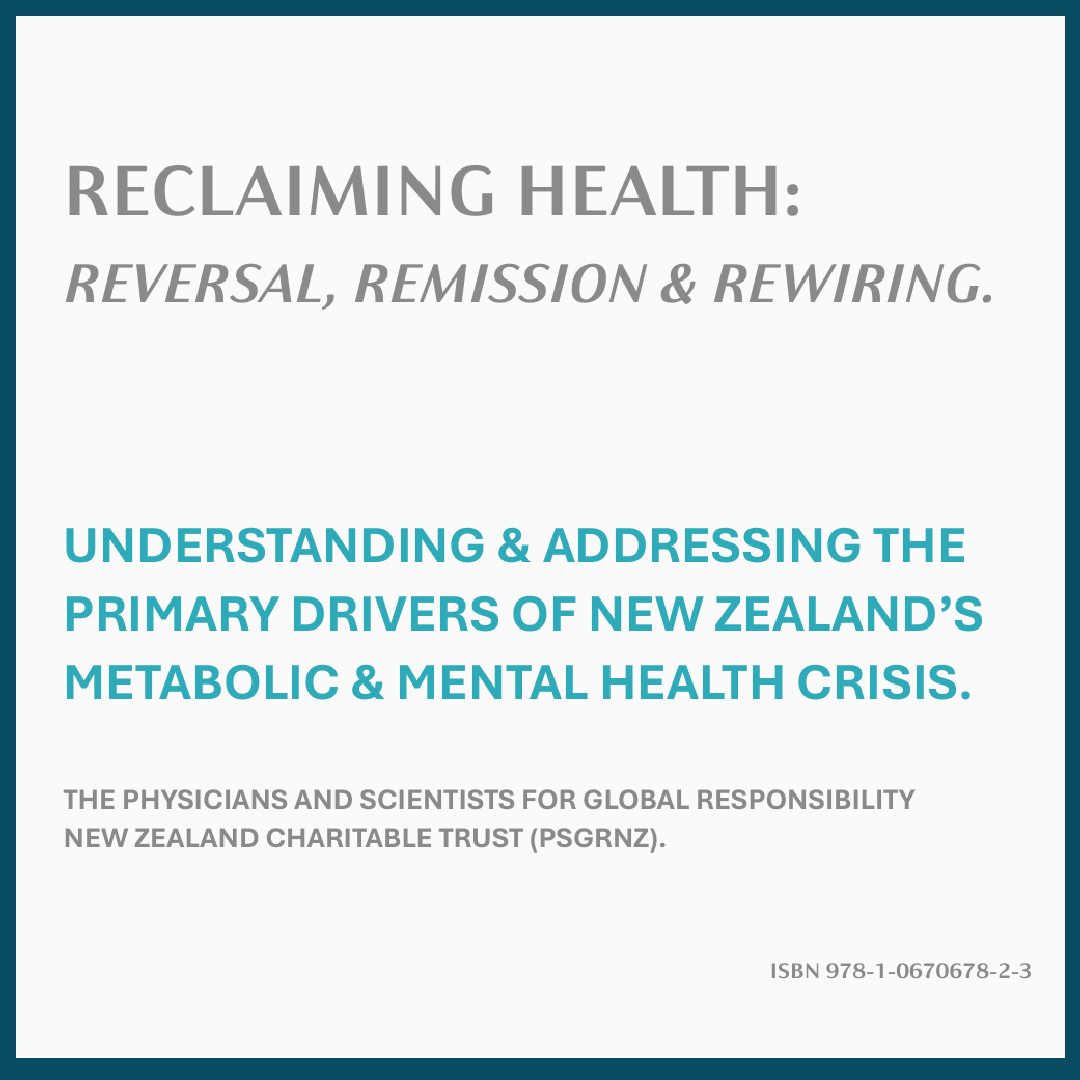
Titled Reclaiming Health: Reversal, Remission & Rewiring, the report synthesises evidence from metabolic science, nutritional psychiatry, clinical practice, and population data. Diabetes, cardiovascular disease, depression, anxiety, neurocognitive disorders, and obesity are shown to be rising together, often within the same individuals and at younger ages. Link: 3 page summary paper + Reform Recommendations.
At the centre of the analysis is the carbohydrate–insulin pathway, in which repeated blood-glucose spikes drive unstable insulin, insulin resistance, inflammation, and mitochondrial stress. These processes often begin years before diagnosis and cut across traditional disease categories, including mental health.
The report challenges long-standing assumptions that obesity and saturated fat are the primary causes of metabolic disease. Obesity is reframed as one possible downstream outcome. It also integrates evidence on food addiction, showing that refined carbohydrates and some ultra-processed foods activate reward pathways in ways analogous to addictive substances, undermining satiety and making long-term dietary adherence difficult in modern food environments.
KEY POINTS: THE METABOLIC PATHWAY TO CHRONIC ILLNESS:
1. A single systemic metabolic & mental health crisis reframes many diseases as one metabolic failure.
2. Glycaemic and insulin stability underpin metabolic health & reflect core physiological regulation.
3. Insulin & inflammation as metabolic mediators. Displacing the single disease-specific approach.
4. Multimorbidity as signal, not just coincidence. Conditions share common upstream drivers.
5. Cumulative processed & refined carbohydrate exposure. Not just sugar, not just calories.
6. Nutrition & diet guidelines developed to avoid deficiency, not assure functional sufficiency.
7. Macronutrient hierarchy inverted. Carbohydrates structurally privileged over fat and protein groups.
8. Insulin as primary risk biomarker overturns cholesterol primacy.
International experts have welcomed the report’s synthesis. “The Physicians and Scientists for Global Responsibility have made clear the reasons for the worldwide pandemic of metabolic syndrome,” said Dr Robert Lustig, paediatric endocrinologist and Emeritus Professor at the University of California, San Francisco. “Fix the food and you fix health, healthcare, and society all at once.”
“This report is an important moment for New Zealand public health,” said Professor Grant Schofield, Professor of Public Health at Auckland University of Technology. “For too long, the voice of nutrition has been whispered when it should have been shouted. The PSGRNZ rightly identifies that the bulk of our poor health, in both chronic disease and poor mental health, is metabolic.”
“We need evidence-based system changes if we are to combat the twin epidemics of obesity and diabetes,” said Dr Leonardo Trasande, Professor of Pediatrics and Population Health at NYU. “I hope this report sparks needed conversation, and action.”
“This document summarises the key science and clinical findings relating to the harms of excessive consumption of sugar, refined carbohydrates and ultra-processed foods,” said Dr Jen Unwin, UK-based clinical psychologist and co-founder of Food Addiction Solutions. “We have gone past the point where there can be any doubt that these food-like substances are at the heart of the multiple crises of chronic ill health.”
Lead author, sociologist Jodie Bruning, emphasises that a central theme of Reclaiming Health is policy failure rather than individual failure. The report documents how health governance frameworks progressively draft out individual biology and metabolic vulnerability, with legacy nutrition models aimed at preventing acute nutrient deficiency rather than supporting metabolic and brain health.
This disconnect has ethical consequences. The report highlights how informed consent is compromised when people are not told about the likely progression from prediabetes to diabetes, or about cumulative medication pathways and risks. Low-income communities experience a disproportionate and preventable burden of harm, and early-onset disease in young people reduces lifetime health and quality of life.
[…]
Via https://psgr.org.nz/reclaiming-health/319-reclaiming-health-pressrelease
 The Most Revolutionary Act
Pingback: ‘Reclaiming Health’ calls for Urgent Reset of New Zealand Health Policy & Sets Out a Path to Reversal, Not Just Management, of Chronic Disease. | Worldtruth