
By Shastri Ramachandaran
Events in Bangladesh, a close neighbor of India, where the local war crimes court sentenced former Prime Minister Sheikh Hasina – ousted from power last year as a result of violent protests led by young people – are watched with the utmost caution by New Delhi.
The world’s largest democracy has been watching its neighborhood unravel for several years now, from Sri Lanka to Bangladesh to Nepal. Recently, the protests that brought down the governments in these countries have acquired a new label – the ‘Gen Z’ protests. International think tanks and media describe them as young people challenging the government over inequality, lack of opportunity, and corruption. They are also driven by digital platforms, mainly social media available on every young person’s phone.
A recent report by the BBC questioning why Indians are not protesting to overthrow their government, following the examples in the country’s neighbors either shows a desperate hunger for ‘news’ in the region or reveals the typical colonial mentality of a media dedicated to the self-appointed ‘international community’. This community, of which the UK is a part, likes telling people what they should and should not do in their country with regard to their ruling class.
The long piece, written by two Indian journalists, is virtually inciting disaffection against the government by asking why India’s Gen Z is not taking to the streets. The feature compares India with its neighbors that have witnessed violence and disruptions over the past several years:
“In Nepal, young protesters brought down a government in just 48 hours last month; in Madagascar a youth-led movement toppled its leader; frustrated Indonesians, worried about jobs, forced concessions from the government after protests… and in Bangladesh, anger over job quotas and corruption brought regime change last year.”
In India, however, “taking to the streets feels risky and remote,” the piece says, even as it paints India’s Gen Z as “vast, restless and hyper-connected – more than 370 million people under 25… Smartphones and social media keep them constantly informed about politics, corruption, and inequality.”
Looks like the BBC wants to see young Indians pouring out into the streets too, bringing the country to a standstill and forcing regime change. The report notes, among other protests, the campus and street protests in 2019 against the revocation of Kashmir’s autonomy, farm laws, and the Citizenship Amendment Act, and more recently, the violent clashes in the Himalayan territory of Ladakh bordering China, quickly dubbed a Gen Z protest as the scenario was similar to what happened in neighboring Nepal just weeks before – and brought down the government of KP Sharma Oli.
The BBC’s disappointment over India not going the way of Nepal or Bangladesh might be more than a case of a once-colonial power’s ‘public service’ broadcaster indulging in a bit of provocative reflection to get attention. For the situation in India’s neighborhood is so fraught that few would wish it upon any other people or country.
Falling governments
The GenZ protests in Nepal, which is suspected to have been staged with the encouragement, if not involvement, of external forces, doubtless overthrew a corrupt regime of venal, self-serving politicians. It looks like an attempt at a color revolution was aborted by the intervention of the Nepalese Army.
While India did not overtly intervene in Nepal, observers point out that New Delhi has never supported any uprising in the neighboring nation. Its role remains a matter of conjecture for now. Nepal currently has an interim government. For all the impressive credentials and good intentions of those holding office now, the administration seems to be a make-do set up without any direction. Sooner or later the interim government will have to hold elections. This is bound to raise concerns beyond Nepal because more than the ousted politicians entering the fray, there is the prospect of the royalist parties and the dethroned palace elements gaining new legitimacy. Should this happen, aided and abetted by external powers, Nepal’s multi-party democracy – though it was messy, corrupt and failed to deliver even minimum governance and development – would be set back by at least 35 years.
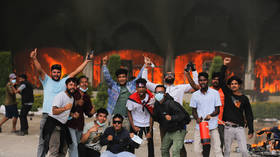
Before Nepal, it was Bangladesh, where the government of PM Sheikh Hasina was ousted in September 2024, following violent clashes described in the international media as a “student-led movement.” Hasina fled the country after popular protests ousted her in August 2024 and took refuge in India.
Bangladesh is still boiling with discontent as Nobel laureate Dr. Muhammad Yunus, installed by the protest movement as interim government caretaker, is himself accused of “creating a situation that could disrupt the general elections” scheduled for February 2026, nearly one and a half years after the fall of the previous government. The former ruling party, the Awami League, has been banned from the upcoming election, and its supporters are being oppressed by the interim government, with mob rule continuing to govern daily life and hopes of ending corruption fading.
Two years before Bangladesh, it was another of India’s neighbors that witnessed mobs successfully toppling the government. In 2022, a swelling wave of public anger against the economic crisis and widespread corruption swept through the island nation of Sri Lanka and ousted the President Gotabaya Rajapaksa, who fled the country in July 2022.
Neighborhood on fire
As India watches the neighborhood burning, it has had to take steps to secure its interests in the region.
On the southern front, India and Sri Lanka have, for the moment, opened a new phase in their relationship. New Delhi addressed Sri Lanka’s 2022 crisis by providing more than $4 billion in aid and strong support at the IMF. This lifeline, which encompassed credit for essential goods such as fuel and fertilizers, along with humanitarian supplies of food and medicine, bolstered Colombo’s confidence in New Delhi.
While India’s assistance helped avert a more profound crisis, it was also motivated by strategic interests. India’s foreign policy leadership saw Sri Lanka’s turmoil as a chance to counter China’s expanding influence on the island and to showcase India’s growing capabilities in regional competition.
India’s relationship with Bangladesh has been strained ever since Hasina was ousted. Yunus is going to great lengths to needle New Delhi with words and deeds that further poison relations.
On October 26, Yunus triggered a major diplomatic row with his gift of a map purportedly showing India’s northeast, which borders China and Bangladesh, as part of Bangladesh to a visiting Pakistani general. This distorted map is the cover of the book ‘Art of Triumph’, which Yunus presented to Gen Sahir Shamshad Mirza, the chairman of Pakistan’s Joint Chiefs of Staff Committee. The map illustrates the idea of a ‘Greater Bangladesh’, floated by a Dhaka-based Islamist group called Sultanat-e-Bangla. This outfit has a version of the map showing India’s West Bengal and the northeast, comprising seven states known as the ‘Seven Sisters’, along with parts of other states, including Odisha, Bihar and Jharkhand, as part of Bangladesh.
Last year, during a four-day visit to China that included a meeting with Chinese President Xi Jinping, Yunus pitched Bangladesh as the “only guardian” of the Indian Ocean that Beijing could use as another logistics hub for global trade. Yunus described India’s Seven Sisters as landlocked, having no access to the ocean.
To make matters worse, Yunus is now strengthening ties with Islamabad. In ignoring Indian sensibilities, Yunus forgets that while Bangladesh, formerly East Pakistan, fought for liberation from West Pakistan in 1971, this was with the backing of India and India-USSR cooperation. Without this support, today’s Bangladesh may not have been born. This is a particularly sore point in New Delhi-Dhaka relations.
Along with his unprecedented bonding with Pakistan, Yunus is also reinforcing Dhaka’s relations with Beijing. This is causing unease in New Delhi, given that China and Pakistan are “iron friends.” The Sino-Pakistan all-weather friendship with its many-sided cooperation from the economic to defense, is understandably viewed in New Delhi as a military and strategic challenge. This would only add ballast to Pakistan’s hostility and aggressiveness, and heighten the threat perception in New Delhi.
The coming together of Bangladesh, China, and Pakistan as a bilateral and trilateral factor in the region would be formidable enough for New Delhi without the US also embracing Pakistan, India’s worst ‘enemy’ of 78 years. Pakistan’s stock is on the rise, five months after India claimed victory in the three-day military conflict in May.
Indian Prime Minister Narendra Modi being pitted against US President Donald Trump, not only on tariffs, but Trump’s assertion that he ended the India-Pakistan war, has turned out to be a godsend for Islamabad.
Pakistan’s dramatic rise to global acceptance was pithily captured by the Financial Times, which quoted army chief Asim Munir as saying Pakistan “has gradually but surely started to regain its rightful place in the comity of nations,” described this as a “geopolitical turnaround.” Trump, who hosted Munir for two White House meetings, has tagged him as his “favorite field marshal,” much to the chagrin of India’s political leadership.
That chagrin may have become silent rage among many in New Delhi when the US made it plain that it will join hands with Pakistan. While flying with Trump to Kuala Lumpur on October 25, Secretary of State Marco Rubio let New Delhi know where it ranks in the geostrategic calculations vis-a-vis Islamabad. He said: “We know they [Indians] are concerned for obvious reasons because of the tensions that have existed between Pakistan and India historically. But I think they have to understand we have to have relations with a lot of different countries. We see an opportunity to expand our strategic relationship with Pakistan.”
Trump added salt to the wound by repeating his claim of brokering the May 10 ceasefire between India and Pakistan.
If Pakistan’s Munir is playing both the US and China, while the two powers are negotiating their own terms of endearment, then Trump has succeeded as an extraordinarily disruptive game-changer. This has far-reaching strategic implications for India, which has prided itself as the engine driving the US pivot to Asia, and regional security. These developments may kill India’s ambitions in the Indo-Pacific and mean burial of the Quad (Quadrilateral Security Dialogue), which Trump revived in his first term.
If the US has moved on from these, as Trump appears to have, India has to forge ahead with a game plan that can turn the tables to its advantage. How it attempts this and in partnership with which powers and countries will be watched with both interest and concern, as this will determine the emerging security contours of the region.
Strategic autonomy
Here arises the critical question of India’s much vaunted strategic autonomy under Modi. India’s long-standing strategic autonomy has been a constant over the decades. Regardless of the political parties presiding over the government, there has never been any change when it comes to the essentials of India’s foreign policy and national security.
True, the personal styles of India’s prime ministers have differed over the decades. Also, successive US presidents had failed in their attempts to make Modi’s predecessors accept military cooperation beyond a point. Both India’s first BJP prime minister, Atal Bihari Vajpayee, and the 14th prime minister, Dr. Manmohan Singh, for all their amiability and perceived softness, declined and put off indefinitely the signing of a logistics agreement with the US, as well as the interoperability of the armed forces of the two countries.
[…]
Via https://www.rt.com/india/627932-new-great-game-in-south-asia/
 The Most Revolutionary Act
Pingback: WOULD BBC REPORT PROTESTS DISRUPTING THE UK ENTHUSIASTICALLY? HELL NO! | Worldtruth