
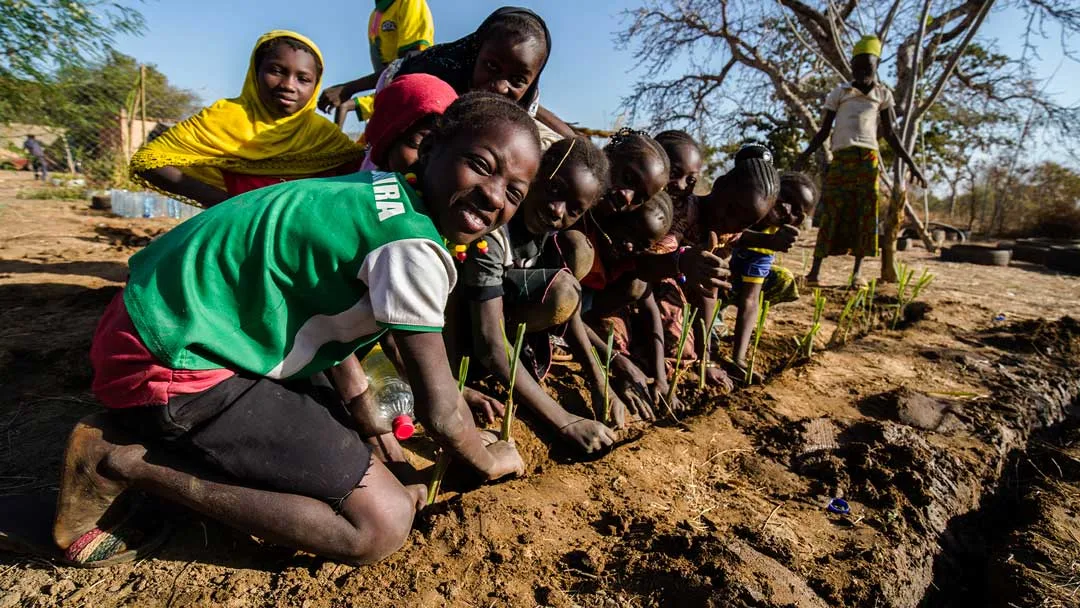
 Yelemani Association works towards food sovereignty in Burkina Faso. Photo: BdF
Founded by Thomas Sankara’s sister, Yelemani Association inspires the fight against desertification in Burkina Faso.
In Burkina Faso, agroecology flourishes as an act of resistance. In a country where more than 80% of the active population makes their living off agriculture, peasant movements and social organizations have defended the production of healthy food and food self-sufficiency as a path to liberation from the wounds left by French neocolonialism.
Leading this effort is the Yelemani Association, founded in 2009 by Blandine Sankara, sister of revolutionary leader and former president Thomas Sankara, who governed the country from 1983 to 1987, when he was assassinated.
The word Yelemani means “change” or “transformation” in the Dyula language, the second most spoken language in Burkina Faso. The name summarizes the organization’s proposal: to change the relationship between people, land, and food, valuing local resources and restoring the dignity of the peasant world.
At the center of this project is agroecology, seen not only as a production technique, but as an anticolonial instrument. For Blandine, cultivating in an agroecological way is resisting the dominant economic model that puts profit above human life.
“We really see these two concepts, food sovereignty and agroecology, as forms of resistance to the economic model, and also as a form of decolonization,” states Sankara.
Based on four pillars: production, valorization of local products, training, and political advocacy, Yelemani has become a reference in the country. It has recovered degraded lands, created a peasant seed bank, trained hundreds of farmers and students, and has been at the forefront of national mobilizations against GMOs and foreign corporations, such as Monsanto and the Bill Gates Foundation.
In an interview with Brasil de Fato, Blandine Sankara talks about the trajectory of the Yelemani Association, the results achieved, and the challenges faced by agroecology in the Sahel country.
“What I have to say is that agroecology is increasingly at the center of agriculture and policies. I’ll talk about agricultural policies in Burkina Faso because today we have a national strategy. This is rare. A country that has a national strategy in the field of agroecology,” she reflects.
Brasil de Fato: Blandine, can we start by talking a bit about how agroecology entered your life and how the Yelemani Association came about?
Blandine Sankara: First of all, it’s important to say that the Yelemani Association was created in 2009. And especially that Yelemani means “change” or “transformation” in the second most spoken language of Burkina Faso, Dyula.
And what does this change mean? For us, it’s the valorization of local resources, to guarantee the dignity of the peasant world and build our daily well-being. It’s not just about peasants. It’s about the dignity of the peasant, on one hand, but also about building the well-being of every Burkinabe citizen.
This is the first explanation about the name Yelemani. The organization focuses on agriculture and food. Our work is directed toward these two fields, which are broad, because they touch all aspects of life, after all, they concern all of us. And in a country like ours, where more than 80% of the active population works in agriculture, this is a central field, because food concerns everyone.
Parallel to change through valorization of local resources and the peasant world, we speak of a transformation of mentality and behaviors. Even though in agroecology we work to produce healthy food and teach cultivation techniques alongside peasants, if there isn’t a change in the mentality of consumers, of all of us, we don’t advance.
This change is also a change of behavior and deconstruction of prejudiced ideas about our own products. So there are two transformations we seek: one in production and another in mentalities.
Here at Yelemani, we promote food sovereignty and the practice of agroecology. It’s clear that with the rejection of the use of GMOs, chemical fertilizers and pesticides. This is our work. Promoting food sovereignty through agroecology and refusing the chemical model.
We see all of this as a form of resistance to the economic model that puts profit above human life. This is the guiding thread of our activities and our daily life. It’s our vision. We really see these two concepts, food sovereignty and agroecology, as forms of resistance to the economic model, and also as a form of decolonization.
Not only of what is on our plates and on our lands, the seeds, but also of our spirits. Because, as I usually say, there has been a colonization of mentalities, a kind of violation of our own power to act. To resist is also to refuse that our fields, markets and kitchens are invaded by imported products, hybrid seeds, pesticides and even by flavors and norms that are not ours.
This is Yelemani’s fight, its mark among the organizations that work for food sovereignty and agroecology in Burkina Faso.
At a certain point in our lives, we lived through the Revolution in Burkina Faso in the 1980s, an experience that deeply marked us. Those who were young at the time, students or even pupils, participated in or witnessed what was at stake in the country.
In my case, I studied sociology and had many opportunities to go to villages and regions of Burkina, which made me understand the realities of the peasant world. Later, in Geneva, during my development studies, I deepened this understanding. It was the era of globalization, of economic partnership agreements, and we closely followed the debates.
Another important factor was the period from 2008 to 2011, when we lived through what was called the “high cost of living crisis”, with the surge in prices of basic products worldwide, linked to the increase in oil barrel prices. There were protests in Ouagadougou and several cities across the country against the increase in food prices.
All of this led us to the conclusion that it was necessary to move toward food sovereignty. Not just as a concept, but as practice. We began experimenting with this in 2009, and it was especially from 2012 that we effectively began our activities.
BdF: What can you tell us about the activities you’ve been developing at Yelemani since 2009 and their results?
BS: We work on four main areas. First, the production and transformation of agroecological fruits and vegetables in Lumbila, which is about 30 km from Ouagadougou. There, there are three plots with production, and it’s mainly women who work. Internally displaced women. What we call internally displaced are people who were expelled from their homes due to terrorism.
The second is the valorization and promotion of local food products. Because it’s not enough to produce, we must value what is ours, this is part of the fight for food decolonization.
Then, there’s education and training on agroecology and food sovereignty, because we think that even if we do good work in terms of production and transformation to offer healthy products and everything else, if the consumer, especially young people, aren’t sensitized, we won’t have results. It won’t be a profound change. So, this is the third axis and we’re working in schools.
But it’s also necessary to work on policies, so we added the fourth area, which is advocacy with political decision-makers so they decide to take agroecology into account.
Among the results, the first was the recovery of abandoned soil in Lumbila, considered unproductive. In one year, we managed to regenerate the land with agroecological practices. We also created a local products market and, since 2023, a peasant seed bank, where farmers can withdraw seeds and return double after harvest, without commercial transactions.
Another important result is the production of pedagogical material. Since 2015 we’ve developed training modules on agroecology and food sovereignty (12 in total) and trained farmers, students, and teachers.
We also had political victories, such as the expulsion of Monsanto in 2015, after a national mobilization against GMOs, and in 2018, a campaign that managed to block the “Target Malaria” project, funded by the Bill Gates Foundation, which planned to release genetically modified mosquitoes.
In 2019, during FESPACO (Pan-African Film Festival of Ouagadougou), we managed to break the monopoly of a French company that prevented the sale of local juices at the event. After popular pressure, a decree authorized local producers to sell their beverages.
But the greatest result for us remains the recovery of abandoned and unproductive land in Lumbila, a symbol of what agroecology can achieve.
BdF: With the end of the revolution in the 1980s, there was a rupture in the path of food self-sufficiency developed by Thomas Sankara. Multinational companies, mainly French ones, and global agribusiness, recovered their presence, developing a form of agriculture that doesn’t collaborate and, in a way, aggravates the problem of desertification in the Sahel. How do you see the effects of colonization on the agrarian question in your country?
BS: It must be said that it was really during colonization that capitalism penetrated the traditional agricultural sector, forcing the modernization of an agriculture considered backward and subsistence, which was forced to evolve into commercial and mechanized agriculture. At that moment, emphasis was placed on crops destined for export, what were called cash products and cash crops.
Therefore, in Burkina’s case, it was peanuts, but especially cotton and, to a lesser extent, also green beans. When we look at the country today, there’s a large area of land, thousands of hectares of land that were destroyed by the use of these chemical inputs for production mainly of cotton. These are thousands of hectares that today need to be recovered. They need to be restored.
The richest zones, the most fertile lands, were used for cotton cultivation, with excessive use of chemicals to produce more and sell more. Therefore, it was really for export, they were export products to other continents, mainly to France.
There are also floods caused by rains, with the loss of seeds, which forces farmers to go into debt to buy new seeds. Therefore, there were many consequences because of this export culture.
In the 2000s, cotton cultivation was done with great support from Monsanto, which I mentioned earlier, the American company. It made producers believe that the harvest would be more profitable with transgenic cotton, without additional insecticide and with better yield.
We can even say that there was an agricultural and food colonization, and that it never ended. The great powers and multinationals continue to exploit the same mechanisms.
That’s what they told our producers. In 2009, this cotton was profitable in the first three years, but very quickly farmers had to go back to using insecticides because the quality of cotton deteriorated and the quantity was also not as expected, it wasn’t up to standard. And that’s not all. It also destroys neighboring crops, not just cotton, but crops that were alongside, like sesame, for example, which was totally destroyed.
And all of this in conditions of climate degradation in Burkina. Therefore, the application of these policies in the agricultural sector led to the total loss of our food autonomy and local knowledge, and even food security increased with the devaluation of food crops for the benefit of these crops.
[…]
 The Most Revolutionary Act
Pingback: THE LONG FIGHT BACK AGAINST THE COLONIALIST FOR PROFIT ABUSES OF FOOD PRODUCTION & FOOD SOVEREIGNTY | Worldtruth