

Russia’s foreign minister condemned the US media leak of a draft peace agreement, referring to it as ‘hype’ and ‘megaphone diplomacy’
The Ukrainian government has “agreed to a peace deal” to end the nearly three-year war between Moscow and Kiev, a US official told CBS News on 25 November.
“The Ukrainians have agreed to the peace deal. There are some minor details to be sorted out, but they have agreed to a peace deal,” the US official said.
Ukrainian National Security Advisor Rustem Umerov also said that an understanding has been reached, expressing optimism that Ukraine’s President Volodymyr Zelensky would travel to the US by the end of November in order to finalize the deal.
Negotiators reached “a common understanding on the core terms” of a deal discussed among US, European, and Ukrainian officials in Switzerland over the weekend.
“We now count on the support of our European partners in our further steps. We look forward to organizing a visit of Ukraine’s president to the US at the earliest suitable date in November to complete final steps and make a deal with [US] President [Donald] Trump,” Umerov added.
According to CBS, this comes after US–Russia negotiations in Moscow. US Army Secretary Dan Driscoll met with Russian officials in Abu Dhabi, two anonymous diplomatic sources told the news channel.
“We remain very optimistic. Secretary Driscoll is optimistic. Hopefully, we’ll get feedback from the Russians soon. This is moving quick,” the US official went on to tell CBS News.
Meanwhile, Russia’s Foreign Minister Sergei Lavrov has slammed the leak of information from US media.
Lavrov said that while Russia “appreciates the US position, which is taking the initiative in resolving the Ukrainian conflict,” the country “operates professionally, not leaking information before formal agreements are reached.”
“Russia expects the US to inform it of the results of consultations with Ukraine and Europe in the near future,” he added.
“It was leaked on purpose to fan the media hype. Those who direct this hype certainly want to undermine Donald Trump’s efforts, to distort the plan according to their wishes,” Lavrov added.
The foreign minister also said Moscow did not receive any official messages from Washington on the matter. Russia will confidentially discuss whatever US proposal is submitted and will do so without “resorting to megaphone diplomacy,” he went on to say.
The CBS report came the same day as a phone call between Zelensky and UK Prime Minister Keir Starmer. The conversation preceded a virtual meeting of the Coalition of the Willing scheduled for Tuesday.
“We have coordinated our positions and the priority issues for discussion, as well as some of our next steps and contacts,” Starmer said.
According to an Axios report released on Monday, Zelensky has been presented with a 28-point US plan. The report says the Ukrainian president was briefed on the plan by US envoy Steve Witkoff and President Donald Trump’s former advisor and son-in-law, Jared Kushner, during a phone call.
It adds that efforts to draft the 28-point plan began last month.
A draft of the plan seen by Axios last week calls on Ukraine to give up additional territory in the east, introduce a cap on the size of its army, and agree never to join NATO.
“The plan is not easy for Ukraine, but the US believes the war must end and that if it doesn’t, Ukraine is likely to lose even more territory,” a White House official told the outlet.
The 28-point US plan is reportedly inspired by Trump’s post-war plan for Gaza. It focuses on “peace in Ukraine, security guarantees, security in Europe, and future US relations with Russia and Ukraine,” Axios wrote.
Since the start of the war in February 2022, Russian forces have successfully occupied much of, but not all of, the territory of four eastern Ukrainian oblasts: Donetsk, Luhansk, Kherson, and Zaporizhzhia.
In September 2022, Russia passed legislation formally annexing them.
Ukraine is demanding that Russia withdraw from these territories entirely, including areas with pro-Russian Ukrainian populations.
Europe remains determined to keep Ukraine war going
Ana Vračar
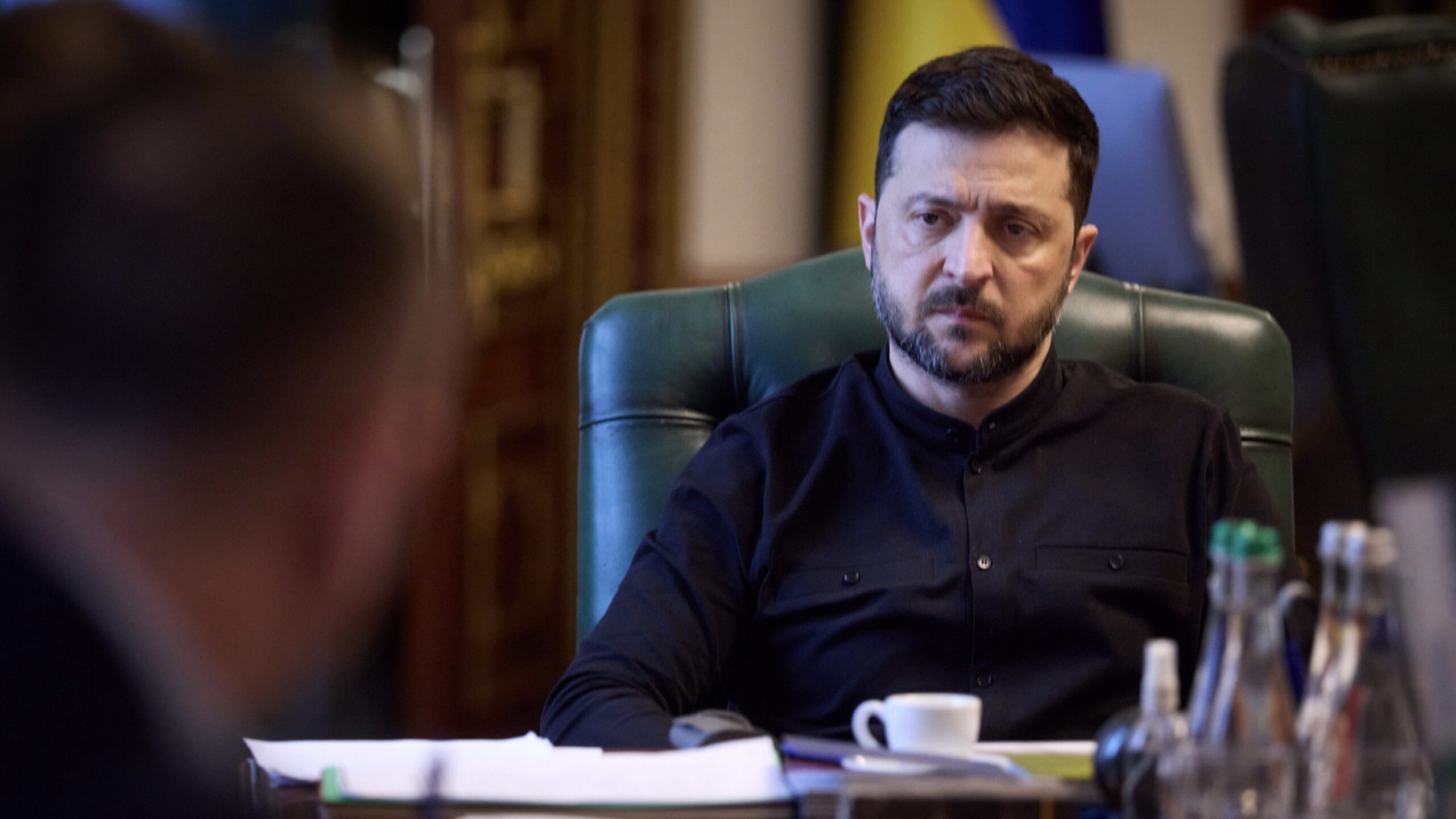 Ukrainian President Volodymyr Zelenskyy in a meeting with government officials. Photo: Volodymyr Zelenskyy / X
European leaders scrambled to resist a US-backed draft plan for Ukraine that includes no NATO membership, recognizing Russian-held territories, and capping Ukraine’s military.
European leaders spent a restless weekend reacting to a draft peace plan for Ukraine backed by US President Donald Trump. The original 28-point document includes provisions that both EU governments and Prime Minister Volodymyr Zelenskyy’s administration condemned as “maximalist,” insisting the proposal concedes too much to Russia: long-requested assurances that Ukraine will not join NATO, recognition of territories currently held by Russian forces, and a cap on Ukraine’s military at 600,000 troops – still making it one of the largest in the region.
Mainstream commentators quickly proposed that accepting such terms would amount to Ukraine’s capitulation. Yet other analysts noted that European leaders’ concerns appear less about Ukraine’s future and more about shielding themselves from fallout. Ukrainian researcher Volodymyr Ishchenko suggested in a social media post that the EU’s real fear is that Russia might actually accept the deal – and that European governments may therefore try to make it unacceptable to Moscow. “It’s especially telling that this fear persists even as Russia enjoys the upper hand and can prolong the war to pursue its perceived ‘maximalist’ goals, while Ukraine descends even deeper into military, economic, political, social, and international crises,” he wrote.
This new episode of Europe’s resistance to a minimal amount of diplomacy comes at a time when most Ukrainians support a negotiated outcome to the conflict. A Gallup poll from July 2025 showed nearly 70% of respondents favoring a negotiated settlement rather than “fighting until victory,” a near-complete reversal of opinions in 2022.
European leaders have obviously not attuned themselves to the shift in public sentiment. After consultations between European and Ukrainian officials over the weekend, an alternative version of the plan removed provisions on neutrality and NATO non-expansion, and raised the troop cap to 800,000. Over the past few days, European heads of state repeatedly dismissed any peace proposal that does not amount to Russia’s full surrender, with some insisting that “Putin should be forced to the negotiating table” – apparently forgetting that it was European governments that stalled negotiations on multiple occasions.
Rather unsurprisingly, Russian authorities said the amended proposal is not acceptable.
The European counter-proposal also proposes lowered expectations about the bloc’s own commitments to Ukraine. While the original draft referenced billions of euros in support for recovery and rebuilding coming from European allies – mirroring the US administration’s push for the region to agree on more military expenditure – the rewritten version is less enthusiastic about the topic. Instead, it suggests that Ukraine’s reconstruction and stabilization should be paid for through what they refer to as reparations, specifically Russia’s frozen assets. European enthusiasm for the concept of reparations has been noticeably absent in other conflicts they have supported, including Israel’s genocide in Gaza.
These moves reinforce what has already been apparent: the EU and Britain are obstructing efforts toward a ceasefire not because they believe Ukraine can prevail militarily, but because they fear the political and financial consequences of acknowledging that their approach to the conflict has failed, causing thousands of deaths.
The fact that some interaction with last week’s plan has happened represents some space for hope compared to previous attempts. Whether this will translate into concrete results, however, remains uncertain, especially given the level of European interference.
[…]
 The Most Revolutionary Act