
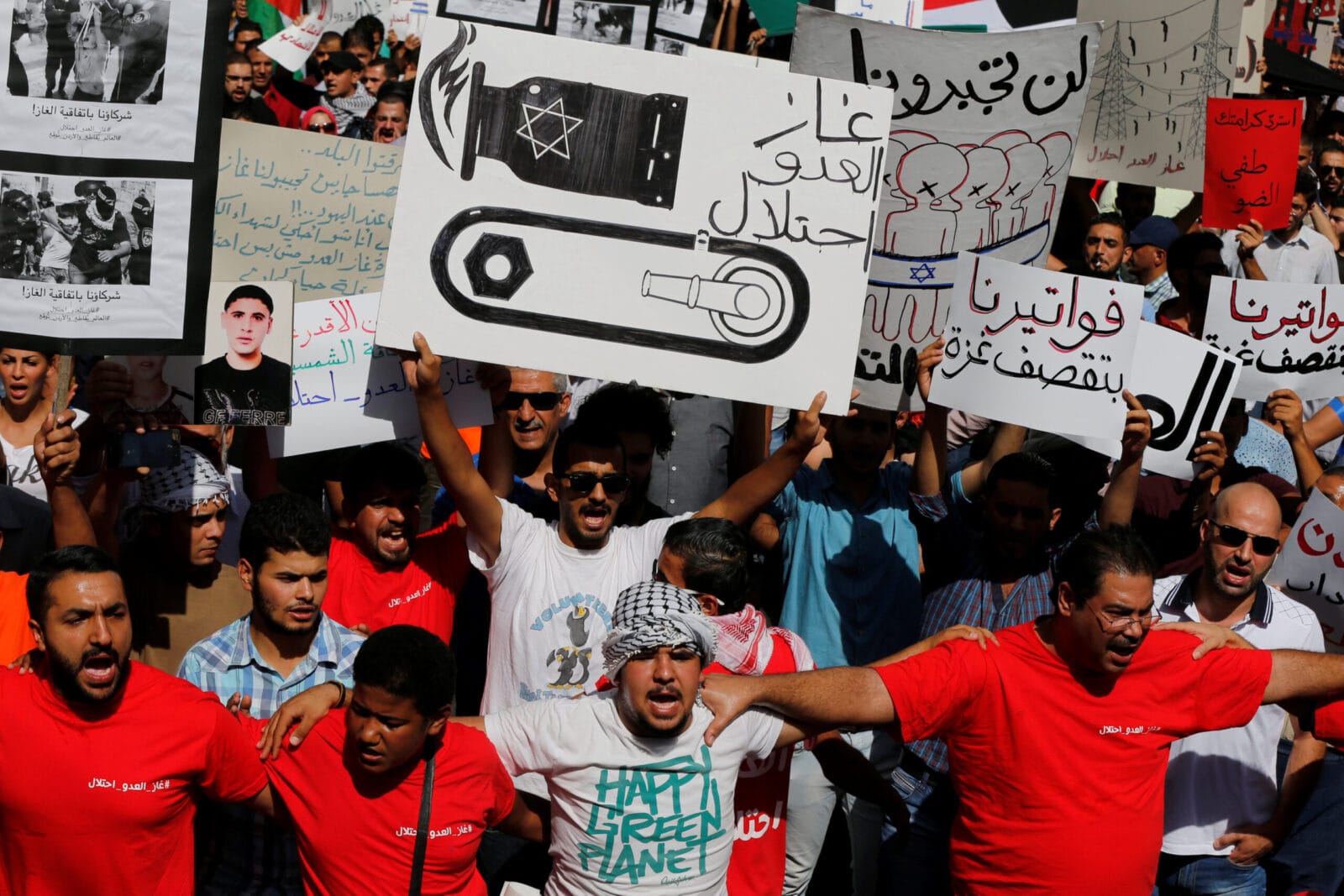
 Jordanian protesters chant slogans against a government agreement to import natural gas from Israel, in Amman, Jordan, October 14, 2016. The center placard reads: “The enemy’s gas is occupation.” Muhammad Hamed/Reuters
On the morning of June 13, 2025, air-raid sirens sounded across Amman and other Jordanian cities warning residents to shelter in place. Hours earlier, Israel had launched an unprecedented attack on Iran, triggering 12 days of retaliatory missile and drone strikes.
As Israeli fighter jets and Western air-defense systems used Jordanian airspace to intercept Iranian projectiles, Jordan’s military also played a decisive role in shielding Israeli cities—even as government officials warned that Jordan would not become a battleground for adversaries. Over the same tense hours, Israel abruptly curtailed natural gas supplies to Jordan and Egypt when it shut down two major offshore gas fields in the Mediterranean, the Leviathan and the Karish. The move was preemptive: Israel feared Iranian retaliation after it had targeted one of Iran’s largest gas fields in the Gulf.
The escalation exposed the asymmetrical dynamics of Jordan’s normalization with Israel. On one hand, Jordan is expected to fulfill its obligations, such as facilitating Israel’s defense—whether through direct military coordination or logistical lifelines like the “land bridge,” a trade corridor aiming to connect Israel to the Arabian Peninsula. On the other hand, Jordan has to face the consequences of this position. Since Israel began its genocidal war on Gaza in October 2023, anti-normalization sentiment has intensified, with public outrage growing at the government’s perceived complicity in enabling Israel’s military.
But Jordan’s present bind sits atop a deeper history. In 1994, it became the second Arab state to normalize relations with Israel by signing the Wadi Araba agreement. Initially framed in terms of a shared peacekeeping agenda, this relationship has been marked by Jordan’s growing economic and political dependency on donor states and on Israel itself across a range of sectors, from security and intelligence to water, energy, agriculture, manufactured goods, technology and tourism.
Hand in hand with the Oslo Accords of 1993 and 1995 between the Palestine Liberation Organization and Israel, the Wadi Araba treaty marked a decisive shift in the region’s political economy. Oslo created the Palestinian Authority, which fragmented resistance and embedded fiscal and infrastructural dependency on Israel while relieving Israel of the direct costs of occupation. Wadi Araba extended this logic to Jordan, binding its economy into Israel’s orbit and international donor-led neoliberal frameworks. Together, these agreements transformed Israel from a regionally isolated rogue state on the margins of Arab markets into a central node of integration, advancing the Zionist project and expanding its influence under the guise of economic restructuring and so-called peace dividends.
Energy and water, in particular, have become flashpoints in Jordan’s material relationship with and dependence on Israel. These vital sectors tie the kingdom’s economy and daily life to the Zionist state, leaving trade, industry and political stability vulnerable to its leverage. The costs are not just economic: Dependence and deepening normalization, amid an ongoing genocide, fuel social unrest and widen the gap between the government and its people.
Energy Insecurity
Historically, Jordan relied on neighboring Arab states for oil and gas. From the 1960s through the 1980s, supplies came largely from Saudi Arabia and other Gulf states. After the first Gulf War in 1990, dependence shifted to Iraq until the 2003 US invasion. Jordan then turned to Egypt. But upheavals following the revolution in 2011 disrupted supplies. To compensate, Jordan imported crude oil from the global market at a high cost, pushing the National Electric Power Company (NEPCO, a government owned entity) into deep deficit.[1] As political ecologists Benjamin Schuetze and Hussam Hussein have noted, this trajectory reflects more than regional disruptions. It also marks a deeper structural dependency shaped by geopolitical alignments, economic liberalization and the erosion of energy sovereignty.[2]
In 2016, in a highly controversial move, NEPCO signed a purchase agreement with Israel, represented by NBL Jordan Marketing Limited (a subsidiary of Noble Energy, a US-based oil and gas company) to supply Jordan with natural gas. This gas was to be extracted from the Leviathan Gas Field in the Mediterranean, operated by the US oil giant Chevron and controlled by Israel. To date, the government has refused to release the full agreement. In the face of criticism, they cite a constitutional court ruling that parliament cannot vote on deals signed between private companies. Yet the government of Jordan is an official party to the deal, having signed supporting agreements with the Israeli government to guarantee the flow of natural gas.
The deal triggered widespread protests from the moment news leaked that the government of Jordan had signed an intent letter to buy gas from Israel.
[…]
Many Jordanians view Leviathan gas through the framework of settler colonialism: as a resource taken from the earth beneath stolen Palestinian land being used to reinforce Israel’s economic power.
[…]
Israel’s weaponization of water and electricity in Gaza—as documented in South Africa’s genocide case at the International Court of Justice (ICJ)—has made Jordanians even more wary of their own reliance on Israel for utilities.
[…]
[…]
.Water Inequalities
Normalization has reshaped Jordan’s water sector much as it has electricity. The two utilities are tightly bound together: Electricity makes up more than half of the water sector’s operating costs, meaning problems in the power sector spill directly into water management. Together, the two account for about a quarter of the country’s public debt.
Imbalances between cost and revenue afflict both sectors. The state-owned electricity company, NEPCO, purchases power from producers then sells it to distributors at below-cost, government-regulated rates that guarantee private profits while locking NEPCO into chronic deficits. The water sector faces its own leakage. Nearly half of Jordan’s water is classified as “non-revenue water,” lost to theft, leaks or inefficiency, compared with around 27 percent in Morocco.[7]
Today, with the 2024 collapse of Syrian President Bashar al-Asad’s regime and Israeli military expansion into southern Syria, Israel controls most of the water that flows into the Jordan and Yarmouk river basins.
These financial weaknesses are compounded by a long history of contested water rights. The Wadi Araba agreement’s division of water from the Jordan and Yarmouk rivers was only the latest chapter in long and protracted conflict over water in the region. Since the First Zionist Congress in 1897, Zionist leaders tried to draw borders around water sources, like the Litani River in southern Lebanon. By 1967, Israel’s control of the Golan Heights, including the Banias and Hasbani rivers, shifted the hydro-strategic balance decisively in its favor. Today, with the 2024 collapse of Syrian President Bashar al-Asad’s regime and Israeli military expansion into southern Syria, Israel controls most of the water that flows into the Jordan and Yarmouk river basins. Access to rivers and aquifers to expand settlements and dispossess Palestinians has been central to Israel’s colonial settlement project in Palestine.
Israel has long weaponized this control vis-a-vis Jordan too. In the 1970s, it took three to four times its share from the Yarmouk River—as delineated by the Johnston Plan of 1955—and blocked Jordan from carrying out projects using the river, like the Maqarin (or Wehda) Dam.
[…]
Severe water scarcity has forced Jordan to seek alternative supplies. Most recently, the IFC along with the European Union and EU Banks, as well as individual states of the United States, France, Italy, Germany, Holland, Spain and Japan have pledged support for financing the Aqaba-Amman Water Desalination and Conveyance Project: an ambitious proposal to use renewable energy to desalinate water from the Red Sea in Aqaba and distribute it nationally through pipelines. The project claims it will provide a third of the country’s water supply by 2030. But local critics point out that the massive debt, almost 64 percent of the $3.5 billion needed to fund this project, further binds Jordan into a dependent relationship to foreign investors, rather than addressing root inequalities in water access linked to normalization and mismanagement.
Against this backdrop, the 2022 water-for-energy memorandum of understanding with Israel and the UAE provoked sharp public opposition. Under the deal, Jordan would build 600 MW of solar capacity to export to Israel, while Israel would supply Jordan with 200 million cubic meters of water annually. The UAE would finance both sides of the project. As with the gas deal, this deal, if enacted, would have deepened Jordan’s political and economic dependence on Israel. Jordan’s former prime minister, Ahmad Obeidat, questioned the benefit of the deal for Jordan by noting it covers 20 percent of Jordan’s water needs and only 3 percent of Israel’s energy needs. His opposition added to the widespread dissent against the deal across Jordan, which forced the Jordanian government to rethink its position.
Although Jordanian Foreign Minister Ayman Safadi cancelled the deal upon the start of Israel’s genocide on Gaza, questions remain about whether it will be revived.
Material Resistance to Normalization
[…]
Since October 2023, mass protests in the streets of Jordan have demanded the government take serious action to stop the genocide and end ties with Israel. There have been calls to nullify the Wadi Araba agreement, for the expulsion of western military bases and to take concrete steps toward economic recovery. The government has resisted these demands, while reiterating its support for the Palestinian cause and a two-state solution.
In this way, its diplomatic stance provides cover for Israel’s ongoing genocide and renders normalization ordinary. Instances that would have been unthinkable a decade ago, such as a prominent academic praising Israel on national television even as Israel faces ICJ prosecution for genocide and war crimes, reflect the cultural hegemony shaping public discourse. In recent polls, 42 percent of Jordanians oppose cancelling the Wadi Araba agreement.
…while some support normalization, activist movements continue to focus on material politics as a site of disruption—even in the face of growing restrictions.
But while some support normalization, activist movements continue to focus on material politics as a site of disruption—even in the face of growing restrictions. “The Jordanian National Campaign to Overturn the Gas Agreement with the Zionist Entity” began out of opposition to the gas deal in 2014 and includes a wide range of activists, lawmakers, professionals, party members, MPs, trade unions and youth movements from across the political spectrum. In June 2025, Amman’s governor for the first time denied this group a permit to protest against the gas deal. Later the campaign stated on Facebook that the governor’s office had implicitly threatened to detain organizers or participants if the protests actually took place.
Governors—appointed by the prime minister rather than elected—hold broad powers to administratively detain anyone deemed to be a “security threat.” This authority has been used against protestors, journalists and social media influencers. Many contemporary activists were born amid or after the 1989 elimination of martial law and are confronting levels of repression unfamiliar to their generation. Recent detentions have extended to party members like Issam Khawaja—a pediatric neurologist and recently elected secretary general of the Jordanian Democratic Popular Unity party. Khawaja was arrested while leaving his workplace at Al-Basheer Hospital for a speech he gave in a protest in downtown Amman. Other recent arrests include students and social media influencers, like Ayman Aballi, who made a video criticizing the government for holding the Jerash music festival during Gaza’s famine, and journalists like Hiba Abu Taha, imprisoned for reporting on the movement of goods between the Gulf and Israel through a land bridge passing through Jordan.
Her case is telling. By highlighting trade with Israel during the genocide, Abu Taha directly questioned the material infrastructure of normalization. Abu Taha was sentenced under the widely-criticized cybercrime act, which was amended in August 2023. The law’s broad provisions against “threatening social harmony” serve as a ready tool against any dissent and journalism the state objects to, raising red flags for international human rights groups.
[…]
Via https://libya360.wordpress.com/2025/10/29/energy-water-and-the-cost-of-jordans-dependence-on-israel/
 The Most Revolutionary Act
Pingback: THE SAD DECLINE OF JORDANIAN REGIME | Worldtruth