
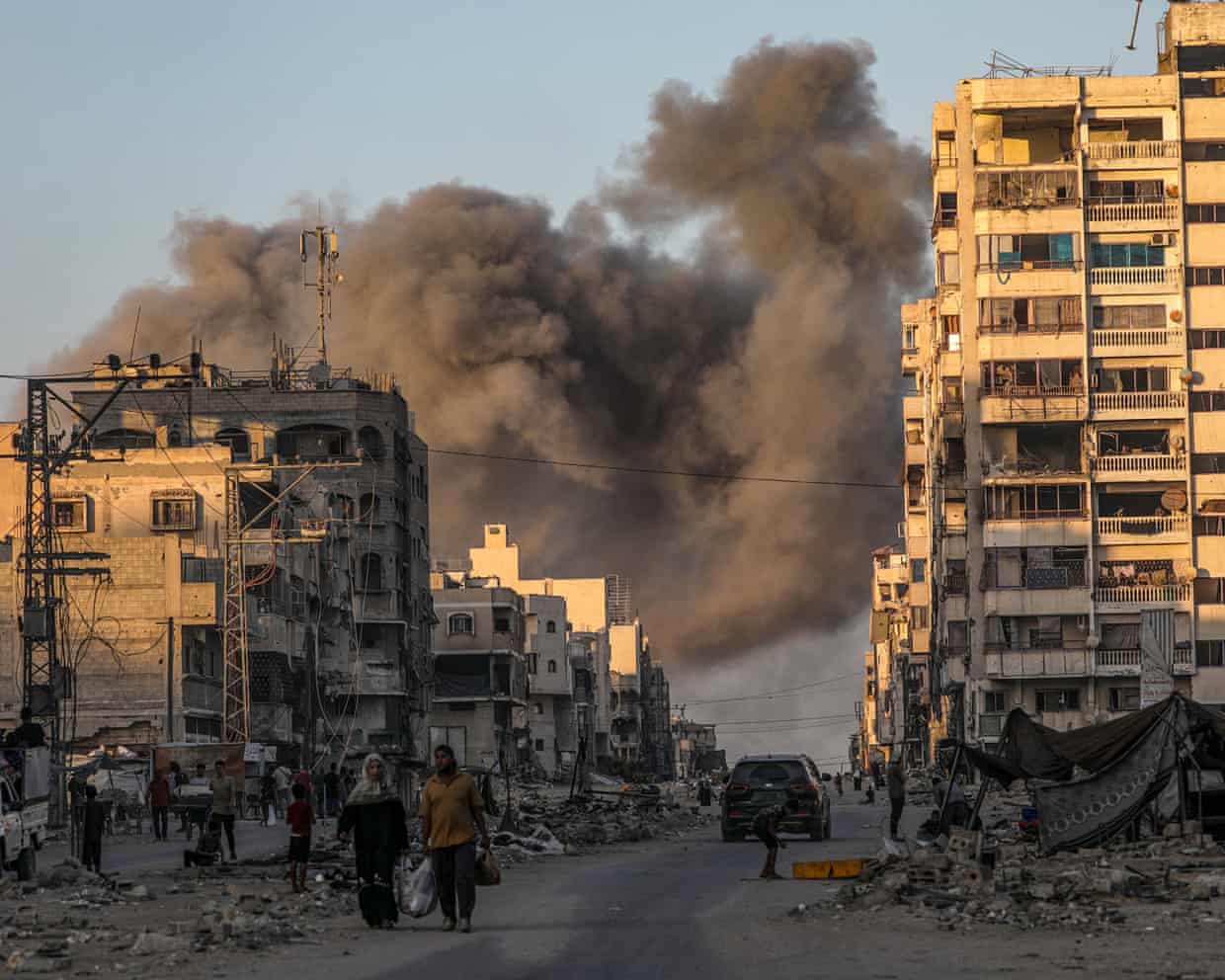
Fire is consuming the whole city. Shells have struck every place, leaving no corner untouched. Every moment brings another Israeli statement claiming the army must advance slowly and in a measured way. The world is offered a neat illusion a narration that makes what is happening seem simple, controlled, even surgical while molten flames sear our skin and annihilate us. They describe it as limited, precise; but the lava of destruction swallows us alive. It’s a lie as big as the one they called the “limited operation” in Rafah.
Gaza is slipping away from us.
Hundreds of thousands still have nowhere to flee. Most cannot afford to move at all. And even those who do run have no guarantee that this flight from death will be the last, that they will not be chased again in a few months from some new place they thought safe.
Gaza is the last nail remember this for me. If our city of Gaza is lost, then farewell to the whole Gaza Strip. We will be erased quietly, as you are erasing us now. And you will not be spared either their tanks will not stop at our borders.
Do you know what is happening now? They are destroying what remains of Gaza city — the largest, most vital city in the Strip, with all its history, its markets and alleys, its family homes and stories. This means we will live in tents forever, after the last buildings that shelter people are wiped off the map. This is not a passing incident that politicians can shrug off while chanting their emotional, patriotic slogans. This is a catastrophe that must be stopped at any cost.
The scene in Gaza city is apocalyptic. Terror fills every street; night is unbearable. Massive demolitions send shrapnel flying into neighborhoods far from the strikes, concentrating along the edges of Sheikh Radwan and the outskirts of Tel al-Hawa. Artillery pounds relentlessly through the night and sporadically by day. Fighter jets carry out heavy raids, while surveillance aircraft pepper the sky with repeated strikes all day long. Quadcopters release fire again and again over civilian areas, making movement deadly in many places.
People keep fleeing, yet huge numbers remain in the city. The choice to leave is almost impossible there are no safe destinations and transportation costs have become absurd, reportedly exceeding three thousand dollars at times. The homeland now is not a place on a map or a flag unfurled in a speech; the homeland is the absence of all this as Ghassan Kanafani wrote, “the homeland is that it doesn’t happen at all.”
I asked myself: what is the homeland? Is it the country we dreamed of but never saw? The only city we have ever known? The house that is the fruit of a lifetime? The warm embrace of family? The quiet laughter of children after a good meal? Or is it, as Kanafani said, simply the absence of what is happening to us? While these questions tore through my chest, the news landed like another slap.
It was no surprise when U.S. Secretary of State Marco Rubio announced before leaving Israel for Doha after the Arab-Islamic summit: Washington supports the continuation of the Israeli military operation in Gaza, hoping it will end with “the defeat of Hamas and the return of the hostages,” adding, “After Hamas is defeated we will talk about rebuilding Gaza.” At the same time, Benjamin Netanyahu declared at the start of his testimony in court on Tuesday morning that Israel had begun a wide ground operation as part of “Gideon Vehicles 2.”
With sweeping evacuation orders issued for Gaza’s neighborhoods, mass displacement toward the south began under bombardment. Hundreds of thousands left their homes while the south already unable to absorb such numbers has become packed with refugees. The tragedy has a double axis: Israeli policies of mass displacement and systematic destruction, which amount to war crimes and crimes against humanity; and the other axis, Hamas, clinging to an inflexible rhetoric that lacks realistic political decisions, treating people’s lives like bargaining chips in a regional and international game.
Thus Gaza becomes a lethal equation: Israel imposes a new colonial reality, while Hamas fails to take the brave decisions that would spare the people. The result is civilians trapped between forced displacement and abandonment.
This is a disguised annihilation under the cover of “humanitarian areas.” Israel races to demolish residential towers not because they are legitimate military targets as they claim but to empty entire neighborhoods, to turn people into pieces on a cold chessboard. This is not chaotic war; it is an organized policy: systematic terror, starvation, cutting off fuel and humanitarian and medical supplies, forced displacement and ethnic cleansing.
I think of fleeing southward to my family in Deir al-Balah. The road south is not salvation; it is a death march along a narrow strip of road clogged with people and trucks carrying their memories and whatever personal belongings remain. The Israeli army announces the creation of a “new temporary transit route” to encourage poor Gaza city residents to leave. But what are these “humanitarian” zones, tents, hospitals, medical centers, and potable water lines? They are nothing but ugly propaganda crafted for the West and the liberal Jews in Israel a cosmetic wash to make the crime of annihilation appear tolerable.
Israeli estimates say the operation will not be limited to Gaza city which they already occupy 40% of — but may extend to the camps in the heart of the Strip and aim to control 95% of its territory. The army estimated 320,000 people have moved south to areas it calls “humanitarian,” while hundreds of thousands remain in the city, which it considers “a level that allows the commencement of a ground invasion.”
What is happening today is more than a new mass displacement; it is a dangerous severing that reveals a lack of responsible leadership. Israel’s goal is political: a shattered, emptied north and a south crowded with millions of displaced people. Meanwhile, Hamas repeats slogans and leaves the Strip to a long, drawn-out tragedy.
Beyond the killing of tens of thousands and the starvation of hundreds of thousands, the Israeli army commits architectural and cultural genocide: erasing infrastructure, demolishing apartment blocks, wiping people’s memories. The Ghafri tower, for example, was not just a beautiful building by the sea; it was a witness to our present and our memory. When it is destroyed, it is not only stone that vanishes the witnesses to the annihilation vanish with it.
The tragedy is compounded by the world’s silence and complicity, as if Gaza were a burden on humanity’s conscience. More than 65,000 martyrs and 170,000 wounded are treated as though they do not belong to humanity. Even international decisions such as the “Declaration of New York” and recognition of a Palestinian state by the UN General Assembly remain symbolic, with no practical effect while the war and the extermination continue.
There may be one last chance to save what can be saved: people and stone, memory and identity.
Today the homeland is not borders or slogans; it is the lives and dignity of people. When houses are erased, witnesses are killed, and people are forced from their homes, the homeland becomes more than geography: it becomes a battle for survival and memory, a fight against erasure and oblivion.
We are being exterminated here. We are being exterminated. Pause over that word: it is too simple for what we are living through. Read it slowly, repeat it. Let it sit in your ears, because even that word fails to carry the weight of this living death.
Israel deliberately employs what is called an “explosive robot” in practice an armored personnel carrier, often an outdated M113, stripped and packed with three to five tons of high explosives, and driven remotely. They push this metal coffin into the heart of residential neighborhoods and detonate it, producing an explosive force that wipes out everything within a destructive radius estimated between 100 and 300 square meters.
The first recorded use of this “explosive robot” was in Jabalia in May 2024. Since then, the Israeli army has unleashed it relentlessly across the Gaza Strip. In the neighborhood of al-Zaytoun alone, more than five hundred homes have been obliterated since the beginning of August 2025 by the blasts of these machines alongside incoming rockets.
Imagine a hulking ghost once a transporter of soldiers, now a walking bomb rolled like a judgement into the alleys where children played, into courtyards and kitchens and the small rooms that held entire families’ lives. It does not distinguish. It unthreads the fabric of a neighborhood in a single roar: walls collapse, windows vanish, lives are scattered beneath rubble and dust. The sound of its approach is a new kind of terror; its explosion is a deliberate act of erasure, an engineered obliteration of homes, memories and the fragile safety that remained
 The Most Revolutionary Act