
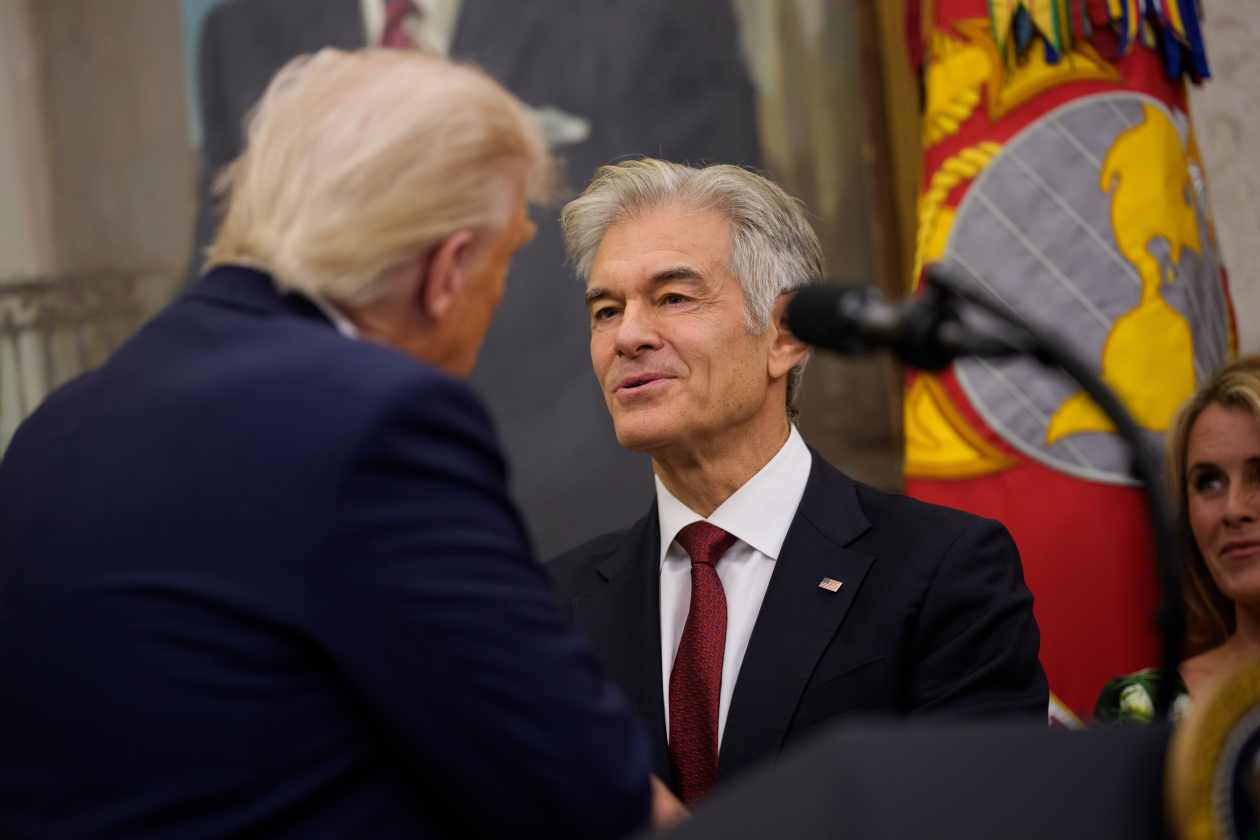
President Donald Trump congratulates Mehmet Oz in April as TV’s “Dr. Oz” is sworn in as the Medicare and Medicaid Services administrator. Photo: Getty Images
Oz’s attempts to cut Medicare’s costs have been frustrated by statutory constraints.
Elon Musk’s leadership of the temporary “Department of Government Efficiency” dominated the beginning of President Donald Trump’s second term. DOGE, as Musk branded the new entity, was tasked with reducing federal spending through cutbacks to personnel, contracts, grants and “woke” initiatives.
An outcry from those targeted generated much news coverage. But “DOGE” had no statutory power. It was largely boxed in by existing appropriations and legal entitlements to federal funds established by Congress — and many of its cuts would be reversed in court. The so-called department also greatly exaggerated the savings it generated, by counting reductions in credit authority which were unlikely to be used. Skeptical analysts suggest that “DOGE” likely generated a one-time reduction in federal spending of just $15 billion.
By contrast, since Trump appointed celebrity physician Mehmet Oz to run the Centers for Medicare and Medicaid, the agency has generated savings of more than $50 billion — which will likely increase over time.
When Oz was nominated to run CMS, the New York Times accused him of having “sown misinformation — about Covid treatments, weight loss hacks and unproven supplements,” but it otherwise gave little attention to his ambitions. These have proven to be substantial, and CMS has generated major savings in the few months that Oz has been in charge.
Over recent years, the Biden administration sought to maximize enrollment in publicly funded health insurance, regardless of the cost to taxpayers. This was a bonanza to insurers — allowing them to claim payments for individuals enrolled in both “Obamacare” and Medicaid plans.
CMS staff found insurers getting paid for Medicaid beneficiaries enrolled in multiple states, including one who was receiving benefits from 13 different states.
Following Oz’s appointment, CMS generated an expected $11 billion in savings for 2026 by tightening oversight of enrollment in the Obamacare plans created under the Affordable Care Act of 2010. It has also saved up to $25 billion per year, by prohibiting states from artificially inflating federal Medicaid reimbursements by taxing benefits. Congress incorporated these reforms in the One Big Beautiful Bill Act, to prevent a future administration from reversing them.
Under Oz, CMS has also reined in the ability of states to claim Medicaid funding for nonmedical services — a maneuver that has increasingly allowed them to inflate other expenditures at federal expense. This will save $3 billion in 2025, and slow costs from surging further. Oz has also reversed the Biden administration’s last-minute attempt to expand Medicare and Medicaid to cover weight-loss drugs for cosmetic purposes — which Congress had specifically sought to prohibit.
Nonetheless, Oz’s attempts to cut Medicare’s costs have been frustrated by statutory constraints. CMS recently rolled back the expansion of poorly designed payments for skin substitutes, whose cost to Medicare surged to $10 billion from $300 million between 2019 to 2024. But federal law requires such changes to be offset by payment increases elsewhere — and so no savings will accrue to taxpayers.
To combat this, Oz greatly expanded audits of payments to insurers, by combining new IT systems to detect suspicious payments with a fiftyfold increase in auditing staff. Still, CMS estimates that this will save less than $1 billion per year. The bulk of the overpayment is due to the program’s basic rules, which Congress would need to amend.
Although CMS reforms this year have generated tens of billions of dollars in savings, Medicare’s annual cost is estimated to increase by more than $1 trillion over the next decade. This steady increase is largely beyond Oz’s control, as federal law requires the program to cover any newly developed medical service, regardless of its value or cost-effectiveness. That makes Medicare the primary contributor to the rising national debt.
Federal law gives Oz much more power to cut government spending than it did Elon Musk. But that power remains greatly constrained by laws stipulating the scope of eligibility, benefits and payment arrangements. Only congressional action can rein in the automatic growth of Medicare and Medicaid expenses, which is needed to make the nation’s fiscal situation sustainable.
[…]
 The Most Revolutionary Act
Pingback: Dr. Oz saving government more money than Elon Musk and ‘DOGE’ | Worldtruth