
by Brian Shilhavy
Editor, Health Impact News
With the apparent beginning of WWIII and the conflict between Israel and Iran dominating the headline news this past week, many other significant news stories have seemingly flown under the radar of both corporate and alternative news sites this past week.
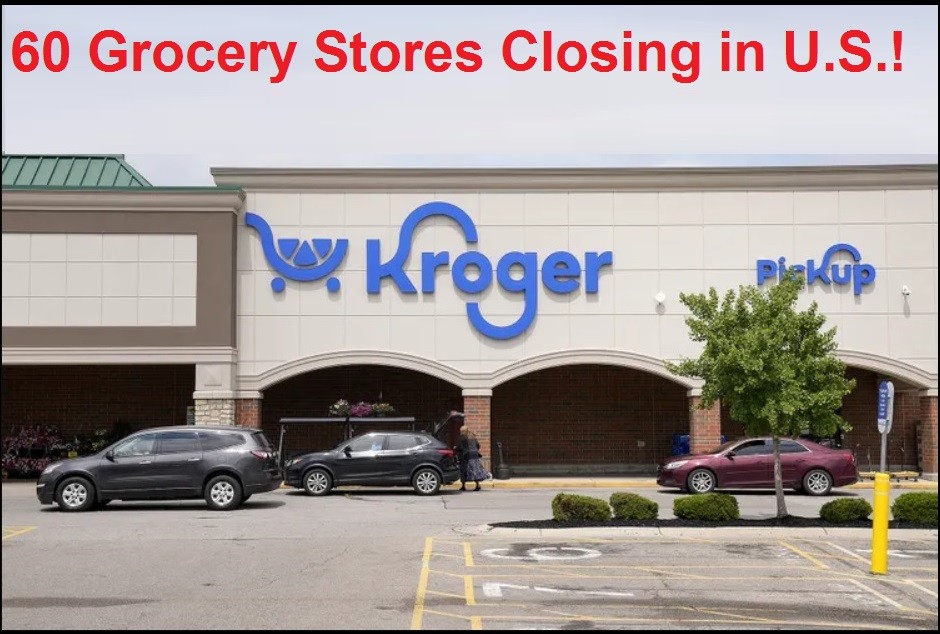
On Friday during a 2025 1st quarter sales report, Kroger announced that it is planning on closing 60 stores nationwide in the U.S. during the next 18 months.
Kroger is one of the largest grocery chains in the U.S. with 2,731 stores employing 409,000 people, so closing 60 stores is 2% of all its locations.
I have read several articles that covered this announcement from yesterday, and nobody reporting on this can give a good reason why Kroger is doing this.
The nationwide grocer is one of the largest supermarket chains in the U.S. and currently operates over 2,700 stores nationwide. Which stores it plans on closing and why remains unclear. (Source.)
The reason they don’t want to say why is because it is politically incorrect to do so.
Because if you blame it on tariffs, or the rapidly declining farm labor due to ICE actions, then Trump will humiliate you publicly as he has done to other major retailers recently, such as Apple and Amazon.
This is only going to get worse.
The tariffs are not in the news much these days, but they are still there, and scheduled to increase substantially in early July.
And many U.S. farmers are struggling because ICE is deporting much of their farm labor. Not only are these deportations affecting farm production, they are taking $dollars out of the economy from these laborers who spend what they earn, and grocery stores are going to feel a major brunt of this reduction of spending in the economy.
This was published in the Wall Street Journal three weeks ago:
Ending Parole for 500,000 Migrants Creates New Headaches for Employers
Excerpts:
The Supreme Court’s decision allowing the Trump administration to revoke temporary protections for half a million migrants brings the U.S. economy closer to labor shortages in industries and regions that rely on foreign workers.
The impact will take time to unfold, but could be far-reaching.
The potential departure of hundreds of thousands of people from the labor force is creating anxiety for employers and adding a fresh dose of uncertainty for an economy already grappling with the administration’s tariff policies.
LeadingAge, a group representing nonprofit aging-care providers, said the court ruling means many members will lose workers. “The sudden loss of these employees will have repercussions,” the group said.
The administration’s efforts are creating significant uncertainty for employers, said Helen Konrad, an immigration lawyer at McCandlish Holton who advises firms with hundreds of thousands of workers.
In recent months, Konrad has heard accounts of staffing agencies being asked not to provide foreign workers out of concern from clients that the workers could lose their immigration status—a request that cannot be met without violating antidiscrimination statutes.
“Employers are totally getting crushed in the middle of this chaos,” Konrad said. (Source.)
As far as the tariffs, the data regarding the slow down at U.S. ports is just now starting to be reported, as container rates dropped the most in two years at the busiest ports on the West Coast according to data from May.
It is going to get worse.
This was reported last week:
Imports to the busiest U.S. seaport at Los Angeles dropped 9% year-on-year in May and could remain muted through the remainder of 2025, after companies responded to President Donald Trump’s 145% tariffs on China by canceling or putting holds on shipments, according to port officials.
China is the top U.S. supplier of seaborne goods, and Los Angeles is the No. 1 port for those imports. Domestic businesses ranging from retailer Walmart, to automaker Ford on the toys, furniture and auto parts that land on its docks.
The Port of Los Angeles handled the equivalent of 355,950 20-foot shipping containers of imports in May, when the 145% tariffs began to show up in data.
“May marked our lowest monthly volume in over two years,” Gene Seroka, executive director of the Port of Los Angeles, said on Friday.
“Many importers just simply slammed on the brakes.”
The ports of Los Angeles and Long Beach handle 31% of U.S. ocean trade and are a barometer for U.S. economic activity.
Long Beach has not reported May results. Its CEO previously forecast a more than 10% drop in May imports. (Source.)
No Shortages of Food in Stores in Iran in Spite of the Bombing
One place where there are no shortages of food nor a shortage of shoppers is reportedly in Iran.
PressTV out of Iran published this report today.
Iran, of course, has faced many years of sanctions by the U.S. and Europe, so they are not dependent on Western supply chains. Iran has also never been a colonized nation, either under the British Empire or the modern American Empire, and that may actually help them now, especially after the war as they look to restore their infrastructure and economy.
As I have written previously, I have had many Iranian friends here in the U.S. over the years, and at times some of them have shared with me Iranian pistachios that they brought back from Iran, but cannot be purchased here, and they were some of the best pistachios I have ever had!
But I cannot import them and sell them in my online store, due to U.S. sanctions.
In 2011 I published an article comparing Iran’s agricultural system, which at that time 14 years ago had a goal of being 25% organic in 5 years.
How could they accomplish that? Because “organic” principles without heavy chemical inputs was how “normal traditional farming” was done throughout Iran, and they didn’t even know it had a label (“organic”).
If you looked at their neighbors, however, such as Iraq and Afghanistan, one of the first things the U.S. occupying country did when they invaded and toppled the government, was to let Big Ag come in and take over with GMO seeds and massive chemicals.
[…]
 The Most Revolutionary Act
Pingback: Kroger Supermarket Chain to Close 60 Stores Across the U.S. – The Retail Collapse has Begun | Worldtruth
Pingback: American Farmers Losing up to Half Their Crops due to Migrant Workers’ Fears and Deportations as Food Prices Increase | Worldtruth