
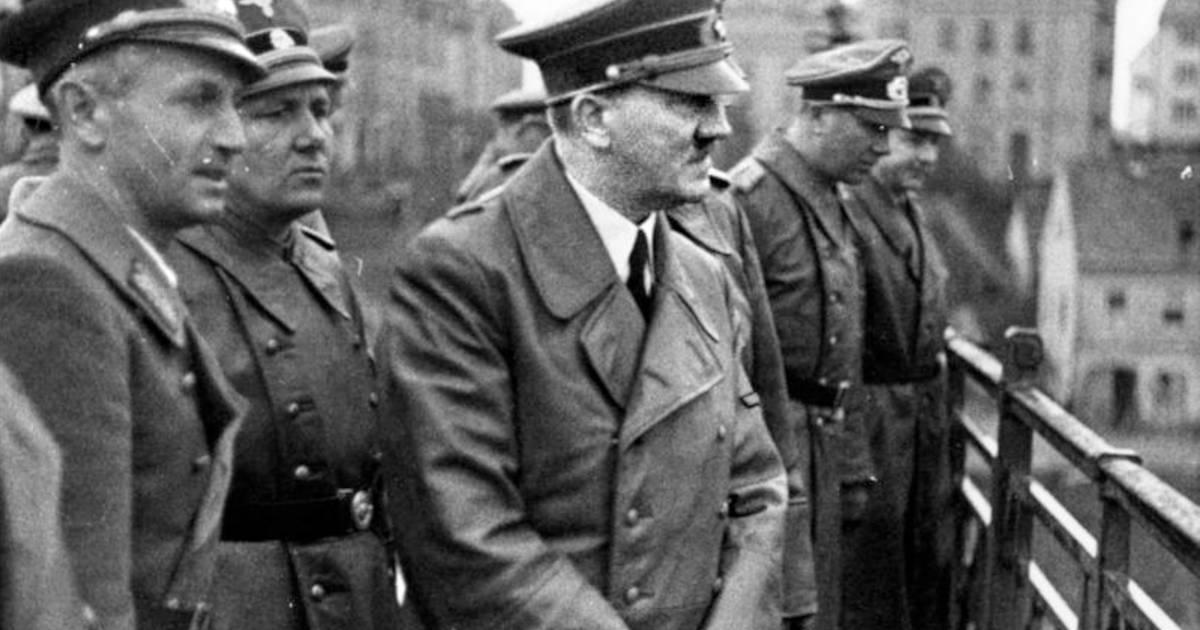
1941 picture of Adolph Hitler with several Nazi officials. On his immediate right is Martin Bormann, who was perhaps the most famous Nazi known to have escaped to South America after the war. Source: German Federal Archives/CC BY-SA 3.0.
Recently declassified CIA files have unveiled a long-standing and little-known chapter of post-WWII history: a covert operation to track down Adolf Hitler, 10 years after he was presumed dead. Contrary to the commonly accepted account of his suicide in a Berlin bunker in April 1945, intelligence agents in the United States and South America continued investigating the possibility that the infamous dictator had faked his death and fled across the Atlantic.
The records, originally classified but made public in 2020, reveal that American operatives believed Hitler may have escaped to Argentina, where he was hiding under an assumed name. In fact, as late as 1955—over a decade after the war—CIA informants were still gathering intelligence that suggested the former Nazi leader was alive and had relocated further north into Colombia.
From Germany to Argentina to Colombia … to Who Knows Where
The initial phase of the investigation centered on La Falda, Argentina, where a spa hotel was believed to be one of Hitler’s possible hideouts. According to a War Department file dated October 1945, the owners of the hotel had been ardent supporters of the Nazi regime. They were not only sympathetic to the ideology but had financially backed Joseph Goebbels, Hitler’s chief propagandist. Their close ties to Hitler reportedly extended to shared vacations in Germany.
US officials were convinced that this secluded hotel would serve as a logical refuge if Hitler were to flee Nazi Germany. The information was relayed to the FBI with the implication that this location could be crucial to locating the fugitive leader.
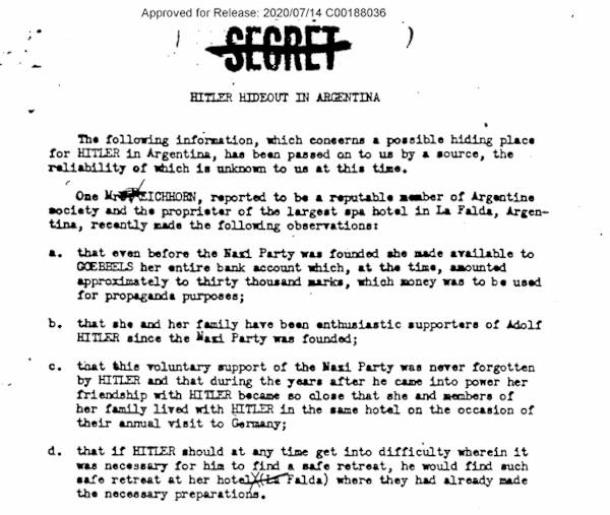
CIA document detailing the allegations of Hitler’s escape to Argentina. (CIA Archives).
The mystery deepened when another CIA report surfaced decades later, detailing an incident in 1954 where a photograph emerged showing a man who bore a striking resemblance to Hitler. The picture, reportedly taken in Tunja, Colombia, featured a man identified as “Adolf Schrittelmayor” seated beside another man named Philip Citroen.
Citroen, described as a former SS officer, claimed he met regularly with Hitler in Colombia and had even posed for the picture with him. According to an informant labeled CIMELODY-3 in the CIA documents, Citroen spoke freely about these encounters and shared the photograph with a mutual acquaintance, who managed to take it without Citroen’s knowledge.
In the report dated October 3, 1955, CIA officers were attempting to verify Citroen’s claims. Citroen had apparently told his contacts that because a full decade had passed since the war, any potential prosecution of Hitler for war crimes would be null and void.
“Philip Citroen—commented that inasmuch as ten years have passed since the end of World War II, the Allies could no longer prosecute HITLER as a criminal of war,” the document stated.
While some agents pursued leads, others were more cautious. Despite the photograph and the claims surrounding it, skepticism lingered within intelligence circles. Many regarded the supposed image of Hitler as a hoax, or at best, inconclusive.
Nevertheless, the CIA approved further investigation. On November 4, 1955, agents were given the go-ahead to reach out to another individual identified as “GIRELLA” in the documents. This person was thought to have deeper insight into “Adolf Schrittelmayor’s” movements in Colombia prior to 1955. However, the same memo also noted internal doubts about the feasibility of uncovering hard evidence.
“It is felt that enormous efforts could be expended on this matter with remote possibilities of establishing anything concrete,” the report admitted.
No additional documents related to the investigation have been released to the public since, leaving open questions about whether the operation was quietly closed or if further files remain under wraps.
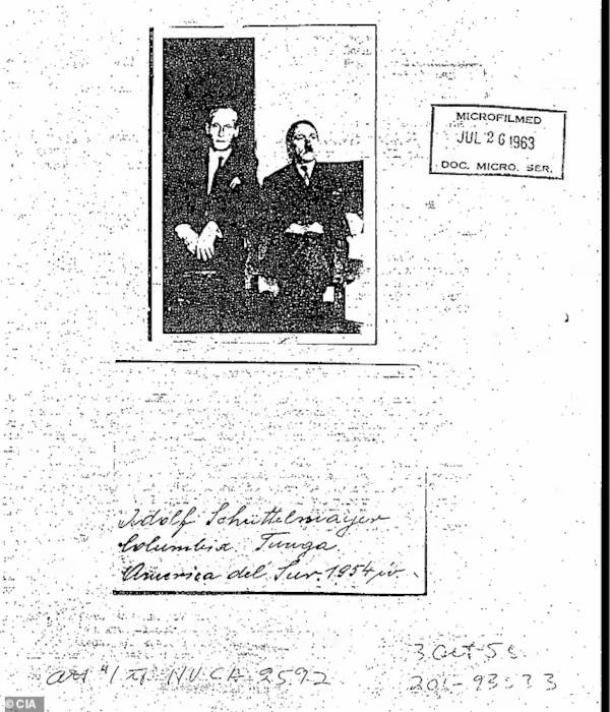
Photograph of man who may have been Hitler, with former SS officer in 1954 in Tunja, Colombia. (CIA Archives).
Argentina to Expose the Nazi Conspiracy?
In the present day, and the story has taken a new twist. In March, Argentina’s President Javier Milei issued an order to declassify all government-held records related to Nazis who fled to or were protected by Argentina after WWII. This announcement has reignited global interest in the long-standing theory that Hitler may have escaped justice and vanished somewhere in South America.
- Unearthed Brooch Tells of the Nazis’ Abuse of Ancient Norse Runes to Spread Their Dark Ideology
- The Myth of National Socialism: How the Nazis Distorted the Nordic Past
Argentina’s historical role as a postwar sanctuary for Nazi fugitives is well established. It’s known that many high-ranking officials, including Adolf Eichmann and Josef Mengele, found refuge in the country, often using elaborate escape routes dubbed “ratlines” that were organized with international complicity. These routes funneled Nazi war criminals out of Europe and into safe havens like Argentina, Chile, and Brazil.
With the imminent release of these documents, historians and intelligence analysts hope to fill in longstanding gaps in what has become one of the CIA’s most intriguing cold cases.
But Wouldn’t He Have Shaved Off His Mustache?
Skeptics have long dismissed the idea of Hitler’s survival as—to use their favorite all-purpose insult—a conspiracy theory. Yet, it is indisputable that the United States government did collaborate with many former Nazi figures in the aftermath of WWII. A prime example is Operation Paperclip, a program that brought approximately 1,600 German scientists to the US, including Wernher von Braun, who would later lead NASA’s early space programs. Paperclip was a real-life conspiracy, showing that the term ‘conspiracy theory’ doesn’t automatically mean wrong, as those with a skeptical mindset seem to believe.
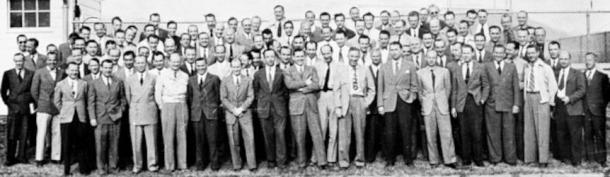
Group of 104 German scientists brought to the United States under Operation Paperclip. (NASA/Public Domain).
While the CIA documents on Hitler stop short of confirming his survival, they do reveal that US intelligence took the possibility seriously for at least a decade after the war. The photo, the hotel hideout, and the South American connections were enough to keep the investigation alive.
Now, as Argentina moves to declassify its own files, more evidence may emerge—either to support or further discredit the theory. But without human remains and DNA testing, there’s no definitive way to close the book on this decades-old mystery.
Given the confirmed presence of numerous Nazi fugitives in South America, the notion that Hitler might have escaped to join them isn’t entirely outside the bounds of possibility. With regards to the supposed photo of him in Colombia, however, the question must be asked: if Hitler really did go into hiding in South America, wouldn’t he have shaved off his mustache, the one identifiable characteristic that could have given him away?
[…]
Via https://www.ancient-origins.net/news-history-archaeology/hitler-survived-south-america-0022012
 The Most Revolutionary Act
Pingback: Declassified CIA Files Claim Hitler Escaped to South America | The Most Revolutionary Act – Additional survival tricks