
Lost Kingdoms of Africa – The Berber Kingdom of Morocco
BBC (2013)
Film Review
The Berber kingdom acquired great wealth and created distinctive architecture that persists to the present day. Nearly half Morocco’s inhabitants still speak Berber, along with Arabic and French, and many maintain traditional Berber customs along with their practice of Islam.
The founder of the Berber empire was an 11th century nomad, Abdullah Ibn Yassin, who led a rebellion against North Africa’s Arab-run Umayyad Caliphate (which he viewed as heretical as regards Koranic teachings). Their first conquest was Sijilmasa, a major oasis and trading center whose 50,000 residents traded with Mali, Senegal, the Middle East and India. From there, Ibn Yassin and his army crossed the Sahara to seize the trading town of Awdaghust and dominate the region’s gold trade. Part of their success stemmed from their ability to find water under the desert and construct miles of tunnels to carry it.
Crossing the Atlas mountains (with the highest pass 13,500 feet) to reach the heretical Berbers on the Mediterranean coast was much more difficult. With 400 horsemen, 800 cameleers and 2,000 foot soldiers, Ibn Yassin first attacked Aghmat, which became his new headquarters. Among other public buildings he constructed were stone and mortar bath houses with hot and cold running water that used the recycled water for irrigation. In 1070, he moved his headquarters to Marrakesh. With mountains and foothills on three sides, Aghmat was too hard to defend.
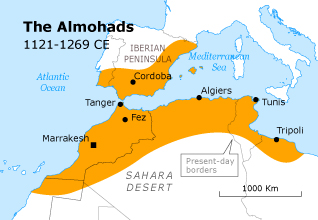
Jusef Ibn Tashfin, who succeeded Ibn Yassin, transformed the Berber conquests into an empire. Over the next 26 years, he conquered Fez, Tangier and Algiers and most of Andalus (the Iberian peninsula).*
Ibn Tashfin’s 23 year old son Ali Tashfin, a renowned patron of Andalusian architecture) ucceeded him in 1143. He also defended against the 20-year siege of Marakesh, by the Amohads, a rival Berber group concerned about the ruling Berbers’ failure to correctly align their mosques with Mecca.
After assuming leadership of the Berber jihad, the Amohads extended their territory in into Libya and Seville (Spain), which became a second Berber capital. The Amohads minted gold and square silver dinars that have been recovered in London, Germany, Holland and China. They’re also known for stunning gardens and artificial lakes. The University of Fez (Morocco) attracted scholars from across the Mediterranean to study science, history, religion and medicine. The important Jewish philosopher Moses Memonides taught and studied there. Commentary on Aristotle by Andalusian scholar Ibn Rashid first introduced classical Greek philosophy and literature to medieval Europe.
Artisans in the Medina market (in modern Tunisia) still practice metallurgy and tanning and handcraft pottery and soap exactly the way their Berber ancestors did.
Following the death of the Berber military leader Aku bin Absud in 1199, succession squabbles allowed rivals to make claims on Amohad territory. Loss of their tax base and control over the Mediterranean economy eventually caused the collapse of Amohad rule in 1269.
*Initially a united empire following its conquest by Muslim warriors in the 8th century, Al- Andalus had splintered into smaller kingdoms under assault by Christian rebels.
 The Most Revolutionary Act
Pingback: REAL CONSERVATION PRACTICES | Worldtruth