
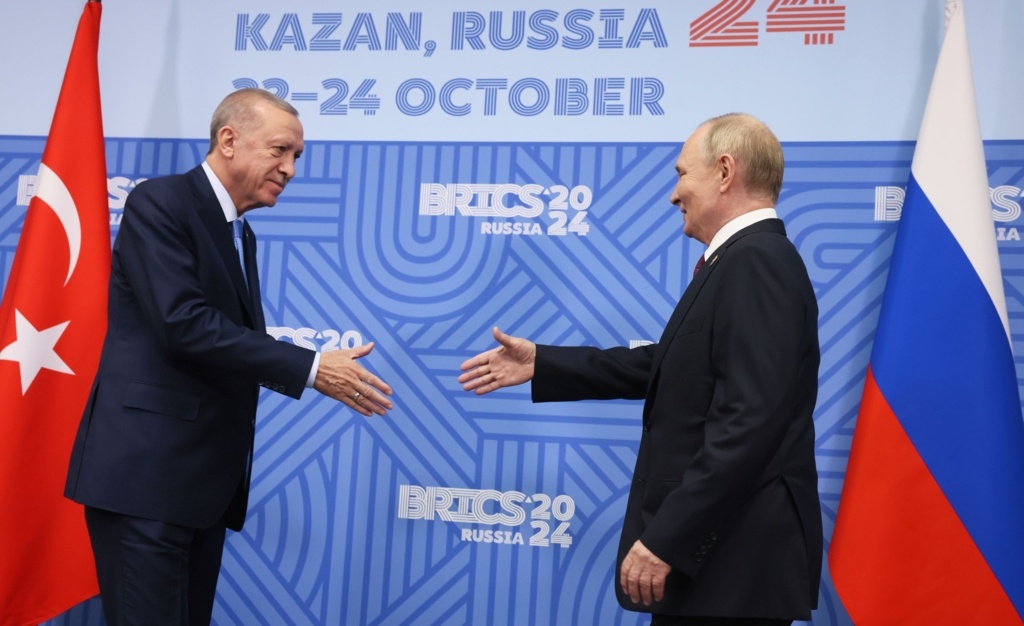
President Recep Tayyip Erdoğan meets with Russian President Vladimir Putin at the most recent BRICS conference in Kazan, Russia.
by Brian Shilhavy
Editor, Health Impact News
It’s been a few days since I have provided an update to the current conflicts in these beginning stages of World War III, and much has happened within a very short period of time.
Let me outline the chronology of events first, before providing commentary.
As I previously reported, on November 11, 2024, Russia shocked the world by launching their new missile, the Oreshnik, into Ukraine which demolished a Ukrainian defense industry facility in Dnepropetrovsk.
There are currently no missile defense systems that can intercept these new missiles. See: Russia Threatens Air Strikes with New Missile on American Bases in the Middle East, Alaska, Hawaii, Montana, and North Dakota
Four days later, on November 25, 2024, Russia issued a public statement that was quoted in the Turkish media calling for an end to Israeli airstrikes on civilians in Lebanon. (Source.)
That same day, it was announced suddenly in the U.S. corporate media that a ceasefire agreement had been reached between Israel and Lebanon.
The next day, on November 26, 2024, Turkey publicly complained about new sanctions on Russia that the Biden administration had just implemented, that would affect Turkey’s ability to pay for natural gas from Russia to get through the winter.
Türkiye seeks exemption from US sanctions on Russia’s Gazprombank
As winter nears, Türkiye’s industries rely on secure gas supplies, with Russian gas playing a key role, says Turkish Energy Minister Alparslan Bayraktar.
Ankara wants an exemption from US sanctions on Russia’s Gazprombank, said the Turkish energy and natural resources minister, warning that such measures would jeopardise the security of the country’s gas supplies.
“These sanctions will affect Türkiye. We cannot pay, if we cannot pay we cannot buy the goods. The foreign ministry is in talks,” Alparslan Bayraktar told reporters late on Monday.
As winter approaches, Türkiye’s industries need secure gas supplies and Russian gas plays an important role, he said.
Noting that previous Iran sanctions included a natural gas exemption, Bayraktar said: “We seek a similar exemption from the US.”
Bayraktar noted that the Biden administration made this decision about 45 days before president-elect Donald Trump is set to take office, adding: “We don’t understand the Biden administration’s timing.”
“The problem is that lifting these sanctions is not something that can be done overnight,” he added.
Separately, a Turkish official said that representatives from Turkish and Russian foreign, trade and finance ministries as well as central banks met on Monday to discuss the US move and its impact on bilateral energy trade.
“We discussed with the Russian delegation what can be done to prevent Turkey from being subject to sanctions during this process and what the effects of this will be,” the Turkish source said.
Aside from Russia, Türkiye is directly affected by this decision, Bayraktar said, adding that the country’s supply security is at risk.
Last week, the US announced sanctions against 118 individuals and entities tied to Russia’s financial sector, including Gazprombank, the country’s largest remaining bank yet to be blocked by Washington. (Source.)
The day after this was published, on November 27, 2024, anti-Syrian rebel forces started a lightning fast military campaign that soon took over Aleppo, Syria’s second largest city.
These forces then rapidly marched on Damascus, Syrian’s largest city, this weekend, with the result that Syrian President Bashar al-Assad has now fled to Moscow, allegedly bringing with him much of Syria’s national assets to ensure a comfortable lifestyle for his new home is Russia.
Who exactly is going to run Syrian’s government at this point is not clear, at the time of my writing this.
So those are some of the facts, and all of this has happened so rapidly, that it appears there is no scripted description of these events in the world’s English media newsrooms at this time.
The perspective on what has just happened these past several days, will differ widely depending on which English news you are reading, as U.S., Russian, Arab, Iranian, and Turkish English news all have a different slant on what just happened in Syria.
Sputnik News, an English news medium out of Russia, has published what I think is a good summary of each country’s interest in Syria.
Syrian Crisis: Key Interests of the US, Israel, Turkiye, Iran, and Russia
The 13-year-long Syrian civil war, culminating in the fall of the Bashar al-Assad government and the risk of further fragmentation of Syria, has significant implications for both global and regional players.
Here’s a look at the strategic interests of key stakeholders:
The United States
- Washington viewed Syria’s fragmentation as a way to undermine Iran, which, along with Lebanese Hezbollah, Iraqi Shiite militias, and Yemeni Houthis, forms the Axis of Resistance against US-backed Israel.
- Weakening this Axis ensures greater security for Washington’s ally, Israel.
- A declassified 2012 Defense Intelligence Agency report revealed that the US planned to support the creation of a Sunni Salafist principality in Syria to isolate government-controlled territories considered the “strategic depth of Shia expansion” for Iran and Iraqi Shiite militias.
Israel
- Technically at war with Syria since 1948, Israel views the collapse of Syria as removing a long-standing adversary. The Israeli Defense Forces (IDF) have targeted Syria’s arms stockpiles and military installations to eliminate its war potential.
- Syria was also a critical link for Iran to supply Hezbollah in Lebanon. Syria’s disintegration benefits Israel by weakening the Axis of Resistance and reducing external pressure on its policies regarding Palestinian territories.
- Additionally, Syria’s fragmentation has enabled Israel to solidify its control over the Golan Heights, nullify the 1974 ceasefire agreement, and expand its territory by seizing Syria-controlled Golan areas.
Turkiye
- Ankara aims to maintain control over northern Syria, bordering Turkiye, where the US-backed Kurdish People’s Protection Units (YPG), designated as terrorists by Turkey, currently operate.
- Syria’s fragmentation poses a threat to Turkiye due to the Kurdish aspiration for an independent state, which threatens Turkiye’s national security and territorial integrity. Approximately 30 million Kurds live in the mountainous regions of Iran, Iraq, Syria, and Turkiye.
- The Turkish-backed Syrian National Army has recently expelled the YPG from Tal Rifaat (north of Aleppo), severed a key route between Raqqa and Aleppo, and encircled the city of Manbij from three sides.
Iran
- Syria played an important role in the Axis of Resistance in confronting Israel and defending the Palestinians, according to the Iranian Foreign Ministry.
- Iran and Syria also cooperated in the joint fight against ISIS* and other sectarian factions threatening Iran and its Shiite allies.
- Iran sought to preserve Syria’s territorial integrity and assisted in political reconciliation between warring parties to prevent chaos and fragmentation, which could lead to broader regional instability.
- Iranian Foreign Minister Abbas Araghchi has expressed concerns about the potential for sectarian war, civil war, Syria’s disintegration, and its transformation into a hub of terrorists.
Russia
- Syria has been a longstanding Russian ally, providing the Russian Navy with a permanent presence in the Mediterranean Sea at the port city of Tartus since 1971.
- Russia’s involvement in the Syrian conflict coincided with the ISIS* expansion and came at Damascus’ request to combat terrorism “abroad to prevent it from striking at home,” as President Vladimir Putin stated in 2015. The Syria crisis threatened to expand to Russia’s Caucasus and beyond.
- Following the defeat of ISIS, Russia’s strategic interests included stabilizing the situation on the ground, curbing remaining terrorist threats, and ensuring reconciliation of warring parties along with a political settlement to maintain regional stability.
In my opinion, Russia is probably the one who brokered this deal, especially considering the chain of events that started after they unveiled their Oreshnik missile.
Consider also that Russia, while allowing the government in Syria to end and bringing Assad to Moscow, maintained their very key military bases in the region.
Syrian opposition guarantees security of Russian military bases — Kremlin source
Russian officials are in touch with representatives of armed Syrian opposition, the source said
MOSCOW, December 8. /TASS/. Leaders of armed Syrian opposition have guaranteed security of Russian military bases and diplomatic missions on the Syrian soil, a source in the Kremlin said.
“Russian officials are in touch with representatives of armed Syrian opposition, whose leaders have guaranteed security of Russian military bases and diplomatic missions on the Syrian territory,” the source said. (Source.)
However, while Russia may have been the driving force to allow this to happen, many sources believe it was Turkey who carried out the plans, and at this point, based on everything I have read so far, I tend to agree.
The Turkish – Kurdish problem is a problem that has existed for decades now, and Turkey blames the Kurdish resistance forces as “terrorists” and a threat to their borders.
I lived and worked in Turkey for several years in the 1980s, and I was hired by a private NGO firm in 1990 to go to southeastern Turkey after the Gulf War to help with repatriating Kurds into northern Iraq who had fled Saddam Hussein’s attacks on their cities.
I was hired as a translator, since I was fluent in Turkish at the time.
This could mean that with Russia’s new prominence in weapons technology with the launching of their Oreshnik missile, that they are forming a stronger alliance with Turkey, with whom they have continued to supply energy resources with even during the Ukraine war with sanctions in place, and that includes nuclear power.
[…]
Things seem to be developing very rapidly now, and it is hard to know what the immediate future holds, since Russia has introduced this new missile that apparently cannot be defended at this point.
[…]
 The Most Revolutionary Act
Pingback: Rubio: Syria Facing Collapse | Worldtruth
Pingback: How Likely Is It US Will Contain Turkiye After It’s Done With Iran? | Worldtruth