
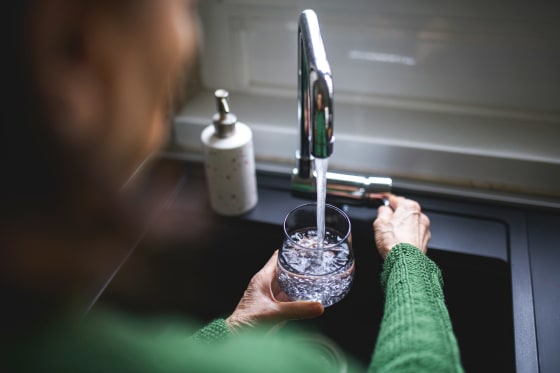
113 million U.S. residents get chloramine-treated water from their taps, according to the new study.Nico De Pasquale / Getty Images
[…]
Some 113 million U.S. residents receive chloramine-treated water from their taps, according to a recent study. The chemical has been used for about a century to disinfect water. Today, it’s often used to protect a system’s “residual” — the water that remains in pipes for several days after it leaves a water treatment plant.
Increasingly, chloramine has been favored over chlorine because the latter also produces byproducts, some of which are associated with bladder cancer and are regulated by the EPA.
David Reckhow, a research professor in civil and environmental engineering at the University of Massachusetts, Amherst, who was not involved with the study, said the finding was an important step. The ultimate goal, he said, is understanding whether the substance is a hazard; he concurred that it was likely toxic.
“It’s a pretty small molecule and it can probably for that reason enter into biological systems and into cells. And it is still a reactive molecule,” he said. “Those are the kinds of things you worry about.”
The authors of the new study arrived at their results after figuring out how to formulate high concentrations of the chemical for laboratory testing, said Julian Fairey, lead author and an associate professor at the University of Arkansas.
“We don’t know the toxicity, but this study has enabled us to be able to do that work now,” said Fairey, who studies drinking water byproducts. “Now, we can go about the hard work of trying to figure out what its toxicological relevance is in our water systems.”
He added that some past studies have suggested a link between drinking disinfected water and increased rates of certain cancers.
[…]
 The Most Revolutionary Act
Pingback: The Risks of Water Chlorination | The Most Revolutionary Act | Vermont Folk Troth