
Episode 1: Why Are There So Many Families?
Language Families of the World
Dr John McWhorter
Film Review
In this introductory lecture, Columbia linguistics professor Dr John McWhorter asserts the world has roughly 7,000 languages, which according to best evidence, developed from a single language in East Africa where the human species first arose. He believes that language probably developed at the same time as tools and art. Although Homo sapiens first appeared on the planet 300,000 years ago, we only have evidence of art dating back 100,000 years. It’s still possible art and language developed earlier and we have yet to find the evidence.
McWhorter attributes the large number of modern languages to the inherent changeability of human speech. Each new generation makes language sounds somewhat differently.
For example
- the “s’ sound can become “sh”, “zh” or “z”
- “ah” can become “aw” or even “oo” or the French “ieu” sound
- “k” can become a guttural “ch” as in German or “gh”
In addition words can get combined and shortened.
He gives the example of
- “slowly” (shortened from the expression “slow-like” )
- “only” (shortened from “one-like”)
and words derived from the Proto-IndoEuropean root word “mrecht meaning short
- bra – from the word “brachial” meaning the short upper part of the arm (the “m” sound has changed to “b”)
- merry – originally meaning short
- pretzel – meaning crossed short arms (the “m” sound has changed first to “b” and then to “p”)
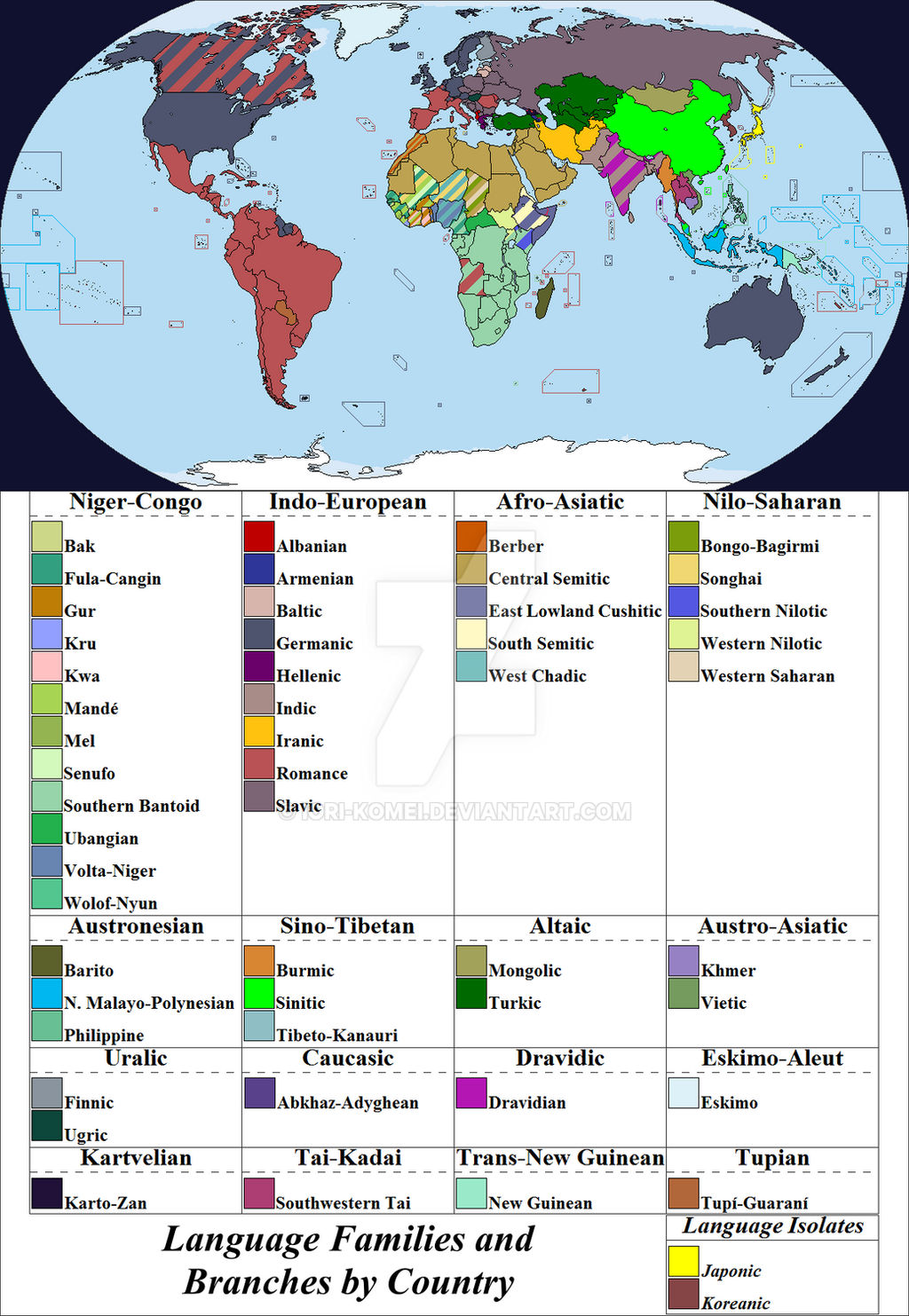
He completes the lecture by identifying the various language families found on each continent:
- Europe (and parts of Asia) – Indo-European
- Africa – has four completely different language families, excluding the click languages, which consist of three completely different families
- Asia – has four completely different language families Altaic (Turkic), Chinese, Vietnamese and Thai
- Austronesian is one language family with 1000 different languages – the main ones are Hawaiian, Maori, Tagalog (spoken in the Philippines), Indonesian and Malagasy (spoken in Madagascar off the coast of Africa). The immense similarities between modern Austronesian languages suggest the populations speaking them only separated very recently.
- New Guinea – 25 different language families
- North America (pre-Columbian) – 10 different language families
- Mexico/Central America – seven completely different families
- South America – 15 different families
- Georgian languages (from the Caucasus mountains) – three different language families
- Basque – last living language from an extinct language family.
Film can be viewed free with a library card on Kanopy.
https://www.kanopy.com/en/pukeariki/watch/video/6120000/6120002
 The Most Revolutionary Act
Linguistics changes daily. We have no way of recording from the past.
LikeLike
Absolutely, Katherine. Prior to the emergence of written language, there was no way to monitor linguistic changes.
LikeLiked by 1 person
That’s why I like my family’s collection of old books. One of them was published in the late 1800s, about the Etruscans. It is written by an Anglican priest, I believe, and has line drawings of the symbolism in the tombs, with identification of the people in the funeral procession. I took the book out recently and glanced at it, looking for something . . . My parents liked collecting things, but didn’t take care of their stuff. I’m tasked with organizing what’s left.
LikeLike
If it weren’t for cuss words, I’d be speechless 😶
LikeLike
Then I am most definitely a coarse, uneducated peasant. 😂😆
LikeLike
It turns out, Shelby, that English cuss words have the most interesting linguistic history of all. After the Norman French conquered England in 1066, all the nobility, merchants and artisans spoke French. Only peasants continue to speak the Anglo-Saxon dialects. For some reason, it was perfectly okay to refer to bodily functions in French. For example it was okay to say fornicate (spelled fourniquer), defecate (defequer) and urinate (uriner), but only coarse uneducated peasants referred to these functions in Anglo-Saxon (fuck, shit, piss).
LikeLiked by 1 person
Pingback: Linguistics and the Study of Language Families | The Most Revolutionary Act | Vermont Folk Troth
Pingback: The Caucasian Languages | Worldtruth