

Episode 23 Medieval Warfare Ends with Gunpowder
The Middle Ages Around the World
Dr Joyce E Salisbury
Film Review
Gunpowder was discovered by Chinese alchemists looking for a chemical to bestow immortality who discovered a white organic crust formed on decaying matter called saltpeter (potassium nitrate) was flammable. They first used it in 1110 in fireworks and initially attached it to arrows. By 1240, gunpowder, fireworks and rockets had spread to the Muslim world. From there it spread to Western Europe. In 1267, Roger Bacon wrote to the pope describing gunpowder.
The first recorded use of gunpowder bombs was in 1232, when Song dynasty combatants launched an iron device against Mongol warriors that exploded on hitting its target. After hiring Chinese engineers to make their own bombs, which often included shrapnel, urine, feces or oil, the Mongols used them extensively by the 14th century.
One hundred years later, gunpowder had made traditional warfare, carried out by medieval knights on horseback, obsolete. The combined use of gunpowder and the longbow enabled England to conquer most of France during the 100 Years War (1337-1453). Both the primitive guns (which shot iron balls) had a far greater range than French knights with crossbows, which allowed the English to trike the French defenders long before they were in range to be fired on. In addition,
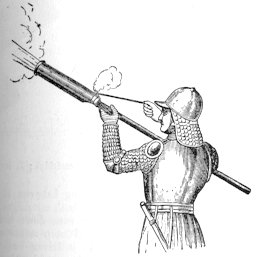
Primitive handgun used at Battle of Crecy
Likewise, crossbows took much longer to load – an English archer could fire 10 arrows a minute with a longbow, in contrast with a France archer who could only fire two with a crossbow.
By 1415 the British and their Burgundian allies controlled northern France as far south as the Loire, and the French king Charles VI had abdicated and disenfranchised his son Charles. The outcome of the war was significantly altered by a teenage peasant girl named Joan of Arc, who heard voices from God directing her to lead the French armies to victory and assure the coronation of Charles the VII. According to Dr Salisbury, Joan of Arc revival of national loyalty (as opposed to loyalty to a king) significantly changed the course of the war for the French. The armies she liberated Orleans and other cities that stood in the way of Charles’s coronation (according to French tradition) in the cathedral at Reims.
After capturing her, the Burgundian army turned her over to the English, who turned her over to the Inquisition – who tried her for heresy and burned her at the stake.
Charles VII would be the first king to organize a French artillery, leading to a string of French victories until only Calais remained in English hands.
The most significant transformation this created in European warfare was that kings and nobles could now hire commoners trained in the use of gun, cannon and longbows to fight their wars for them.
*The Hundred Years War was triggered by a dispute over succession when the French king Charles IV died in 1328 without a direct heir. Charles IV’s through the English king Edward III was the closest living relative through his mother, Charles’s sister Isabella. After the French parliament ruled succession couldn’t pass through the female line, Charles IV’s first cousin Phillip VI became king of France. After the latter attempted to claim supremacy over English lands in southern France, Edward III invaded France with 4,000 knights, 10,000 commoners with longbows and 50 commoners with small guns.
Film can be viewed free with a library card on Kanopy.
https://www.kanopy.com/en/pukeariki/watch/video/13172786/13172834Medi
 The Most Revolutionary Act