
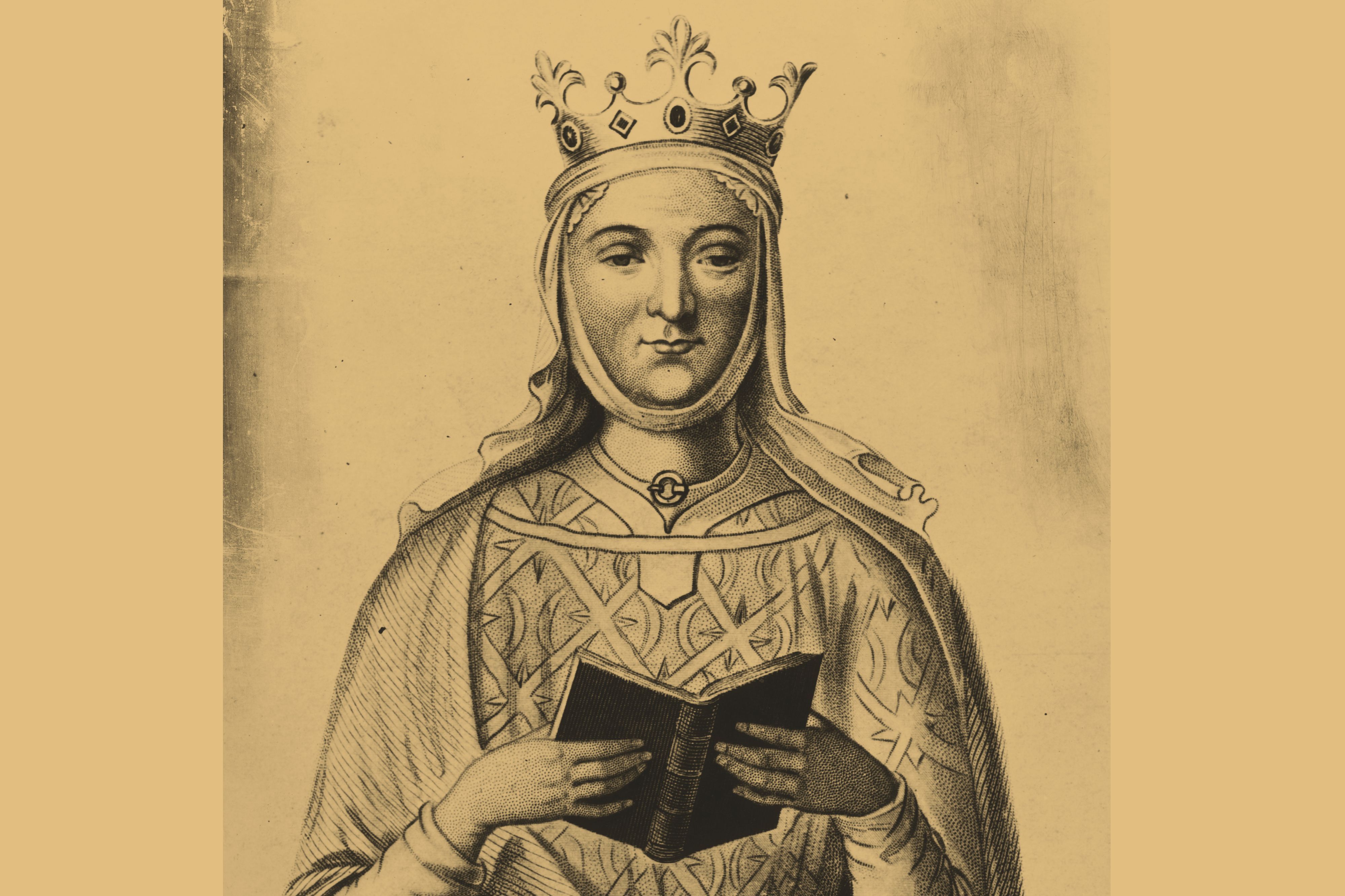
Eleanor of Aquitaine
Episode 15 Life in Medieval Palaces
The Middle Ages Around the World
Dr Joyce E Salisbury
Film Review
Europe
In the high Middle Ages (12th-13th) noble women, including Eleanor of Aquitaine, ran their kingdoms and feudal estates when their husbands were away at war. Keeping up with the latest fashions was a sign of wealth, and they wore silks, exotic furs, low cut dresses that revealed their breasts, make up. They curled their hair with hot irons and replaced their scarves with hats. By the 14th century men were wearing short tunics and revealingly tight pants.
Many medieval forests were clear cut for the scaffolding used to construct European castles and city walls. Servants slept in the same room as the king/queen, who had curtains around their bed mainly for warmth. Prior to to the 13th century, when the first fireplaces were installed, the smoke-filled rooms of castles were heated by open hearths vented by small glass-less windows in the outer walls..
Meals – Medieval European nobles ate more meat per capita than any other culture on Earth. Forbidden to eat carnivores, Catholics ate pork to distinguish themselves from Jews and Arabs and regarded horse meat (associated with pagan Scandinavians as taboo. They used onions, leak, garlic, parsnips, cabbages and turnips as seasonings, and easily accessed apples, pear and berries. Members of the nobility used bread slices as plates and spoons and knives. Peasants boiled their grain because it was more nutritious than making it into bread. They depended more on beans, eggs and cheese for protein and ate more vegetables.
Beverages – the nobility drank wine imported from France, Spain and Greece. Peasants drank ale (less alcoholic than beer), which was unhopped and had to be brewed daily (hops serve as a preservative). They also drank hard cider, mead (made from honey), perry (pear cider) and, contrary to contemporary mythology, water.
Middle East
Only one Muslim palace remains because Muslim rulers tore down their predecessors’ palace. Only one survives, the 14th century Alhambra in Grenada.
Turkish palaces had no fireplaces and were heated by small charcoal braziers.
Persian castles had very narrow fireplaces that required wood to be stacked on end for burning.
In Muslim palaces, men and women were were strictly segregated. Rulers were allowed concubines in addition to four wives.
Outside of Europe people sat cross legged or squatted to eat and used hands, spoons and knives. Under Islam, meat had to be Halal, which meant all the blood had to be removed prior to cooking. Carrion and pork were forbidden, but Muslims could eat all typesseafood, a variety of cheeses and yogurt and lot of spices. Muslim nobility drank snow water from the mountains, near beer other other lightly fermented drinks and mixed fruit juices.
Asia
Indian palaces had no heating. Instead guests were provided with woolen coverings.
In 12th century China, the emperor’s palace, windows were covered with silk, rather than paper, as used in Japan and Korea. Women were secluded as part of Confucian tradition (and were only sent for for sex) and royal women had to be carried because foot binding prevented them from walking.
Meals – During the 7th century, many in the Chinese nobility still sat on the floor to eat, though others began copying nomads who lay on couches. There was no restriction on the animal protein they could eat (pork was most popular, but they also ate camel, bear, bamboo rat, sea otters, flying cockroaches, elephants, monkeys, snakes). They alao ate fish, horseshoe crab and imported mangoes, figa and citrus. Chopsticks replaced knives and spoon in chopsticks in 400 AD.* Owing to a meat shortage, cooks diced the meat and smothered it in rice. Chopsticks worked better for plucking out minute portions of meat of meat. In northern China, millet was the main staple, in southern China rice.
Beverages – They drank fruit juice flavored water, tea (from 6th century on), and rice wine.
Emperors and nobles slept on cushions surrounded by their servants who slept on the floor
*Confucius, who was a vegetarian, believed there was no place for knives at the table because they reminded him of the slaughter house.
Film can be viewed free with a library card on Kanopy.
https://www.kanopy.com/en/pukeariki/watch/video/13172786/13172813
 The Most Revolutionary Act