
Episode 1 Medieval Beginnings
The Middle Ages Around the World
Dr Joyce E Salisbury
Film Review
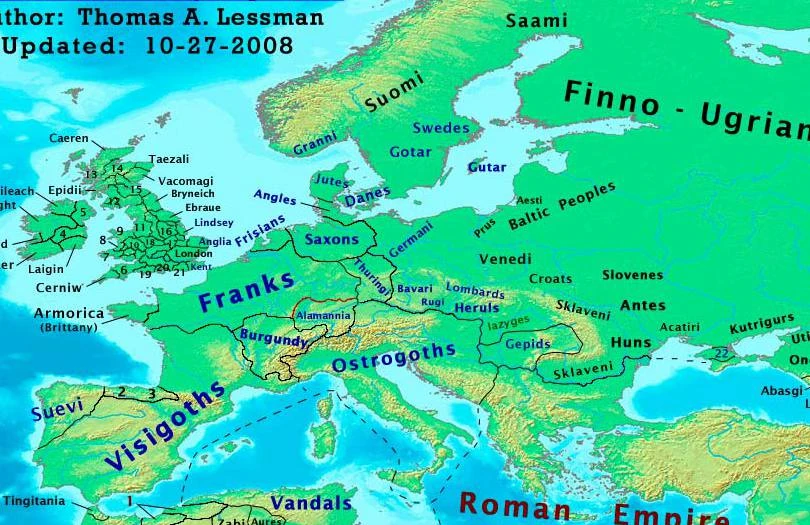
Dr Salisbury blames the fall of the world’s major empires in the first centuries AD on increasing penetration of steppes nomads into settled areas. China’s Han dynasty was brought down in the third century AD by increasing Xiongnu raids. Likewise India’s Gupta empire was brought down by Hun invasions (via the Khyber Pass). The Huns also played a major indirect role in the fall of Rome. In 400 AD, the Visigoths and Ostrogoths, pressured by westward Hun migration, received permission from the Roman emperor Valens to cross the Danube and settle in the Roman province of Gaul.
Angered by their treatment by Roman administrators (who raped their women and forced them to into slavery), the Visigoths were on the verge of an armed uprising when Valens marched on them (from Constantinople*). Following his defeat (and slaughter) in the Battle of Adrianopolis by skilled horseback warriors, his successor Theodosis I hired Germanic mercenaries to fight them. Meanwhile Visigoths and Ostrogoths repeatedly raided and pillaged the northern Roman provinces and even sacked Rome in 410.
Theodosis was followed by his daughter Gala Placidia, who served as regent for her son Vaentinian III. In 414-415 Gala was queen consort to Ataaulf, king of the Visigoths. In 452 after her daughter Honoria proposed marriage to him, Attila the Hun invaded Italy to claim his bride. He was just outside Rome after sacking Aquileia, Milan, and Pavia, when Leo, the bishop of Rome, rode out to meet with him. When famine and plague in his homeland forced Attila to withdraw, this apparent “miracle,” resulted in Leo becoming the first pope with authority over the entire Catholic church.
In 476 the last Roman emperor was deposed by Otoakar, a Germanic soldier serving in the Roman army.
The Roman Empire subsequently split into multiple warring kingdoms, with the Visigoths controlling Spain and France (with the Franks later replacing the Visigoths in France), the Angles and Saxons England and the Ostrogoths Italy. Although large cities disappeared, the trade in luxury goods continued. Although Silk Road traffic was disrupted for two centuries following the fall of Rome it resumed under the Tang dynasty (618-907). Trade also flourished across the Indian Ocean form Africa.** Africa exported horses, ivory, saves and gold, while India, China and Southeast Asia exported pepper, cinnamon and cardamon.
After crossing the Indian Ocean, ships either unloaded at Mecca on the Arabian peninsula or in the African kingdom of Aksum, where they transferred their goods to camel caravans en route to Cairo, Aleppo and the Tigris River Valley. This allowed frankincense and myrrh from Yemen to be incorporated into the luxury trade, as well as gold, ivory, ostrich feathers and slaves from West Africa and salt (a non-luxury good) from northern Europe.
*The emperor Constantine moved the capitol of the Roman empire from Rome to Constantinople in 324 AD because of its better access to the Silk Road Trade.
**Greek and Roman sailors had learned to exploit the monsoon trade winds in 45 AD.
Film can be viewed free with a library card on Kanopy.
https://www.kanopy.com/en/pukeariki/watch/video/13172786/13172788
 The Most Revolutionary Act
Pingback: Urban Life After the Fall of Rome | Worldtruth