
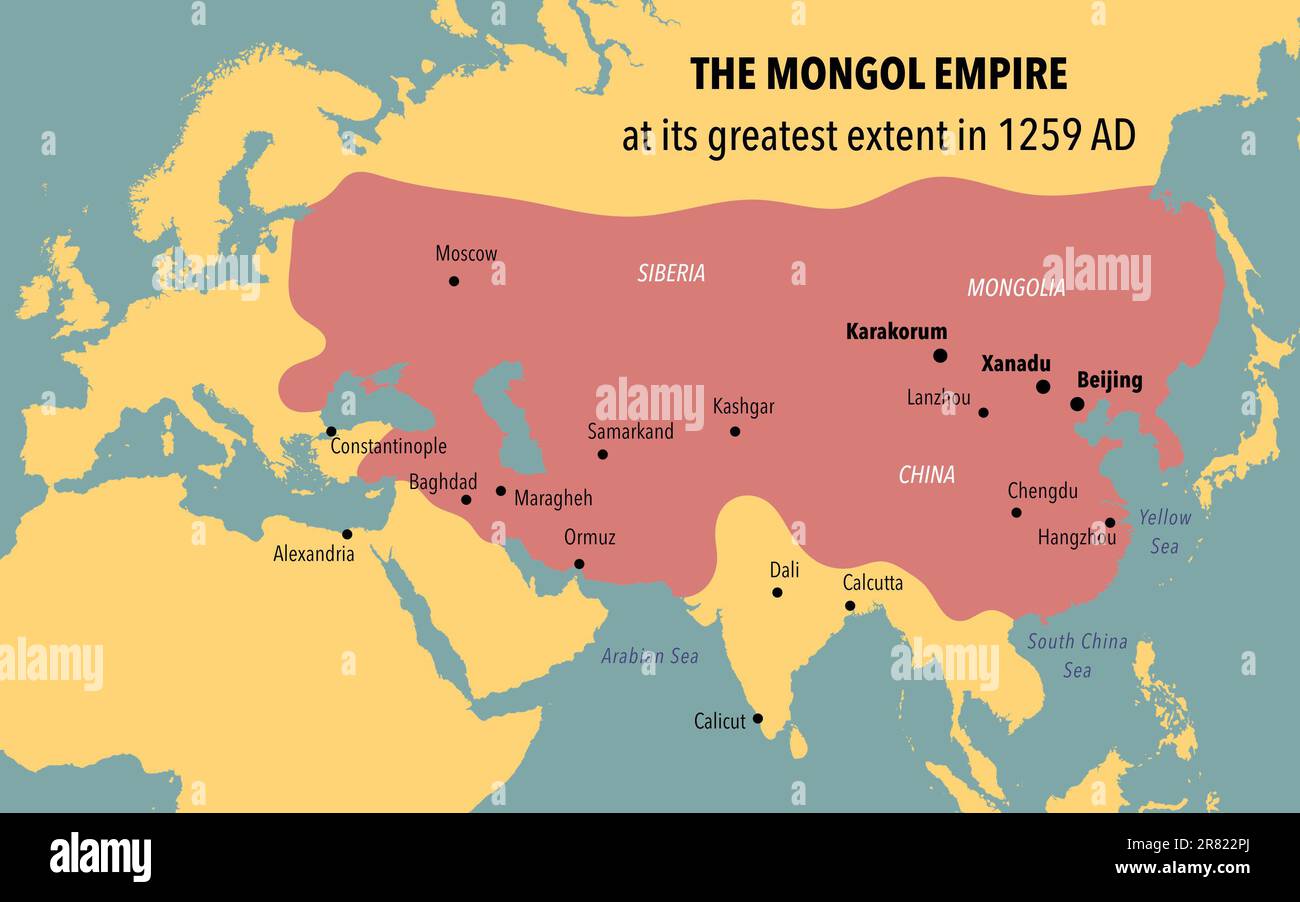
Episode 19 Collapse of the Mongol Empire
The Mongol Empire
Dr Craig Benjamin (2020)
Film Review
Although the Mongols controlled 1/6 of the world’s land are by 1300, for the most part they adopted the cultures of their conquered territories and abandoned their allegiance to the Mongol empire.
Ilkhanate (Persia)
- Abu Sahid died in 1335 leaving no male heir
- Aba Khan elected by the kuritai and executed one year later in popular uprising.
- 1337-1354 after military factions installed eight regional princes as khan the khanate virtually disintegrated into independent regions run by warring military commanders.
Yuan Dynasty
- Temur – Qubulai Khan’s grandson becomes emperor and nominal Great Khan in 1295. He depletes the treasury with ongoing war against the Chaggatai khanate and bribing Mongol officials weary of sedentary life to remain in China.
- Kaishian – Temur’s nephew, seizes throne via military force in 1307 following Temur’s death.
- Ayur Barwader – Temur’s son, succeeds Kaishian as Yuan empire faces fiscal bankruptcy. First Yuan emperor to speak and write Chinese, he reinstates Confucian civil service exam.
- Shidebala – Ayur Barwader’s brother, assumes throne in 1320.
- Yesun Temar – Yesun Temar succeeds his brother following his Shidebala’s assassination in 1323. Becomes extremely controversial for awarding grants to a Tibetan Buddhist sect promoting tantric sex acts and human sacrifice/
- El Temur – powerful Kitchap* commander who seizes Beijing following Yesun Temar’s death in 1328 and sponors a series of puppet emperors with short reigns ended by popular rebellions.
- Toghon Temur – son of a puppet emperor who assumed the throne in 1329 and , returned from exile in Mongolia take up the throne in 1333. His 35 year reign was characterized by rampant corruption and constant rebellion. The collapse of the Yuan dynasty was enabled by massive flooding along the Yellow River, population decline related to a 1353-54 plague epidemic and loss of the Grand Canal (essential to move food from agrarian southern China to the more populace north) from infrastructure decay.
- Zhu Yunzhang – leader of Buddhist rebel group known as the Red Turban Movement captured the capitol in 1368 and drove Toghan Termur and 60,000 Mongol supporters out of China. The first Ming emperor, his dynasty would survive until 1634.
Korea
1351-1374 – King Kongmin was the first to oppose Mongol leadership and the wealth Korean families who supported them. His assassination in 1374 led to widespread peasant revolts. Following the Ming announcement they intended to occupy northeast Korea, General Taejo launched a coup installing himself as emperor in 1392. The Choson dynasty he founded survived until 1910, when Korea was annexed by Japan.
Golden Horde
The Golden Horde mongols retained power the longest because they remained semi-nomadic and resisted adopting Slavic languages and culture.
1438-1440 – Golden Horde divided into four states, the Kazan, Crimean and Astrahan Khanates and the Great Horde.
1502 – Khan Mengli Durai of the Crimean Khanate, in alliance with the Ottoman Turk empire. conquered the Great Horde.
1552 – Under Ivan the Terrible, the Russian state conquered Khazan.
1556 – Under Ivan Terrible, the Russian state conquered Astrakhan
1783 – Crimean Khanate annexed by Catherine the Great.
The nomadic Russian Tatars (Mongols) remained semi-independent until Stalin deported them to eastern Siberia.
*The Kipchaks were nomadic pastoralists who first appeared on the Eurasian steppes in the 11th century.
Film can be viewed free with a library card on Kanopy.
https://www.kanopy.com/en/pukeariki/watch/video/12373094/12373132
 The Most Revolutionary Act
Pingback: Collapse of the Mongol Empires | Worldtruth
Pingback: The Crimean War 1853-1856 | Worldtruth