
Episode 17 The Mongols in Russia – The Golden Horde
The Mongol Empire
Dr Craig Benjamin (2020)
Film Review
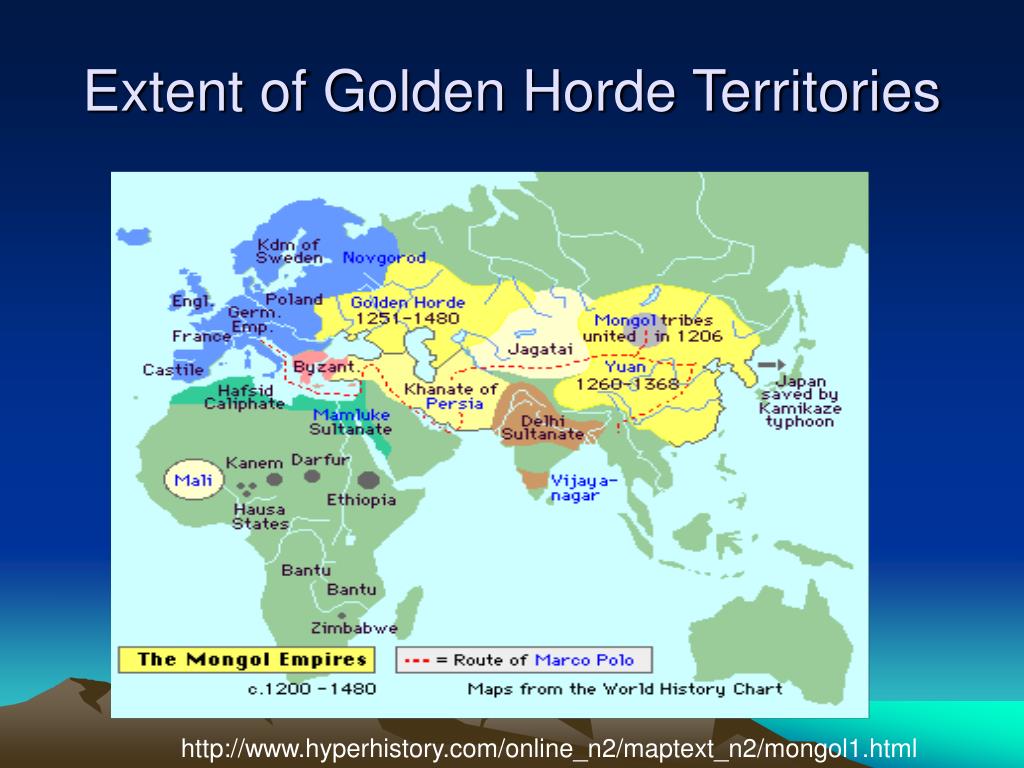
In the initial founding of Golden Horde, Batu (son of Chingiss Khan’s oldest son Jochi) controlled the Blue Horde (everything west of the Volga River) and his brother Orda the White Horde (everything from the Volga to Lake Balkhash in Siberia). After invading Hungary and Poland, Batu announced his intention to extend his military campaign to the Atlantic. He and General Subedai were on the brink of invading Austria, Italy and Germany* when Ogedei Khan died and Batu was recalled to Mongolia for the kuritai that would elect his successor.
In the 13th-15th century, the Mongols called the principalities of Rus (which included territories held by Turkic, Kipchak, Burgar and Cuman nomads) the “Ulus of the Jochids.” The Russians renamed it the Golden Horde. Owing to the turkification of the Mongol occupier (Mongols constitute only a small minority of the population), Turkish script replaced Mongolian on the khanate’s coins in the 1280s.
Berke (his son) – succeeded Batu in 1257. A Muslim, Berke transformed the Ulus of the Jochids into a Muslim state. Allying himself with the Egypt’s Malaluk empire, Berke went to war with the Persian Ilkhanate over their occupation of Azerbaijan.
Mengu Timur (his cousin) – succeeded Berke following his death in 1264. His was the first khanate to issue gold and silver coins independent of the Great Khan. He expanded trade (mainly in silks, slave and spices) with the Crimean trading colonies of Venice and Genoa as well as with Armenian, Persian and Croatian traders.
Toda Mongke (his brother) – succeeded Mengu Timur’s in 1280. Toda Mongke, who was assassinated by his cousin Tole Buqa in 1280, who claimed to be Batu’s senior heir. Another cousin Nokai disputed Tole Buqa’s claim resulting in a war for the succession.
Tole Buqa – after winning the war of succession, declared war on Genoese merchants in Sarai who were kidnapping Mongol children and selling them into slavery. After an eight month siege in 1307 he confiscate all their goods and sacked the the town of Kappa. He subsequently allowed them to return.
Ozbeg Khan (his nephew) succeeded Tole Buqa in 1312 overseeing a period known as the golden age of the Golden Horde. Increasing Islamization led to the Golden Horde (which preserved religious tolerance) becoming part of Dar al-Islam (a federation of the world’s Muslim nations). Ozbeg Khan made the Prince of Moscow the Grand Prince of Vladimir,* greatly increasing the wealth and prestige of Moscow, The role of the Grand Prince was to collect taxes the other princes owed the Mongols.
Tinebeg – succeeded Ozbeg in 1342
Janibeg (his brother) – succeeded Tinebeg when he died unexpectedly. Best known for the Siege of the Genoese city Keva in 1346-47. The batte is best known for the Mongols use of siege engines to fire human corpses into the city that were infected with bubonic plague. This led to an outbreak of plague on Genoese ships as they returned to Constantinople. From there the disease spread rapidly to Italy and throughout Europe. Janiberg captured Azerbaijan, which was in serious turmoil from the Ilkhanate’s economic and political decline.
Between 1359-1380, the Golden Horde descended into anarchy as 25 khans claimed the throne. During this period Lithuania expanded its territory to include Kiev, and the Volga Bulgars and Urgench (in Uzbekistan) broke away from the Golden Horde.
During 1362-89 Genoese merchants in Crimea stopped pay taxis, and Dmitri Donskoi (in an embryonic Russian states) stopped paying tribute. Donskoi successfully repelled Mongol warriors sent to punish him. In 1389 allied Russian forces defeated the Mongol military for the first time at Kulakova.
*Batu had even sent a letter to the Holy Roman Emperor Frederick II demanding he step down.
Film can be viewed free with a library card on Kanopy.
https://www.kanopy.com/en/pukeariki/watch/video/12373094/12373128
 The Most Revolutionary Act