
Counterweight trebuchet
Episode 13 The Mongols in China
The Mongol Empire
Dr Craig Benjamin (2020)
Film Review
The Song Dynasty was the most technologically advanced civilization on the planet. With a million troops, they were less physically skilled than Mongol warriors. At the same time, the rugged terrain of southern China, with its mountains, rice paddies and forests (planted by the Song) was disadvantageous to mounted warriors. The Mongols were only able to defeat the Song by building a navy (with the help of Song defectors) and confronting them on the Han and Yangtze River. With only 500 hundred ships, they blocked the Han River and destroyed the Song Navy’s 3,000 ships.
After another five-year stalemate, two Persian engineers constructed 100 massive counterweight* trebuchets that enabled them to attack the Song cities with 12,000 boulders an hour. The Mongols also used them to launch gunpowder explosives (a Chinese invention) packed with scrap metal (the first known use of shrapnel a a weapon). The Mongols also mixed feces and poisonous beetles with their gunpowder (the first known use of biological weapons).
After conquering the city of Funchung, the Mongols slaughtered 3,000 Song soldiers and 7,000 civilians in the hope of intimidating other cities. It only required a single shot from a a giant trebuchet convince the city of Shanyung to surrender. With army in total disarray, the Empress Dowager surrendered on behalf of the child emperor in 1276.
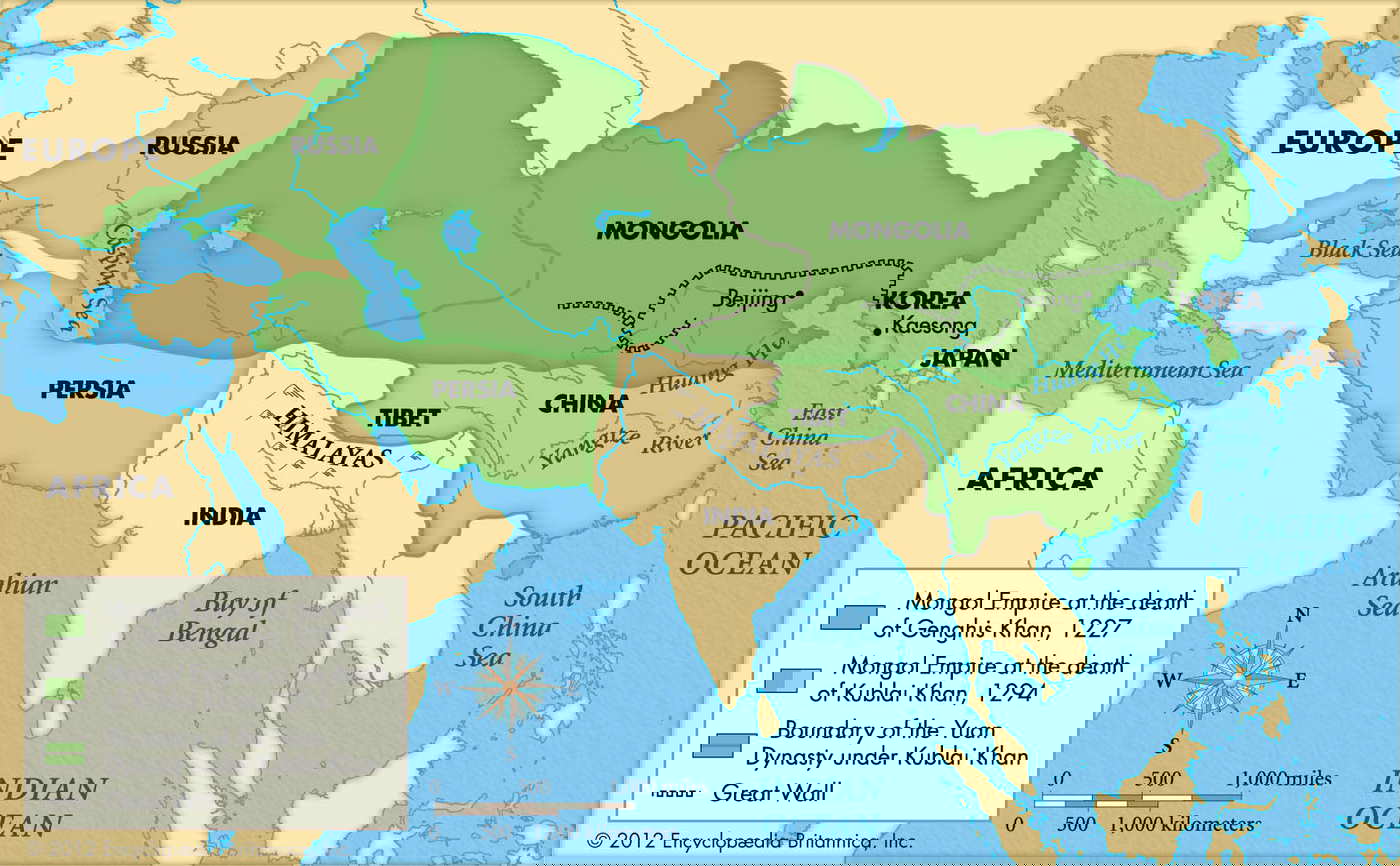
When Qubilai Khan became the new emperor, China was reunified for the first time in 300 years. The name he took for the new dynasty (“Yuan”) derives from the I Ching and means “origin of the universe.” After following all the traditional rites of new emperors and moved the capitol to Beijing (a former Jin city) to be nearer the Mongol seat of power.
There were four social classes under the Yuan dynasty:
- The Mongols (granted numerous legal and tax advantage)
- The Senuren (European, Russians and Muslim administrator imported from Peria).
- The Hanren (Han, Jurchin, Khitans and Koreans)
- Nanren (soutern Chinese and other southern ethnicities)
Qubilai Khan established 12 new provinces overseen by centrally appointed Persian officials. Many former Han administrators found themselves out of work when the Mongol emperor dismantled the 1500 year old Confucian exam system. Many became artists.
Plagued by corruption and inefficiency, Qubilai’s administration was really good at collecting taxes.
Positive Yuan Dynasty innovations:
- an empire wide communication system using horsemen or runners
- an expanded Chinese canal system was expanded for more efficient trade
- reunification of China for first time in three centuries (and persisting to the present day.
- bring peace to a country at war for more than 100 years.
Marco Polo
Marco Polo, son of an aristocratic Venetian family describes Qubilai Khan’s reign in his famous book The Travels of Marco Polo. In the book, he claims (which is disputed) that Qubilai Khan employed him for 17 years as governor of a city or province. However for the most part the book accurately describes the canals, the Chinese practice of regular bathing (unknown in medieval Europe) and the Yuan social welfare system.
*Using a counter weight of a box filled with rocks, these trebuchets no longer relied on human muscle to reload.
Film can be viewed free with a library card at Kanopy
https://www.kanopy.com/en/pukeariki/watch/video/12373094/12373120
 The Most Revolutionary Act