
Episode 11 Dividing the Empire: A Tale of Four Brothers
The Mongol Empire
Dr Craig Benjamin (2020)
Film Review
By the time Chenggis Khan’s grandson Mongke became Great Khan in 1251, the empire built by Ogedei (see Ogedei Khan’s Western Campaigns) had disintegrated into independent warring khanates.
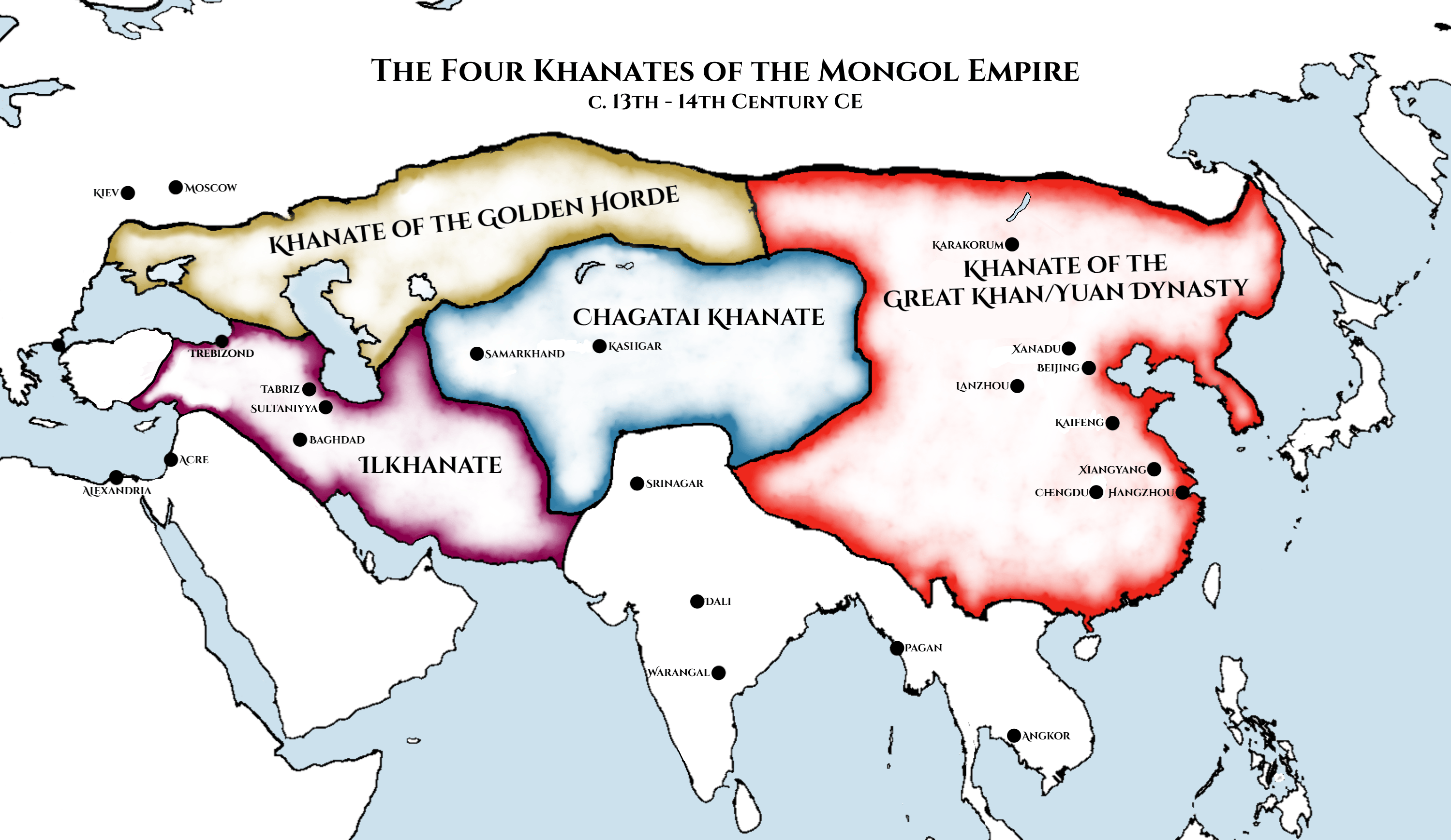
Mongke tried to unify them by appointing two extremely skilled central administrators Menggesser and Aqaa Bulgai. After ordering a census, he created four official administrative regions for tax purposes, as well as four secretariats directly responsible to the central Menggesser and Bulgai:
- the principalities of (ruled by the Jochi’s descendants, aka the Golden Horde)
- Turkestan/Chagatai Khanate (ruled by Mongke Khan)
- the Ilkhanate (ruled by Mongke’s younger brother Hulagu)
- the Yuan Dynasty (ruled by Mongke’s younger brother Qubilai Khan)
In 1252, Mongke ordered a second kuritai to receive approval and support to continue the wars of Ogedei. He allotted 20% of the army to Qubilai in his conquest of the Song empire, 20% to Hulagu in his consolidation of Ogedei’s victories in Persia. He allotted an estimated 600,000 warriors and untold millions of non-nomads to himself he joined Qubilai in attacking the Song Dynasty.
Facing formidable iron fortifications on the northern Song border, he dispatched Qubilai to invade the Dali empire to the west of the Song empire. Assuming control of the Dali empire in 1254, Qubilai attached the Song from the west while Mongke approached from the north. Facing hundreds of thousands of skilled former Jin dynasty warriors, four years of bitter battle, the Song Empire finally surrendered.
Meanwhile Hulagu’s army in Persia captured the fortresses of Nizari assassins west of Persia and in 1258 sacked Bagdad, capitol of the Abbasid Caliphate. After opening dams to drown 20,000 of the caliphate’s cavalry, the Mongol armies used pontoon bridges to cross the Tigris and Euphrates rivers and Chinese engineers to crush the city walls with siege engines that pummeled it with massive boulders.
Pausing three days to collect the massive treasure of precious metals and jewels amassed by the Caliph, Hulagu unleashed his warriors to pillage Baghdad homes and rape and slaughter at least 90,000 civilians. They destroyed all the books in Baghdad’s phenomenal House of Wisdom, using the book covers to make shoes.
Once the Mongols moved on, Hulagu appointed Ata Mada Jervaine the new governor of Baghdad and offered the Nistorian Christian patriarch the former Caliph’s palace as a residence. The city would become an important center of Mongol administration, trade and religious affairs.
Continuing to march west the Mongols defeated Aleppo in five day with their siege engines. Opening its gates to them, Damascus was spared looting.
General Ket Buq now led a sizeable Mongol force north, while a third force marched to Gaza, where they briefly skirmished with European Crusaders.
The Mamaluks (former slave solders who now controlled Egypt – see Mongol Queens and the Contest for Empire) put an end to the Mongol’s westward advance at the battle of An Jalut.
All Mongol military campaigns ceased with Mongke’s death in 1265. Batu’s youngest son Arique Boke called a kuritai, which none of Mongke’s brothers attended, resulting in Boke being appointed Great Khan. When Quibilai called his own kuritai, he too and was declared Great Khan. Boke ceded to Quibilai when the led led his army north against him in 1274.
With Qubilai’s failure to demand loyalty from the other Mongol rulers and the four khanates established under Mongke became totally independent.
*For almost two centuries, from 1090 until 1273, the Order of Assassins played a singular and sinister role in the Middle East. A small Shiite sect more properly known as the Nizari Ismailis, the Assassins were relatively few, geographically dispersed, and despised as heretics by both the Sunni Muslim majority and even by most other Shiites. See Holy Terror: The Rise of the Order of Assassins
Film can be viewed free with a library card on Kanopy.
https://www.kanopy.com/en/pukeariki/video/12373094/12373116

 The Most Revolutionary Act