
 Episode 6 Mongol Institutions under Chinggis Khan
The Mongol Empire
Dr Craig Benjamin (2020)
Film Review
The administrative structure Chinggis Khan created for the Mongol Empire is described by Persian historian Jervaini (1226-1283 AD), an administrator in the Mongol government of its founder’s successors.
Under Chinggis Khan’s administrative success stemmed in part from reorganizing Mongol society along military lines, in part from a successful tax regime and in part from his new law code, known as the Great Yasa. Borrowing from the Chinese, he began by dividing his empire into 1000 Miquan (extended families), with each responsible for supporting (with funding and recruits) 1000 troops. Each Miquan was subdivided into 10 Jaghams of 100 families, which were further subdivided into Anban of 10 families. When the Mongols defeated new tribes, they were assigned to existing Miquon.
Miquon leaders could only communicate with the great khan directly (not with each other). Mongol men who chose not to enlist in the military were assigned to hard, unpaid physical labor.
The Mongol Military
In 1206, Chinggis Khan established a new 10,000-man military unit called the Keshing bodyguard. All were sons of military officers. This provided a training ground for new officers and political administrators. Following enlistment, warriors were expected to report for duty with their gear and horse fit for duty or they could be fined. If they failed to report, their wives could be forced to replace them.
Taxation
Initially Chinggis Khan established two basic tax structures: 1) the alba, pastoralists paid to the military and administrative elites and 2) the kuptua, a 1% levy enacted to finance special projects. The kuptua eventually became a permanent 10% tithe.
This would prove a far more stable source of income than plunder. Late in his reign, Ghinggis Khan divided the the empire into four regional fiscal and taxation regions – Mongolia, Turkistan, northern China and Khwarazmian-Mazandaran (modern day Iran).
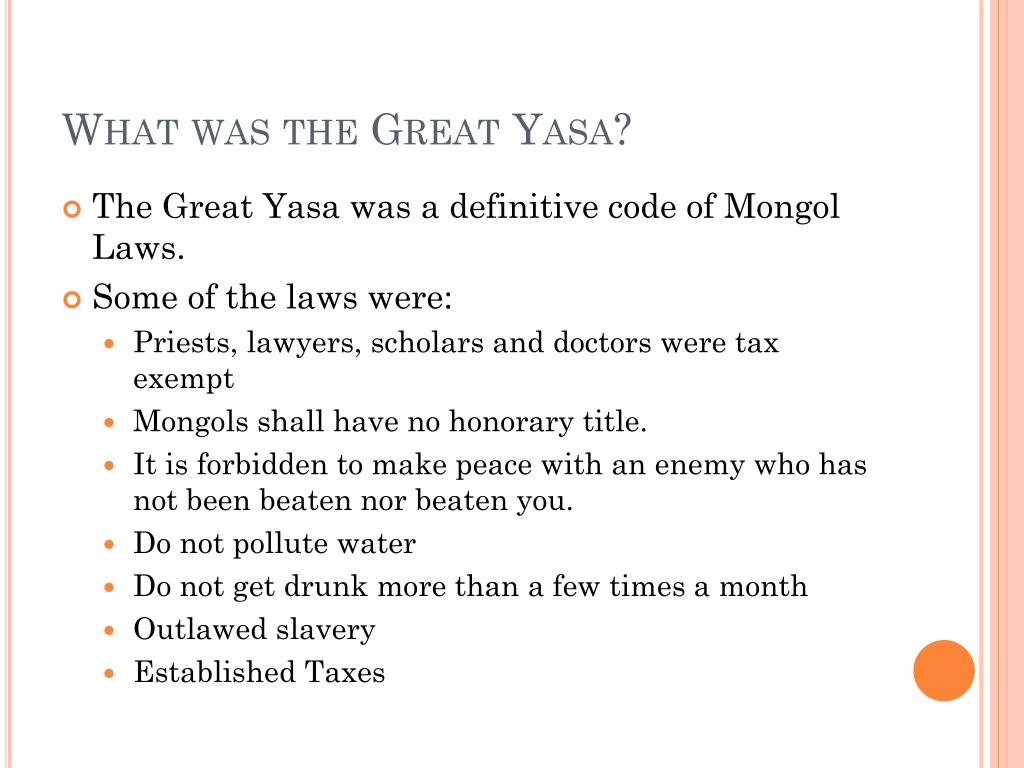
Although merchants were exempt from the kuptua, they paid a transaction tax (tamgha) of 5% on all goods and services. Religious organization and leaders were exempt from all taxes.
The Great Yasa
The laws Chinggis Khan enacted were known as the Great Yasa, Reportedly recorded in Uighur script, archeologists have never found the document. In general, they systematized existing Mongol taboos:
- livestock had to be killed on their back to ensure now blood was wasted.
- striking a horse in anger, wounding or stealing, resting a whip on it or touching it with a sword was punishable by death.
- young birds were protected.
- it was forbidden to extinguish a fire touching it with a knife.
- it was forbidden to wash in a running steam in spring or summer or to urinate in a stream at any time
- it was forbidden to spill liquid on the ground
- spitting food on the ground was punishable by death
- it was forbidden to step on the threshold of the great khan’s tent because it was sacred.
- Military pillaging without permission or failing to pick a fallen comrade’s weapon was punishable by death. Likewise if Mongol divisions lost too many warriors in battle, their comrades could be put to death for lack of effort.*
*The Spartans enacted similar laws in Greece.
Film can be viewed free with a library card on Kanopy.
https://www.kanopy.com/en/pukeariki/watch/video/12373094/12373106
 The Most Revolutionary Act
Pingback: Mongol Institutions Under Chinggis Khan MEK Enterprises Blog - Breaking News, SEO, Information, and Making Money Online!The Number 1 Online Blog Worldwide!
Pingback: Collapse of the Mongol Empires | Worldtruth