
Episode 3 Nomadic Predecessors of the Mongols
The Mongol Empire
Dr Craig Benjamin (2020)
Film Review
Like the Mongols, earlier nomadic empires (eg the Xiongnu and various Turkic empires)) all lived in portable Gers (Yerts), were killed horse riders, used the composite bow, played board games and sang epic songs.
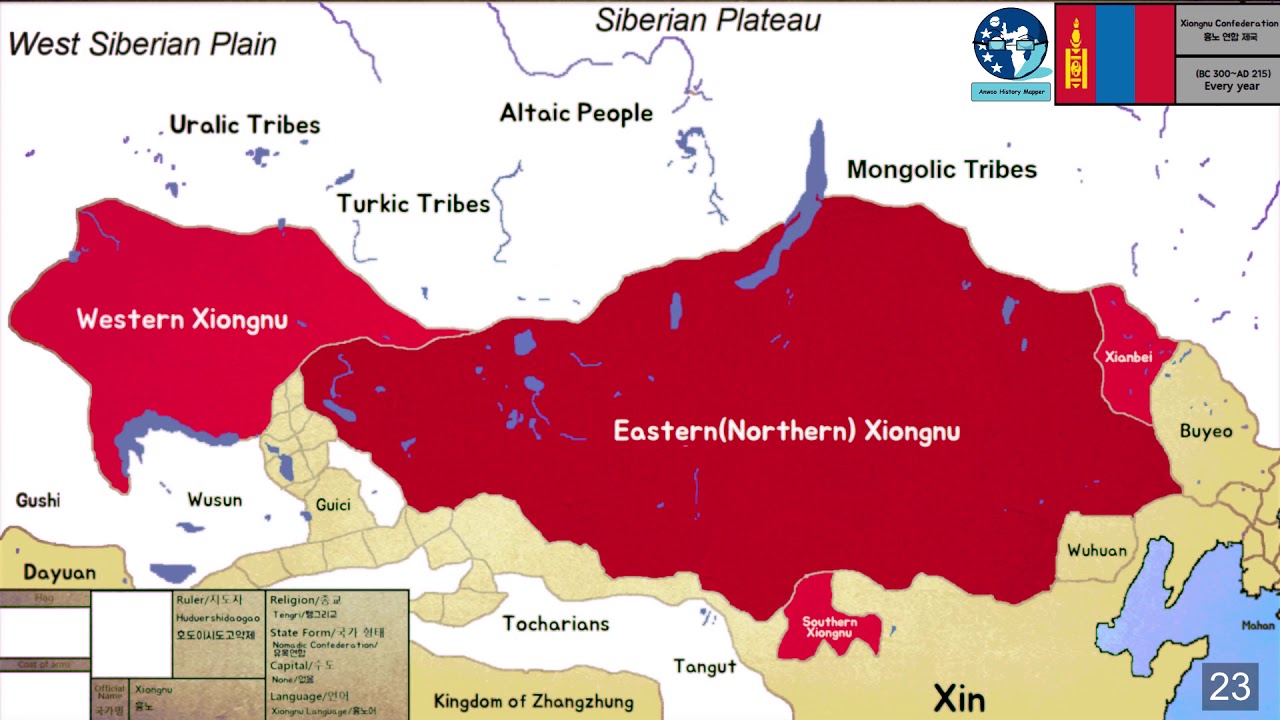
The Xiongnu
During the 3rd century BC, China’s Chin (Xin) dynasty was plagued by repeated Xiongnu raids. In response, the Chin military trained their own mounted archers, as well as adopting the Xiongnu composite bow, stirrups and trousers. The Chin also built the first 1000-mile earthen Great Wall, attempting to thwart them.
The Xiongnu were first militarized by Touman, though it was his son Modu (who murdered him) who organized them into a formidable fighting force. Modu also adopted saddles with pommels and iron-tipped armor piercing arrows. He also unified warring Xiongnu tribes into a vast confederation.*
After failing to defeat the Xiongnu, the Han Dynasty began paying them tribute, providing royal princesses as brides and formally recognizing all territory north of the Great Wall as belonging to the Xiongnu.
After Emperor Wudi (141-87 BC) adopted an extensive horse breeding and mounted warrior training program, he eventually drove them out of northern and western China. They returned following Wudi’s death, only to be driven back to the steppes after the Xiongnu federation split into two warring factions.**
It was the Xiongnu who established the template for the five great steppe empires that followed. During China’s breakup into warring kingdoms, many Chinese warlords recruited Xiongnu horsemen as mercenaries and a number settled permanently in western China in modern day Xinjiang province.
In 398 AD, the Xianbei (descended from Xiongu nomads), established the Wei dynasty in northern China.
The Turks
The Turks formed the next major nomadic steppes confederation, under the leadership of Bumin Qaghan in 545 AD. The confederation split into two Khaganates in 552 AD, with the western Khaganate winning control of the western commercial cities Samarkand (in modern Uzbekistan) and Panjakent (in modern Tajikistan). The eastern khaganate self destructed after a 626 AD famine allowed the Chinese to attack and dissipate the confederation.
They regrouped into a second Turkic Khaganate in 745 AD, that was powerful enough to force the Chinese to pay tribute. The Uighurs gradually took over the steppes from them (744-844 AD) as the Turkic tribes they replaced migrated to the fringes of the Abbassid Caliphate, where they converted to Islam.
The Seljiks (ancestors of the Ottoman Turks) also helped to spread the faith as they migrated westward and hired themselves to the Abbassid Caliphate as mercenaries.
The Jurchen replaced the Seljjiks, and eventually formed the Jin Dynasty in northern China.
*Chingiss Khan would later adopt Modu’s method of military organization, which was extremely effective in uniting an ethnically and linguistically diverse people. Modu appointed 24 Great Leaders, to a council of state, selecting four of them as Wang (kings): the Wise King of the Left (who ruled the Southeast), the Luli King of the Left (who ruled the Northeast), the Wise King of the Right (the Southwest), and the Luli king of the Right (Northwest). Each of the 24 Great Leaders was in charge of 10,000 cavalry.
**The Huns were possibly descended from one of these factions.
Film can me viewed free with a library card on Kanopy.
https://www.kanopy.com/en/pukeariki/watch/video/12373094/12373100
 The Most Revolutionary Act