
Episode 1 The Mongols Place in World History
The Mongol Empire
Dr Craig Benjamin (2020)
Film Review
In this introductory lecture, Dr Benjamin gives a brief overview of the movement of the Mongols’ movement (led by Chinggis Khan) out of the east Asian steppes to conquer China, Japan, Korea, Russia, Armenia and much of eastern Europe, the Middle East and Persia. They were the last of a long series of pastoral nomads to use mounted archers to raid China for manufactured goods they couldn’t access on the steppes (ie the Xiongu, the Gygihus, the Khitan, The Xiani, the Turks and the Jurchen).
Despite destroying hundreds of cities and killing millions of people, the Mongols played a vital important role in spreading Eastern Ideas to the West. They also facilitated Eat-West trade by providing security for trade caravans and promoted religious tolerance in regions they conquered. Their social structure tended to be more egalitarian than settled communities and allowed women more power and influence.
Benjamin attributes their phenomenal military success to their advanced horse riding and ca;vary skills, their siege craft and their development of the composite bow.
Significant Mongol leaders
- Temujen (aka Chinggis Khan) 1162 -1227 Consolidated 42 warring Turkic tribes and invaded and subjugated northern China and the vast Islamic caliphate stretching from China’s western border to Persia.
- Ogidai – (1227-1241) Chinggis Khan’s third son was appointed chief Khan of an empire four times the size of the Roman empire (comprising Korea, Georgia, Armenia, Russia, Poland, Hungary)
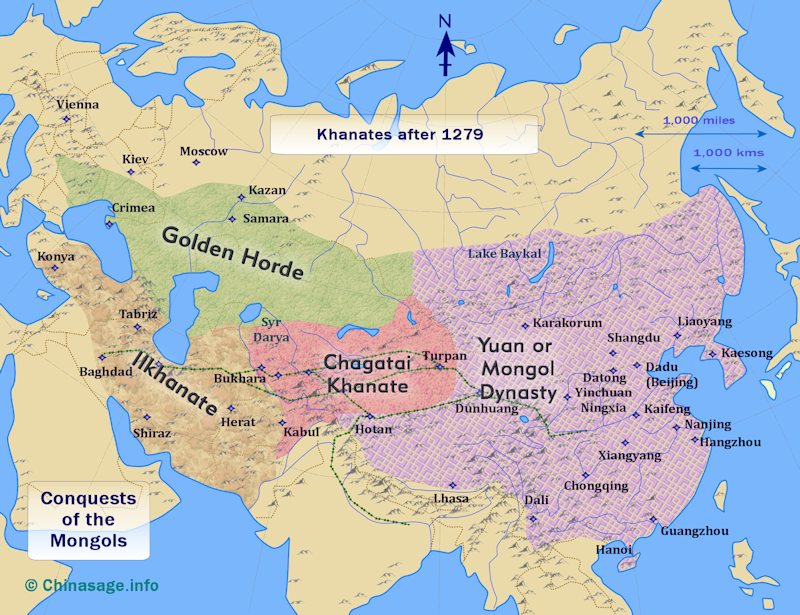
- Mongke (1251) – appointed great Khan under a regime that divided the Mongol empire between Kubla Khan (who captured China’s Song dynasty in 1279 and created the Yuan Dynasty), Hulagu (who sacked Baghdad in 1258 and created the Ilkhanate Khanate in Persia), the Golden Horde (which controlled Russia until 1380), and the Mongol’s central Asian homeland under Chaggatai (the second son of Chinggis Khan)
- Tamerlane – (1336-1405) descendant of Chinggis Khan who conquered India and southern Russia
- Babur – (1526–30) descendant of both Chinggis Khan and Tamerlane who founded the Mughal Empire in northern India
Benjamin devotes the last third of the lecture to discussing the status of other world empires at the time the Mongol empire arose:
China: was in relative decline following the collapse of the Tang empire in 907 AD, which had reestablished the Silk Road (first developed by the Han Dynasty 202BC-220AD), as well as inventing gunpowder, printing and steel,
Middle East: the Dar al Islam Empire, controlling Persia, the Arabian peninsula, North Africa and Afghanistan and the Iberian peninsula, gave way first to the Unaayad Caliphate in 661AD and the Abbasid Caliphate in 750AD – at the time the largest civilization ever.
Former Roman Empire: in 800AD Charlemagne unifies all of France, parts of Northern Spain and Northern Italy and much of Germany, only for his sons to split it up into smaller kingdoms.
Viking invasions: major role in shaping not only Britain, but France and Russia (where Viking invaders were known as Rus). The birth of the Norman empire (in Normandy) in the 9th century following the Viking invasion of northern France and Russia, following the Slav migration into Russia and Eastern Europe from the 5th to 10th centuries.
Film can be viewed free with a library card on Kanopy.
https://www.kanopy.com/en/pukeariki/watch/video/12373094/12373096
 The Most Revolutionary Act
Pingback: Collapse of the Mongol Empires | Worldtruth