
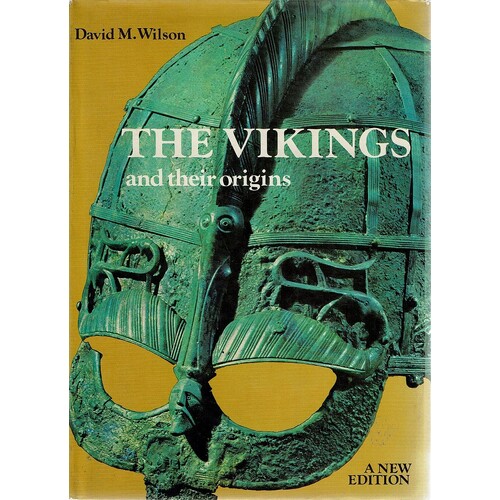
The Vikings and Their Origins: Scandinavia in the First Millennium
By David Wilson
Thames and Hudson (1970)
Book Review
Archeological evidence indicates the Roman empire enjoyed a brisk trade with Scandinavia. Remains of many Roman luxury goods – bronze and silver vessels, glass blows, bronze figurines of Roman gods, silks, textiles, spices and wine – have been found in Sweden an Norway.. The Scandinavians, in turn, provided Rome with furs, seal skins, rope, daily produce, cattle, slaves and amber.
In Roman historical literature, Pythias, Ptolemy, Tacitus and Pliny the Elder refer to Thule (Norway’s island of Smøla) and the Siuones (Swedes), the Goutoi* and the Chaideinoi (Norwegians).
The earliest Scandinavian runic alphabet dates from the late fourth or early fifth century AD. It’s believed to be derived from either Greco/Roman or North Italic/Celtic alphabet.
The Scandinavians worshiped a pantheon of Indo-European gods including Thor (equated to Zeus/Jupiter), Odin (god of thunder, war and magic), Njord (god of wealth and fertility), and Freyja (goddess of love).
Era of Great Migrations
The collapse of Rome in 476 Ad created a power vacuum enabling a wave migrations across the European continent:
- Beginning in the sixth century AD, Angles and Jutes from Denmark conquered much of of the British Isles.
- Hun, Goths and Vandals swept across continental Europe
- Sweden raided Frisia**
- Northward expansion (into a region populated since the Stone Age by a culture using bone and stone tools for hunting and fishing) by Norwegians and Swedes in pursuit of fur, iron, horn and ivory.
- Viking attacks leading to an empire stretching from Iceland to eastern Russia.
After multiple raids on Ireland and Scotland, the Vikings first attacked England in 789 AD and captured York in 867 AD. Full time Viking settlement in England began in 865 AD. In 886 The Treaty of Alfred with Guthrun gave Scandinavians the right to settle in Nottingham, Lincoln, Stanford, Derby and Leicester – regions controlled by Viking rulers until the mid-10th century. The English briefly resumed control of these areas, though by the 11th century they were again under Viking control. Archeologists haves found many Anglo-Saxon coins in Sweden, used to pay tax to their conquerors.
Founding Dublin in 830AD. the Vikings also controlled Ireland, the Faroe Isles, Northern Scotland, the Scottish Isles and the Isle of Man, Iceland and Greenland. Under the Viking, Iceland became the first modern republic, forming a consultative assembly in 930 AD. Viking also briefly settled Newfoundland in the 11th century.
Between 841-844 AD, they also sacked Quentovic, Rowen and Nantes in Franc. In 911 AD, they settled Normandy
It was also common for European rulers to hire Vikings as mercenaries. Between 806-862 AD, the people of European Russia invited the Viking Rurik the Rus to develop trading centers in Novgorod and Kiev. Their new Viking rulers and the settlers accompanying them adopted the culture of their Slav subjects.
*The Geatas are referred to in Anglo-Saxon epic poem Beowulf. The Anglo-Saxons who eventually occupied Britain are believed to have originated in Scandinavia.
**Historic region of the Netherlands and Germany
 The Most Revolutionary Act