
Dmitry Orlov
A handy historical rule of thumb: when debt service costs of a mighty empire exceed its defense spending, the mighty empire is at an end. So far, this rule has held for the Ottoman, Russian and British empires; the US empire is testing it now. The Congressional Budget Office found that the federal government has spent more on paying interest on the national debt than on the military in fiscal year 2024. US defense spending is roughly $1 trillion a year — and
According to the CBO, the US federal debt is going to jump yet again, by close to $2 trillion and exceed the truly gargantuan figure of $36 trillion. A steady stream of billions being sent to support failing imperial projects in the former Ukraine, in temporarily Israeli-occupied Palestine and in the Chinese province of Taiwan are helping with this endless debt bloat.
Meanwhile, as the world gradually but steadily turns away from the US dollar, the process of exporting inflation has stopped, meaning that dollar inflation will remain stubbornly above 3%, in turn forcing the US to continue borrowing at higher and higher interest rates. The tipping point for national bankruptcy and into failed state mode is approaching rapidly.
An inflection point will be reached when Asian countries, including China, which hold huge quantities of US debt in the form of US Treasuries, react to a worsening political relationship with the US by dumping these US Treasuries on the open market. Who will precipitate this disaster in the making? Why, the US government itself! Sanctions and tariffs are America’s favorite tools, and it simply doesn’t know how to stop. The negative feedback loop, which should exist between the US imposing sanctions and tariffs and the sanctioned countries selling off its US debt holdings, simply doesn’t exist. Instead, at every turn, the US government responds by digging its own financial grave faster and faster.
Russia was the first to opt out of this game by zeroing out its holdings of US Treasuries. Now, while Russia quietly plots to deliver a coup de grace to the US in some non-financial, kinetic yet plausibly deniable fashion, it is China’s turn: over the past few years, it has reduced its holdings of US debt by a third and shows no signs of slowing down. In addition, the work on isolating the global economy from the US dollar is ongoing, since its toxic nature has become obvious to almost all participants in world trade. The latest example is Việt Nam, which, as a follow-up to Putin’s recent visit, is switching its trade to national currencies. As an additional follow-up to Putin’s visit, Vietnamese Foreign Minister Bui Thanh Son met with US Assistant Secretary of State for East Asian and Pacific Affairs Daniel Kretinbrink and told him Hanoi views Washington as a strategic partner. In other news, Americans still love the smell of napalm in the morning and words are still cheap.
The willingness of the rest of the world to absorb excess US debt issuance is what has allowed the US to cope with its excessive level of debt. But now the terminal disease of the US dollar is for everyone to behold: everyone is starting to avoid it as if it were a leper. In turn, the death of the US dollar will mean the death of the United States, turning it into the Divided States. Being able to issue checks that don’t bounce is a key function of the US federal government. Once this function becomes impaired — either through hyperinflation or through other, more direct sorts of insolvency, the individual states will inevitably drift apart.
What will happen to each individual state depends on the structure of its economy. Behold the following per capita balance of payments map (for 2019, but these are systemic effects that don’t change too fast).
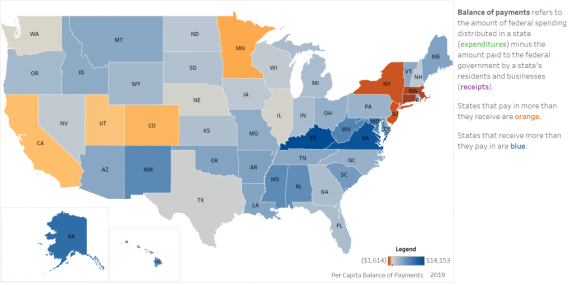
What we see here is that just four states — New York, Massachusetts, Connecticut and New Jersey — are pulling the entire train by giving more to the federal project than they receive. However, if you take away the economic effect of defense spending (Raytheon, Lockheed Martin, Boeing, Northrop Grumman in Massachusetts and Connecticut) and of federally guaranteed student loans (especially in Massachusetts) their share will dwindle. Just four more states — huge California, midsize Minnesota and Colorado and tiny Utah — are also donors, but relatively minor ones.
A few more gray states manage to hold their own, for now: Texas because of energy, Washington because of Microsoft, Illinois because of Boeing and Nebraska which is too small to matter. And the rest are FEDERAL MONEY SPONGES. There is an entire continent’s worth of insolvency coming up between the relatively rich New York and New England and the troubled but still rich California; what is going to hold them together?
[…]
Via https://boosty.to/cluborlov/posts/2e53e1b6-8ec4-4bc0-b924-24ba38ba9375
 The Most Revolutionary Act