
Episode 24: Mummification: How We Know What We Know
The History of Ancient Egypt
Professor Robert Brier
Film Review
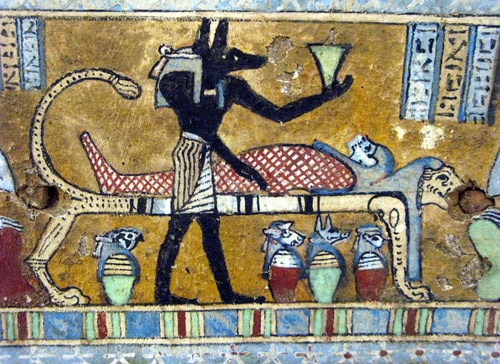
Although Egypt mummified people for 3,000 years, it was a secret profession and Egyptian embalmers left no papyri explaining how to do it. In fact, they took an oath of allegiance agreeing not to divulge their secrets nor infringe on the territory of other embalmers.* Mummification itself was a religious procedure dedicated to Anubes (the jackal-headed god). Often there was a priest present wearing Anubes mask.
In addition to two temples in Thebes illustrating the process of mummy wrapping, the Rhind Bengreal Papyri (from 9 BC) describes various wrapping rituals, as well as broadly outlining the 70-day embalming process. For the first 35 days, the corpse was placed in a dry “place of cleansing” to dehydrate. The papyri go on to describe the seven head openings (which were filled with sacred oils), the 17 mummification rituals and the 17 “body parts” (the seven head openings plus the “four” internal organs (lungs, intestines, stomach and liver*) and the arms, legs, front and back.
The Ritual of Embalming Papyrus (from first century AD) describes waiting for three to four days of mourning before placing the corpse in natron (a naturally occurring mixture of sodium carbonate decahydrate and sodium bicarbonate) to dehydrate it. It also describe filling the head with frankincense and the body cavity with myrrh.
The most information about Egyptian mummification comes from the Greek historian Herodotus (450 BC). He asserts embalmers offered a range of three prices depending on family income. He describes placing the body in natron for 35 days, drawing red cutting lines on the abdomen, and using a sharp obsidian blade to make a 2 1/2 inch incision, as wel as a hook shaped instrument to remove the brain (through the nose).
*Embalmers also sealed the tombs following burial and were paid a fee by families of the deceased to maintain them.
*These organs were preserved in separate jars, while the heart was returned to the body.
Film can be viewed free with a library card on Kanopy.
https://www.kanopy.com/en/pukeariki/watch/video/1492791/1492848
 The Most Revolutionary Act
Pingback: Making a Modern Mummy | The Most Revolutionary Act
Pingback: Making a Modern Mummy MEK Enterprises Blog - Breaking News, SEO, Information, and Making Money Online!The Number 1 Online Blog Worldwide!