

Episode 7 The Rise of the Old Kingdom
The History of Ancient Egypt
Professor Robert Brier
Film Review
Following the unification (3100 BC) of Upper and Lower Egypt, Memphis in Lower (northern) Egypt became the national capitol. Memphis is the Greek name for the city the Egyptians named Hekaptah, which became shortened to Egypta and eventually Egypt. It was a perfect defensive location because locked in by deserts to the west and south, they only worried about potential invasion via the Mediterranean.
Little was known about the first dynasty of pharaohs until their tombs were found at Abidas in the 19th century. Although much further south, Abidos was a sacred city where Osiris’s body part were buried before he was resurrected (see Ancient Egyptian Origin Myth). Traditionally all Old Kingdom pharaohs sought to achieve resurrection after death like Osirirs.
After sand pit burials proved unsatisfactory (because scavenging animals destroyed the corpses), the ancient Egyptians buried their dead in stone pits. They accomplished this by clearing desert sand down to bedrock, chiseling out a burial pit and covering it with a stone slab. Once the pharaohs established a second burial site at Sakara (named after Sakka, god of the dead), they began to build mastabas on top of the rock burial pits.
Inotet, the royal architect who eventually built the first pyramid, was the first to add a mastaba to the pharaoh’s tomb. Successive architect added, one, two, three and four layer of mastaba. This eventually resulted in the Step Pyramid of Djoser, the first stone building in the history of the world, which has five layers. The pyramid is surrounded by stone temples with fluted columns meant to mimic papyrus columns, which were used for the first columns in wooden buildings.
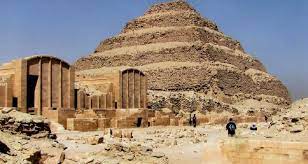 It’s interior is covered with Faence, quarzite tiles that form their own glaze when heated to high temperatures.
During the early days of the Old Kingdom, pharaohs who got old and feeble were either ritually killed or rejuvenated themelves by holding a Hebset after 30 years of rule. This was a ceremony in which and old pharaoh and wrestle younger men. After completing the Hebset, the pharaoh was declared young and fit.
Film can be viewed free with a library card on Kanopy.
 The Most Revolutionary Act
Pingback: The Rise of Egypt’s Old Kingdom | The Most Revolutionary Act | Vermont Folk Troth