
Episode 46 Napoleon’s Fall and the 100 Days
Living the French Revolution and Age of Napoleon
Dr Suzanne M Desan
Film Review
Following Napoleon’s defeat, Alexander was celebrated in Prussia as the savior of Europe. With 170,000 troops, Napoleon marched into Saxony twice in the spring of 1813 and was defeated both times. Austria, which was still neutral, offered the services of foreign minister Metternnich to negotiate peace between France and the coalition (UK, Prussia and Sweden).
After Austria joined the coalition that summer, three-day Battle of Nations was the bloodiest European battle to date. Napoleon’s 180,000 troops were crushed by a 300,000-strong coalition force. Seventy-three thousands French troops died, compared to 27,000 in the coalition.
Napoleon rejected the treaty conditions they offered: retreating to France’s 1797 borders (allowing France to keep Belgium and the Rhineland). In 1814, the French legislature demanded he initiate peace talks immediately. When he refused, the Anglo-Portuguese army swarmed over the Pyrenees into France while coalition forces crossed the Rhine and invaded northeastern France. Simultaneously the Dutch launched an insurrection against French rule and the Swiss declared independence. After the French legislature demanded Napoleon agree to a ceasefire, his sister and brother-in-law (General Murat), who ruled the kingdom of Naples, switched sides to support the coalition.
Napoleon fought brilliantly but lacked the numbers to prevail. On March 9, 1814 Marie-Louise fled Paris with their three-year-old son. Most of the court and legislature fled, as did peasants in the path of coalition forces. On March 31, 145,000 coalition forces invaded Paris, and Alexander I and King Frederick William of Prussia marched up the Champs Elysee and invited the brother of Louis XVI (Louis XVIII) to assume the French throne.
On April 2, 1814, the royalist French diplomat Charles-Maurice de Tallyrand pressured the senate to dethrone Napoleon and appoint Louis XVIII. Having lost the support of his generals,on April 11, 1814 Napoleon signed an abdication from the thrones of Italy and France. He also swallowed poison he carried around his neck with no effect.
Exile to Elba
As per the conditions of his abdication, he then set off for the island of Elba (presently an Italian island in the Mediterranean) under the guardianship of British naval officer Neil Campbell. The coalition had promised him sovereignty of Elba, allowing him to bring 600 troops and paying him a stipend of $2 million francs a year. Marie-Louise, who was given the title of Duchess of Palma, was forbidden to accompany him to Elba.
The island was 26 square miles and Napoleon had 13,700 subjects. He built new roads, sewers, irrigation systems, fortifications and a hospital, as well as importing mulberry trees and starting a silk work industry. His Polish mistress visited him with their their son.
Only taking the throne 310 pound Louis XVII ripped up the constitution the coalition handed him and created his own constitution charter, which granted the French people equality and numerous civil rights, including religious freedom. It also created a two-chamber legislature, with the king resuming the lawmaking power Louis XVI enjoyed. The king declared Catholicism France’s official religion and filled his government with returned emigres.
Napoleon Resumes Power for 100 Days
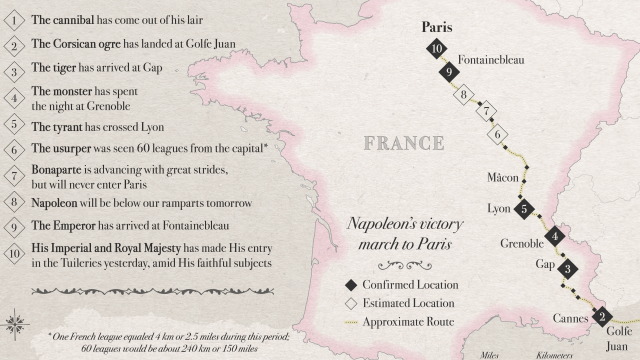
In mid-February 1815, Napoleon left Elba with 100 men, landing on the southern French coast on March 1st. As they marched north, they were joined by 1000s of former troop sent to stop him. On March 19, Louis XVIII fled Paris, as Napoleon led his men unopposed to the Tuilleries palace. They had seized control of central France without firing a shot.
The former emperor now reinvented himself as a revolutionary intent on expelling a new king, and the working class immediately flocked to join him.
One of his former critics Benjamin Costent wrote him a new constitution turning France into a constitutional monarchy with a bicameral legislature and guaranteeing, freedom of the press and religion.
Film can be viewed free on Kanopy with a library card.
 The Most Revolutionary Act