
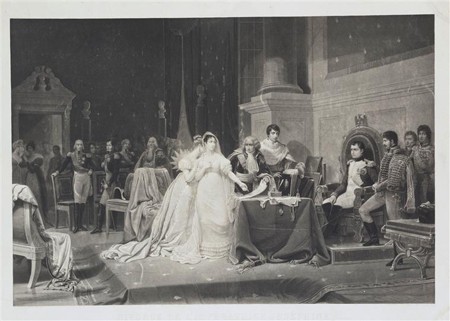
 Napoleon’s Divorce from Josephine
Episode 44 Living Under the Empire
Living the French Revolution and Age of Napoleon
Dr Suzanne M Desan
Film Review
In 1809, Napoleon divorced Josephine due to her inability to produce an heir, which he believed essential to ensure his legitimacy as emperor. As Napoleon had imprisoned him in France, Pope Pius VII was unavailable to annul his marriage.* Instead the French senate granted a civic annulment, which the emperor celebrated in an elaborate divorce ceremony at the imperial court. Josephine kept her title as empress, the palace at Malmaison and a sizeable pension.
In 1810 Napoleon married the Austrian princess and niece of Marie Antoinette Marie-Louise. A year later she gave birth to Napoleon François Joseph Charles.
By 1811 he had created 3,200 nobles, with one-fifth related to the old nobility. The titles Napoleon granted (duke, count, baron and chevalier of the empire) were rewards for exceptional services. Related mostly to valor on the battle field though some were awarded to technocrats, bureaucrats and industrialists. Each noble received a coat of arms and a plot of land in the new empire. By 1814 there were 25,000 men in Napoleon’s Legion of Honor. The titles weren’t hereditary and carried no exemption from taxes.
To reduce the risk of rebellion, the emperor created new jobs by investing heavily in public works. In Paris he had numerous monuments built (including the Arc de Triomphe) to celebrate his military victories. He expanded the Louvre** and renamed it the Napoleon Museum. He also built wine and grain warehouses, canals for drinking water and shipping, and two bridges over the Seine; expanded and upgraded public markets; and moved slaughterhouses and cemeteries outside city limits,
He believed the state should do everything it could to raise living standards by supporting industry and trade. He subsidized key industries, a well as laying the foundation for a national banking and supporting the education of engineers.
He also increased government surveillance, requiring citizens to carry passbooks and banning workers associations (leading workers to create them clandestinely(.
Because so many men were away at war, wages rose, and from 1806 on the economic blockade eliminated competition from cheap British goods. Producing misery in the coastal cities (from the decline in maritime trade), the blockade led to a big boom in textile production in Alsace and Normandy and ultimately shortages of coffee, sugar, dye and textiles and higher prices on most products.
Between 1805-1810, France conscripted 80,000 men a year. With military expenditures accounting for 80% of France’s economic output, by 1813, Napoleon was conscripting anyone who was 4 foot 8 inches or taller. In lycées youth joined junior military companies and wore war uniforms. As imperial propaganda and censorship increased, salons and cafes were subject to surveillance or shut.
By 1813 military expenditures accounted for 80% of France’s economic output, and there was widespread resistance to conscription. The wealthy could pay for a substitute or could get married. With women over 60 marrying 17-year-old conscripts, some couples never lived together. Some “professional wives” married two or three times. Sympathetic communities hid draft dodgers from conscription officers.
*Napoleon’s troops invaded Rome when Pope Pius VII refused to support his naval blockade against Britain. The pope, in turn, excommunicated him, leading Napoleon to annex the papal state, arrest Pius VII and imprison him in France.
**The National Assembly converted the royal palace to an art museum in 1793 to allow commoners access to great art.
Film can be viewed free with a library card on Kanopy.
https://www.kanopy.com/en/pukeariki/watch/video/149323/149409
 The Most Revolutionary Act