
Episode 40 Napoleon Becomes Emperor
Living the French Revolution and Age of Napoleon
Dr Suzanne M Desan
Film Review
In 1802 Napoleon became Consul for life and by 1803 his face was displayed on French coins and he had three residences: Malmaison, a few miles to the west of Paris, and royal palaces at St Cloud and the Tuilleries. The justification he gave for promoting himself to emperor (a hereditary position) was to protect himself from assassination. In early 1804, he had the heir to the French throne (the Duke d’Enghien) kidnapped in Baden (in violation of international law). Accusing him of participating in a British-linked royalist assassination plot, Napoleon had executed via firing squad.
France was at war again when the senate declared him emperor (in May 1804). Napoleon proceeded to hold his third plebiscite in five years for a constitution making him emperor. It was approved but with and even lower turnout than 1802 (20%. h a lower turnout than the 1802 turnout of 20%.
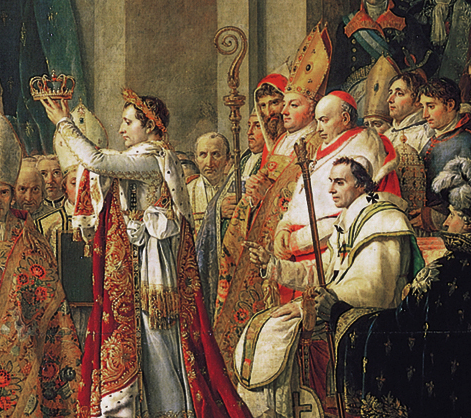
After somehow convincing Pope Pius VII to sanctify the ceremony, Napoleon purposely scheduled his coronation at Notre Dame (like Charlemagne)*, rather than Reims like the Bourbon kings. His staunch Republican mother and brother Lucien boycotted the ceremony (although David added her to his famous painting of the Napoleon’s coronation). After the pope anointed Napoleon and Josephine, he allowed Napoleon to place the crown on his own head as they previously agreed.
Following his coronation, Napoleon’s system of one-man rule replaced all vestiges of representative democracy. He now banned all political clubs, radical newspapers or public protests, and repealed old legislation granting equality/freedom to women and slaves.
Policies he retained from the republic were France’s expansion to its natural frontiers, a secular state that guaranteed religious freedom and the abolition of feudalism and hereditary kings.
Instead he established a meritocracy by establishing the Legion of Honor for soldiers, artists, scientists and men of letters who demonstrated outstanding service to the empire and rewarding them with a pension, title and medal. One-half of the Council of State (the chamber that proposed new laws) and one-third of the Tribunate (the chamber that debated them) opposed this restoration of noble titles and rank.
Napoleon also discontinued the primary schools the republic established for non-elite families and girls. Instead he introduced (in 1802) French lycées (secondary schools) where the sons of property owners could prepare to become military officers and administrators. In 1809 he introduced the Bacalaureat, a national exam French students still take on finishing secondary school.
Napoleon was proudest of the civil code he introduced, still the basis of modern civil law in France. In this way, he permanently eliminated feudalism by replacing the king’s hodgepodge of laws and jurisdictions. This Napoleonic Code was written by four jurists together with the Council of State.
His code deliberately increased the power of fathers and reduced the independence of women and made divorce much harder to obtain (especially for women). Under Napoleon, a wife could only divorce her husband if he maintained his mistress in the family household. He also reinstated paternal power over children under 26, requiring the father’s approval for children’s marriages and allowing a father o imprison children who defied parental authority.
*To help nullify claims to the throne from Louis XVI’s relatives.
Film can be viewed free with a library card on Kanopy.
https://www.kanopy.com/en/pukeariki/watch/video/149323/149399
 The Most Revolutionary Act