
Episode 24: Slave Revolt and the Abolition of Slavery
Living the French Revolution and Age of Napoleon
Dr Suzanne M Desan
Film Review
The slave revolt that started in St Domingue (modern day Haiti) on August 22, 1791 was the largest in history.
Despite Louis XVI’s 1780 decree mandating higher standards for food and clothing for St Domingue’s slaves, the St Domingue courts refused to register the new law. However in 1788 two slaves took slave master NIcolas LeJeune to court for torturing two of his female slaves. After the judges visited the plantation, they initially convicted Lejeune, overturning it under pressure from plantation owners. Fallout from the case led the Spanish King to order a slave workload reduction in the Spanish half of the island. Slaves in the French colonies of Martinique and French Guyana believed the Declaration of the Rights of Man had freed them by granting them full equality. I
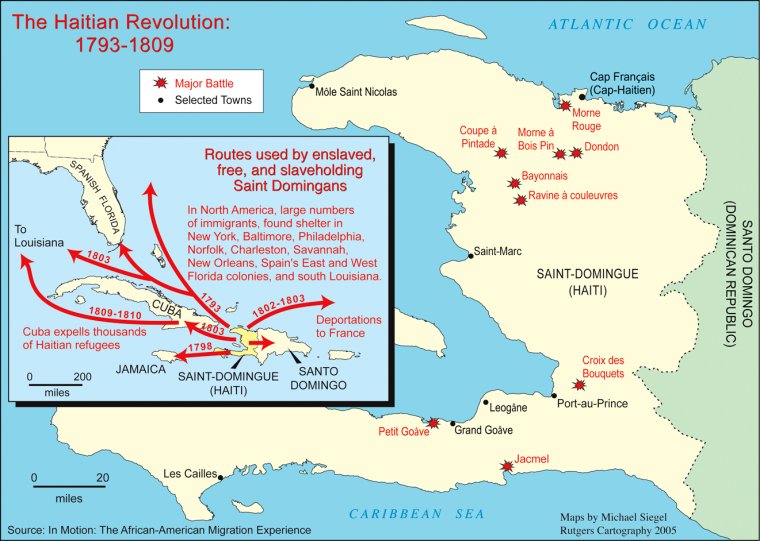
On August 22, 1791, St Domingue slaves (who had been meeting in secret assemblies for more than a year) attacked plantations to the south of St Domingue’s capitol Cap-Français on the northern coast. They set vast sugar cane fields on fire, smashed sugar mills and killed plantation owners. The only plantation owners spared were the four (out of 27) whose slaves were too afraid to join the revolt.
By late September 20,000 slaves had joined the uprising, which increased to 80,000 by the end of the year. They weren’t as well armed as the republican troops the French National Convention dispatched to crush the insurrection. After one month 400 whites and 4000 slaves had been killed, with 4000 taken prisoner. Dutty Bookman, the insurrection’s initial lead and was killed in November 1781,
Following his death, the insurgents retreated to the mountains to regroup. Fighting reached a stalemate, with the insurgents holding the north coast and adjacent mountains and the plantation owners taking refuge in the western coastal cities.
In April 1792, the King and the National Assembly responded to the insurgency by granting equal political rights to all free men of color.
In the summer of 1792 they sent more troops to St Domingue, as well as Commissioner Léger-Félicité Sonthonax (an abolitionist) with orders to enforce the political rights of free black men, as well as crushing the rebellion.
Meanwhile Spain, which had declared war with France, recruited rebel slaves to fight in Santo Domingo (the Spanish half of the island). Toussaint L’Ouverture, a freed slave born in Africa (who would come to lead St Domingue’s successful revolution), was one of the Spanish recruits.
This is the rough timeline Desan provides:
- Early 1793 – insurgent slaves flood down from the mountains into Cap Franςais to release the 4,000 insurgents held in prisons. In response, plantation owners flee to ships in the harbor, with many of them departing for Charleston and Philadelphia in North America.
- June 1793 – Commissioner Sonthonax emancipates wives and children of the insurgents.
- August 1793 – he abolishes slavery in northern St Dominque, requiring slaves to remain on their plantations and work for pay.
- September 1793 – British invade western St Domingue from Jamaica
- May 1794 – Toussaint and 4,000 of his troops switch from fighting for Spain to fighting for France.
- 1794 – French National Convention abolishes slavery in all French colonies.
In 1798 Toussaint and his army drove the British troops out of Haiti and in 1801 he conquered Santo Domingo (the Spanish of the Island) in addition to St Domingue (the French half).
Napoleon would subsequently invade Haiti seeking to reintroduce slavery.
Film can be viewed free with library card on Kanopy.
https://www.kanopy.com/en/pukeariki/video/149323/149369
 The Most Revolutionary Act
Pingback: French Revolution: Bonaparte Invades Egypt | The Most Revolutionary Act
Pingback: French Revolution: Napoleon Invades Egypt | The Most Revolutionary Act