
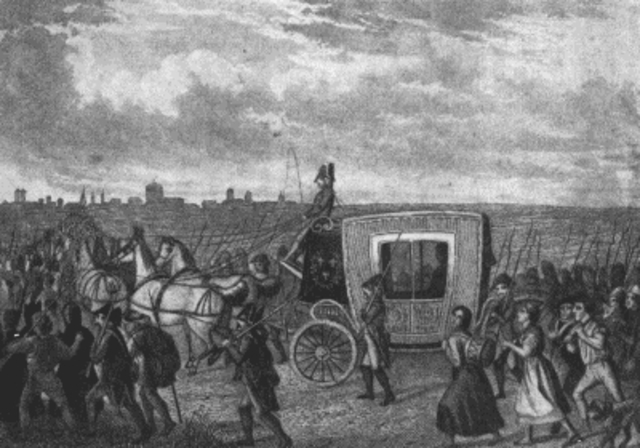
The French people “escort” Louis XVI back to Paris
Episode 16: The King’s Flight
Living the French Revolution and Age of Napoleon
Dr Suzanne M Desan
Film Review
On June 21 1791, the king, queen, children, his sister and some servants went missing. Lafayette, who was president of the National Assembly, put out an announcement they had been kidnapped by foreign agents. In reality, Louis had been planning his escape for weeks with the help of the Swedish aristocrat Count Axel von Ferson. Disguising themselves as peasants, the family hoped to escape to the Austrian Netherlands (modern day Belgium).
According to Desan, Louis XVI was playing a double game, pretending to go along with the revolution while secretly plotting to take back power. The French royalist Francois Claude Amour had agreed to meet the royal family at the border with troops provided by Marie Antoinette’s brother Leopold II.
Believing the peasants of rural France supported him, the king stepped out of his coach 30 miles from the frontier. When a local judge recognized him, Louis falsely claimed that Jacobin fanatics had seized power in Paris, forcing him to flee for his own safety. He also claimed he planned to establish a rural outpost in a border citadel he could use to restore order. Initially agreeing to help him, local officials were dissuaded by the arrival of a National Assembly courier with an order to detain the royal family .
An entourage including 6,000 national guardsmen and 24,000 civilians escorted the coach back to Paris. Many in the crowd carried pitchforks, pikes and firearms – with the dual objective of protecting the king and preventing him from running away.
The majority of the National Assembly remained loyal to the constitutional monarchy, declaring on July 15th that Louis XVI had been kidnapped (a deliberate lie). However once the king’s double game was exposed, ordinary working people began tearing down royal statues and other symbols of royal authority. When radical Parisians introduced a proposal for France to become a Republic, rejected by 75% of the delegates. The immediate response was 6,000 signature petition launched by the Cordelier Club calling for the election of a new National Assembly.
Lafayette, who was also mayor of Paris, declared martial law and the national guard fired a crowd on the Champs de Mars that pelted them with rocks. After a total of 50 protestors were killed in the massacre, the National Assembly reestablished the king’s police spies to hound republican sympathizers and radical journalists.
On September 14, the king formally accepted the constitution. Giving the National Assembly full authority over law making and financial matters, it granted the king a suspensive veto and the power to declare war and appoint minister and diplomats.
Film can be viewed free with a library card on Kanopy.
https://www.kanopy.com/en/pukeariki/watch/video/149323/149353
 The Most Revolutionary Act
Pingback: The Role of British Intelligence in the French Revolution | Worldtruth