
Episode 10: Paris Commands the King
Living the French Revolution and Age of Napoleon
Dr Suzanne M Desan
Film Review
The 1789 October Days relate to a popular uprising in which the people of Paris forced Louis XVI to leave Versailles and return to the historic royal palace in Paris (the Tuilleries). According to Desan, the crisis was triggered by kings failure to approve the August Laws (the Abolition of Feudalism and Declaration o the Rights of Man and Citizen) passed by the National Assembly.*
There was also growing popular angst about increasing bread prices (despite a good harvest**) and the king’s deployment of additional troops at Versailles.
The Parisian women who ran the city markets and led the 1775 flour wars (over high bread prices) also had a special relationship with the king.They organized a 12-mile march to Versailles every August and every time the Queen gave birth.
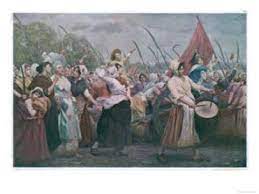
On October 2, 1789, the market women led a a march of 6,000-8,000 Parisian women to Versailles, where they stormed the National Assembly and shouted down proceedings with demands for flour.
Advised to flee, the king declined, fearful that his cousin Philippe d’Orleans might seize the throne in his absence. Instead Louis XVI promised them bread and approved the August Laws.
At this point the Paris National Guard, numbering 30,000** and led by US revolutionary war veteran Lafayette, marched to Versailles to convince the king to move to Paris (to be closer to his people). After a brief skirmish killing a teenage boy and two of the king’s troops, the king agreed.
After cheering the king (and Marie Antoinette), the women made the king’s troops put on tricolored revolutionary badges and together with the National Guard led the royal family in their carriage back to Paris, along with 60 wagon loads of grain,
Within days, the National Assembly also moved to Paris to meet in the Tuilleries stables. It was at this point of history concepts of left and right emerged, with the monarchists meeting on the right side of the podium.
Meanwhile Louis XVI was secretly playing a double game, corresponding with his cousin Charles IV of Spain about invading France and rescuing him.
*Although the king still had legal right to veto either law, he had the right to delay their implementation for up to four years.
** A former scientist turned journalist Jean-Paul Marat accused the Paris commune of plotting with finance minister Jacques Necker and the grain dealers to force prices up.
Film can be viewed free with a library card on Kanopy.
https://www.kanopy.com/en/pukeariki/watch/video/149323/149343
 The Most Revolutionary Act