
Middle East Monitor
[…]
Since the Oslo Accords were signed in 1993 with the goal of establishing a Palestinian state in the occupied West Bank and Gaza, the number of Israeli settlers in the West Bank has grown from about 260,000 to nearly 700,000, according to figures from the Israeli pressure group Peace Now.
Settlements are considered illegal under international law, but successive Israeli governments have continued to expand them in violation of international law and the Oslo Accords.
Palestinians across the West Bank fear that the increase in settlements and outposts threaten not only the viability of their future state but also their livelihoods.
In November, the surge in settler attacks forced many Palestinians to cancel their olive harvest, traditionally a joyful time when families go out into the hills to pick the fruit from gnarled, ancient olive groves.
For years, the settlers have descended from their hilltop fortresses and come to destroy the prized olive trees, either burning or hacking them down or poisoning them with chemicals.
Amid the war on Gaza, many have become more brazen in their assaults.
We learnt how farmers have been sprayed with machine-gun fire to force them off their land so the settlers could harvest the olive trees themselves.
Such attacks have proven to be a death knell for the rural economy, which has depended on agriculture for centuries.
‘They want to scare us, humiliate us’
Families across the West Bank, already haunted by previous displacement, told Middle East Eye that they feared that such crimes, which Israel’s judicial system fails to investigate properly, could usher in another period of forcible dispossession.
In Balata, one of the most densely populated refugee camps in Palestine, many told MEE that following the 7 October attack they feared a repeat of the Nakba, or “catastrophe” as it is known in English, when, at the time of the establishment of Israel, more than 700,000 Palestinians were driven from their homes by Zionist forces, never to return.
The signs of the destruction caused by constant Israeli military raids are clear to see.
[…]
Beaten for Not Licking His Boot
Several released Palestinians have recounted harrowing stories from when they were detained by Israeli soldiers in Balata.
Anas, a 27-year-old, was kicked in the face during his most recent arrest and was ordered by one Israeli soldier to lick his boots after it was stained with his blood.
“They started beating us. My brother Anas was the hardest hit. They kicked him so many times in the face that he lost consciousness. Despite this, one soldier ordered him to lick the blood off his boot. But my brother was now unresponsive; he was unconscious. We called for an ambulance, but they blocked it, preventing any help from coming.”
[…]
All Eyes Are on Gaza
Walking through the streets of Balata, nearly every TV set was tuned into channels broadcasting the latest news from Gaza.
Many Palestinians in the West Bank have shut their businesses in protest against Israel’s relentless bombing of Gaza, where almost all of the enclave’s 2.3 million inhabitants have been displaced after three months of war.
In recent weeks, Israel has come under mounting pressure from the global south to end its assault on Gaza, where the death toll has passed 23,000, with about 70 percent of those killed identified as women and children.
But with Israel repeatedly cracking down on acts of solidarity with Gaza, public displays of protest have been sparse.
The atmosphere at the Balata refugee quickly changed within the space of a few minutes, with armed young men thronging one of the main streets warning residents that Israel was planning another raid.
Dozens of people rushed to block the main entrance of the camp so as to slow down the entry of Israeli soldiers, using rocks, boulders, pieces of sheet metal and whatever else they could gather.
In this Israeli raid, at least one Palestinian man was killed.
[…]
Settlers Taking ‘Advantage of the War’
Unlike urban areas of the West Bank, where Palestinians have strength in numbers to resist settler attacks, remote villages are often at the mercy of rampaging settlers supported by the Israeli army.
Nowhere is this more evident than in the South Hebron Hills.
In the village of Tuwani in Area C, land that falls under full Israeli military and civil control, the villagers are not allowed to possess weapons.
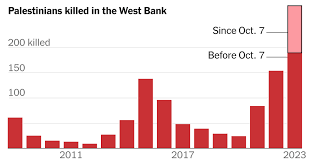
According to the United Nations, in 2023 there were, on average, three incidents of settler violence per day in the West Bank. Since 7 October that has more than doubled to seven per day on average, more than a third of them involving firearms.
Patriarch Hafez Hureini told MEE how armed settlers had imposed a reign of terror and were seizing livestock, wrecking water tanks, smashing solar panels, bulldozing outbuildings and destroying the olive groves.
“They bulldozed all our land with the olives and terraces, destroying everything. We dare not go even 20 metres to our land,” said Hureini.
“The settlers are taking advantage of the war [in Gaza] to seize the land. Now they rule everything round here. They block the entrances to our villages. They steal our possessions. They smash our solar panels and bulldoze agricultural buildings, trees and stone walls.”
His son Mohammed shows everyone that he can the video footage of settlers in military fatigues invading his property. When asked whether they were serving soldiers with the Israeli army, he said he wasn’t sure.
“We have no right to apply the law. We are not safe. Our lives are in real danger.”
He said the situation was worse in the most isolated villages, where people have already started to flee the violence.
The settlers are clear about their intentions. They tell the Palestinian villagers: “Go to the city. Go to Yatta [a city south of Hebron]. In 24 hours if we find you here we will kill you,” he added.
MEE previously reported that Israeli settlers distributed menacing leaflets and left bloodied dolls at schools, warning Palestinians to either leave or be killed.
Residents of one West Bank village said they were sent warning letters that read: “You wanted war – wait for the great Nakba.”
According to information from the West Bank Protection Consortium and the Israeli human rights group Yesh Din, about 545 Palestinians have been forcibly displaced from at least 13 communities in Area C since 7 October.
Bedouins Forced to Live in Caves
Upon reaching the village of Halaweh, a few kilometres from Hebron, several Bedouin families said their plight was being ignored as armed settlers and soldiers erased entire Bedouin villages in the West Bank.
“The [Israeli] soldiers have expropriated a lot of our land,” one Bedouin man told MEE.
“As you can see, there are no roads, no more pastures for our animals. This area is [now] used by the military for exercises. They [Israeli soldiers] come, they demolish the tents and buildings we put up. So, we [have now] dug holes in the earth, making caves out of them, and we live there.
“That way, at least they can’t demolish our homes.”
The violence has forced entire communities from their land, with nearly 1,000 Palestinians from at least 15 herding communities having to flee their homes.
A team of doctors bringing medicine to the most rural areas lamented the dire situation here and the Israeli government’s endorsements of the settler groups.
“We are moving around today, on Saturday, because it is Shabbat, the situation should be calmer because they [Israelis] are busy praying,” a doctor told MEE.
“Often, settlers shoot at us to prevent us from bringing aid and medical care to the villages. Sometimes the soldiers do that too. They close the roads with mobile checkpoints, so we must turn back, leaving many families without medical care,” he added.
Data from Yesh-Din has shown that between 2005 to 2022 at least 93 percent of all investigations into ideologically motivated crime in the West Bank were closed without an indictment.
MEE reached out to the Israeli army for comment but did not receive a response by time of publication.
A ‘Ghost Town’
Nearby Hebron is one of the most populated cities in the West Bank, but tensions between Israeli settlers and Palestinian locals have soared since the 7 October attacks.
Some 32km from occupied East Jerusalem, Hebron was divided into two in 1997, with “H1” placed under the complete administrative and security control of the Palestinian Authority and “H2” administratively run by the PA but controlled by the Israeli military, which has the final say on who enters and exits the area.
The historic Old City of Hebron was once home to one of the most beautiful markets in the entire Middle East.
Today, it has the appearance of a ghost town.
Intensely monitored by Israeli forces and police, surveillance cameras are mounted every 90m in H2, the area administered by the PA.
Israeli soldiers and armed settlers now patrol the area in military uniforms, with the streets mostly empty of the area’s 35,000 Palestinian residents.
The situation has become so dire that many dare not venture out of their homes, with the restrictions making it difficult for Muslims to be able to pray in their own mosque, the Masjid-E-Khalil.
Israeli soldiers have built a gate with a metal detector manned by armed guards. When we arrive, they ask our religion; entry is only allowed at their discretion.
Fawaz is one of the few remaining vendors in the Old City. We ask him how he feels today seeing Hebron reduced to this state.
“You see it with your own eyes. Even though we put up protection, they keep throwing everything at us from the windows: stones, bottles, garbage, and sometimes even excrement. The situation had become intolerable. There are very few of us left who still have a store open,” he told MEE.
“Today, though, everything is less important than what is happening in Gaza. Everything that happens here is nothing compared to the massacre that our people are suffering in Gaza.”
The director of a social policy organisation in Nablus echoed this point. “We cannot shout about not being able to eat when people are being massacred in Gaza,” he said.
[…]
 The Most Revolutionary Act
Pingback: With All Eyes on Gaza, Israeli Settlers Are Waging a Second Nakba in the West Bank | Worldtruth
Pingback: Worldtruth