
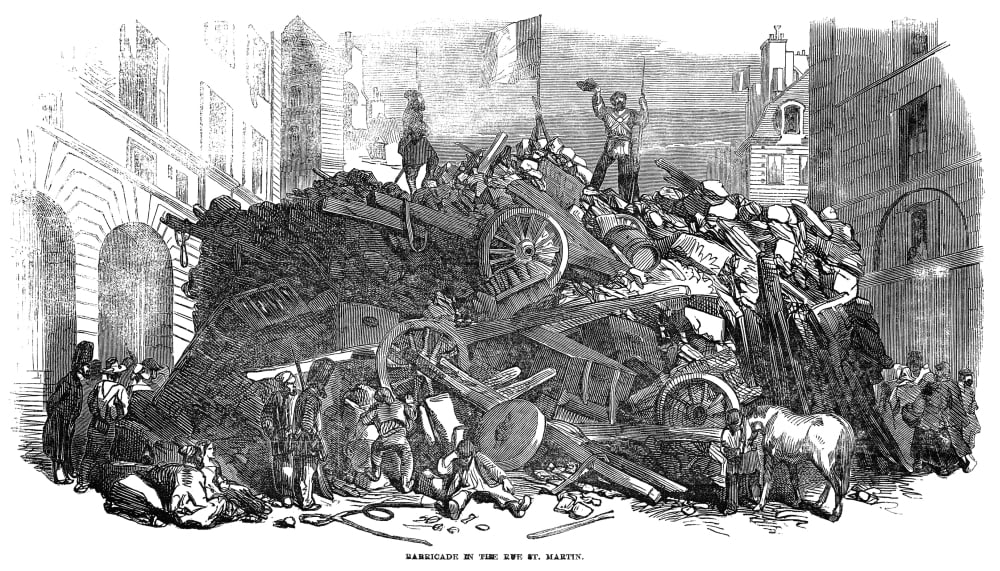
Barricade on Rue St Martin
Episode 7: Storming the Bastille
Living the French Revolution and Age of Napoleon
Dr Suzanne M Desan
Film Review
The storming of the Bastille on July 14, 1789 is celebrated as the start of the French revolution. This fortress was a state prison for the king’s personal enemies, many of whom were imprisoned without trial. Jailers were forbidden to speak to prisoners, who in many cases, were never informed of their crimes. Ironically on July 14th, all but seven had been moved somewhere else.
By July, 1789, economic conditions were so dismal, that Parisians were far more concerned about the price of bread than the workings of their new National Assembly. On July 11, 5000 protestors marched through Paris marched through the city to condemn Louis XVI’s Jacques Necker, viewed as the “people’s protectors” and a strong National Assembly supporter.
On the 14th, journalist and political activist Camille Desmoulins issued a call for Parisians to arm themselves against the 5,000 (mostly mercenary) troops the king deployed outside Paris. In their for arms and ammunition, the Bastille became an immediate target owing to rumors Louis XVI stored gunpowder there.
The fortress was guarded by 30 soldiers and 82 retired military pensioners, many of whom sympathized with the mob. Armed with pikes, axes and a few muskets, a mob artisans, merchants and day laborers sent in a delegation requesting a meeting with the governor (warden), while a small group mounted the roof of a perfume shop immediately adjacent to the the outer wall.
After the Bastille defenders let off one canon shot and a single round of musket fire, the attackers set fire to a load of hay to created a smokescreen. One of the military pensioners joined the rebels, who fired five cannons at the inner gate to break it down. Although the other pensioners dissuaded the governor from blowing up the gunpowder, the attackers eventually killed him and one of the soldiers after he kicked one of them in the testicles. In all 100 attackers were killed and 73 wounded.
On July 15th, the French nobility began fleeing the country en masse. By late July, there were uprisings in Caen, Strasbourg, Bordeaux and Grenoble. Each of the “liberated” cities set up a revolutionary committee to provide governance as well as local militias. The latter came to be known as the national guard. The newly formed commune of Paris chose Lafayette (a former aristocrat who assisted the American colonists in their War of Independence) to lead the Paris national guard.
Anticipating attack by Louis XVI’s troops, they set up barricades in Paris while construction workers began to disassemble the Bastille, this led to the distribution of small stone blocks across France. Lafayette sent a key to the Bastille to George Washington as a souvenir.
On July 16, the king agreed to work with the National Assembly, withdrew his troops from Paris and rehired Necker.
On July 17, he visited Paris, where Lafayette (who favored constitutional monarchy) welcomed him as the “father of the free French.”
Over the next six weeks, the National Assembly wrote the Declaration of the Rights of Man and the Citizen.
Film can be viewed free with a library card on Kanopy.
https://www.kanopy.com/en/pukeariki/watch/video/149323/149337
 The Most Revolutionary Act