
Episode 6: Political Awakening of 1789
Living the French Revolution and Age of Napoleon
Dr Suzanne M Desan
Film Review
Louis XVI’s 1788 decision to call an Estates General to address France’s massive public debt reopened the possibility of power sharing between an absolute monarch and the nobility for the first time in over a century.
Mechanics of Choosing Deputies
Each of the three estates (clergy, nobility and everyone else) met in local assemblies to draw up a list of grievances and chose electors to select deputies to represent them at the Estates General. Although the king agreed to allot Third Estate commoners twice as many deputies as the other two estates, each estate had a single vote on the final proposal they sent the king.
In local assemblies, all men over 25 who paid taxes were allowed to vote on a list of grievances. Except for actors, services and the bankrupt, all adult men were allowed. to vote for deputies. The only women allowed a vote were nuns belonging to the First Estate.
In Paris the Third Estate held their local assembly at the Palais Royal, a shopping arcade belonging to the duke Louis Philippe.* In rural areas, local assemblies met in parish halls and in cities they met in guild halls. Royal censorship had collapsed in 1788 and as the popular assemblies met, thousands of pamphlets were printed to sway popular opinion.
The Grievances
Altogether the three estates came up with 60,000 grievances. The top three were demands 1) for a constitutional monarchy, 2) for the Estates General to meet regularly and 3) for the clergy and nobility to pay more taxes in exchange for return for an advisory role in a representative body.*
The main Third Estate grievances were for 1) a reduction in seigneurial dues, church tithes and royal taxes, equal access (regardless of birth) to professions, an end to the nobility’s monopoly on hunting and fishing, free access to common lands, a reform of the seigneurial courts, an end to the salt tax and end to crop decimation by rabbits and birds owned by feudal lords 2) an increase in midwives and primary schools, 3) a standardization of weights and measures, 4) more uniform and fair systems of justice and taxation and 5) the removal of the toll gates around Paris.
Some Third Estate commoners had competing demands. The guilds wanted an end to guild monopolies to free up commerce. Female flower sellers wanted their guild reinstated to protect their meager earnings.
The Estates General Meets (January 1789)
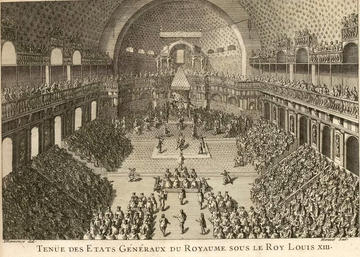
There were 2000 spectators at the opening meeting at the king’s palace at Versailles on May 4, 1789. The king opened the Estates General but didn’t attend after the first day. The First and Second Estate met behind closed doors but the Third Estate opened proceedings to spectators.
Deadlocked over the first procedure (verifying membership), nothing happened for weeks. After persuading poor parish priests to leave the First Estate and join them, Third Estate deputies voted to rename themselves the National Assembly. After rejecting this demand, the king locked them out and they reconvened in an an indoor tennis court. There they committed to draft a constitution creating a constitutional monarchy.
While tacitly agreeing to a new system of consultation, the king simultaneously deployed royal troops on the outskirts of Versailles. In response more clergy and “liberal” nobles joined the National Assembly and refused to disband. As bread riots broke out in Paris and Lyons (France’s second largest city), on June 27th Louis XVI capitulated and directed the other two other estates to join the National Assembly.
*Some of the nobility saw the Estates General to gain back privileges they had lost to an absolute.
**The king’s cousin, Louis Phillipe renounced his title after the revolution.
Film can be viewed free with a library card on Kanopy.
https://www.kanopy.com/en/pukeariki/watch/video/149323/149335
 The Most Revolutionary Act