
Episode 3: France’s Global Commerce and Colonization
Living the French Revolution and Age of Napoleon
Dr Suzanne M Desan
Film Review
One major development contributing to the French revolution was the massive debt (1.5 billion livres) the French government incurred through wars protecting their colonial possessions. In 1789, it eventually tipped France into bankruptcy.
Despite lagging behind the Spanish, Portuguese and Dutch in their colonization efforts, the French eventually latched onto the Dutch invention of joint stock trading companies and global monopolies to facilitate overseas development.
Near Madagascar on the East Coast of Africa they conquered Mauritius and Reunion, which provided coffee and ports of call for ships crossing the Indian Ocean.
In India they became rivals of the English as the Mughal Empire disintegrated. However the French only established fortified trading outposts (as opposed to settler colonies) in India. After the English defeated them in the Seven Years War (aka the French and Indian War) they still retained a few ports on the East coast of India.
By 1700, France was acquiring a third of its textiles and all its spices from India (as the French discarded their woolens for cotton). To protect French textile manufacturers, the French made it illegal in 1686 to import India calico (although traders continued to smuggle it into the country.
Like England and Portugal, France developed a triangular trade involving Africa and the New World. In East Africa they traded cheap Indian cotton, rum, guns and cowrie shells* (from the Maldive islands) for slaves.** They transported the slaves to the French Caribbean colony of Saint Domingue,*** which they traded for sugar, indigo dye and coffee. In this way France provided 40% of Europe’s sugar, 50% of their indigo and 60% of their coffee. They traded their sugar to the Baltic states and Eastern Europe in return for iron, timber and grain.
By the late 18th century, Saint Domingue had 550,000 residents, of whom 30,000 were whites (mostly French). Twenty thousand were (mainly mixed race free people of color.
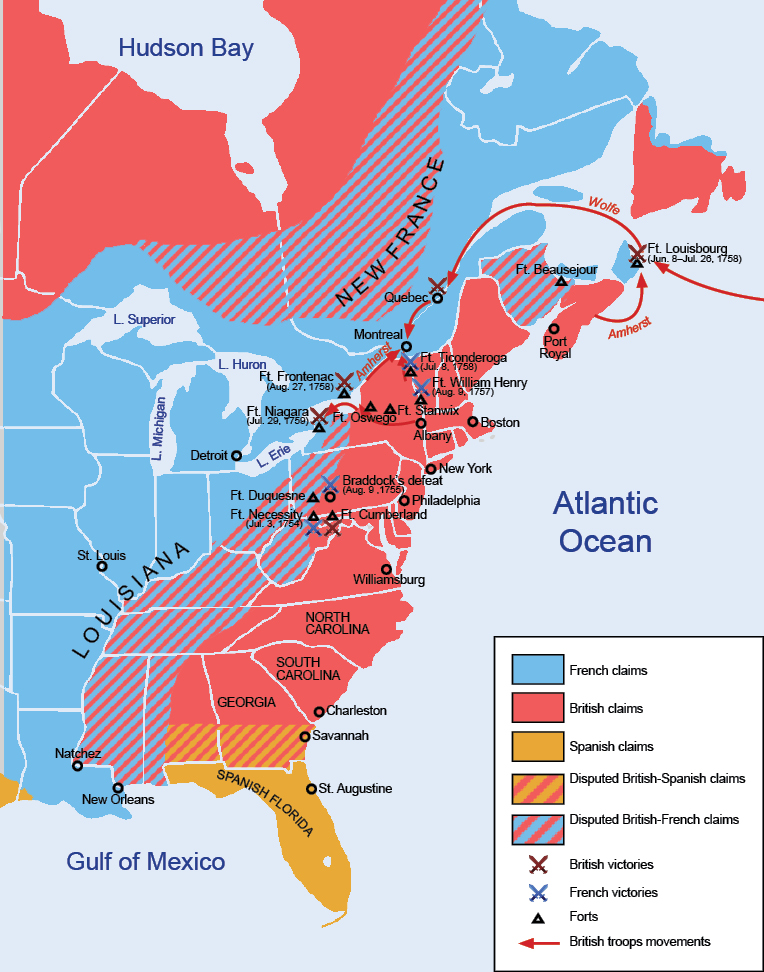
Prior to the French and Indian War, most of the interior US and Eastern Canada was occupied by the France. New France traded timber, dried fish and grain to the Caribbean for slaves and to Europe for manufactured goods.
In the 18th century, wars became global. During the Seven Years War, France, Spain, Austria, Russia and Sweden faced off against the UK, Prussia, Portugal and Hanover. (1756-1763). The France lost all their territories in India, the Caribbean, West Africa, the Atlantic Ocean and Eastern Canada.
The French simultaneously ceded all their territories east of the Mississippi except for St Pierre and Miquelon (off the coast of Newfoundland). They ceded their territory west of the Mississippi (except for New Orleans and Louisiana) to Spain.
*In the Maldives, women divers collected cowrie shells. which were valued as currency by many West African tribes.
**The French philosopher Raynal argued that colonization increased the despotism of kings and human cruelty. He was the first European to campaign to end slavery). His writings led to the formation of a French abolition movement.
***Modern day Haiti and Dominican Republic. By 1700 the, indigenous inhabitants of the island had all died out, allegedly from European diseases.
Film can be viewed free with a library card on Kanopy.
https://www.kanopy.com/en/pukeariki/watch/video/149323/149331
 The Most Revolutionary Act