
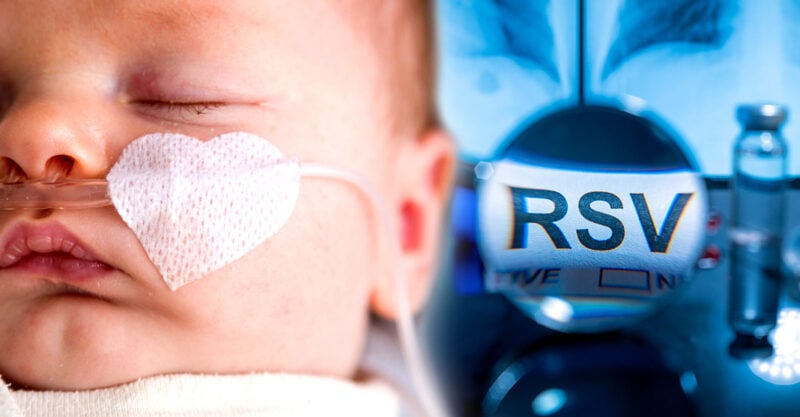
Independent French researchers discovered a significant increase in newborn deaths in France coinciding with the rollout of Beyfortus, a new respiratory syncytial virus shot for infants.
French researchers identified possible safety signals in babies coinciding with the rollout of Beyfortus, a recently approved monoclonal antibody treatment for respiratory syncytial virus (RSV) in newborns.
The discovery comes as public health authorities ramp up warnings about the spread of respiratory viruses and step up their promotion of the drug.
In interviews with The Defender, the researchers — French independent scientist and author Hélène Banoun, Ph.D., and French statistician Christine Mackoi — explained that data from France’s National Institute of Statistics and Economic Studies (INSEE) indicates an improbably high rate of deaths of babies between 2 and 6 days old in France during September and October 2023.
INSEE is the authority that compiles official birth and death data in France.
This increase, the researchers said, coincides with the introduction of Beyfortus in French hospitals, which began on Sept. 15, 2023. In an interview with cardiologist Peter McCullough, M.D., MPH, Banoun said that over 200,000 newborn babies in France have been injected with Beyfortus since that date.
The Centers for Disease Control and Prevention (CDC) recommended Beyfortus in August 2023, while the European Medicines Agency (EMA) authorized the drug in September 2022.
Beyfortus was developed jointly by AstraZeneca and Sanofi.
The drug is offered as a “one-time shot for infants born just before or during the RSV season and for those less than 8 months old before the season starts,” and for some high-risk 8- to 19-month-old infants.
According to The Associated Press, “In the U.S., about 58,000 children younger than 5 are hospitalized for RSV each year and several hundred die.” CNBC reported that “RSV is the leading cause of hospitalization among infants in the U.S.” According to the CDC, nearly all children are infected with RSV before the age of 2.
But the French researchers and other medical experts who spoke with The Defender warned that no long-term studies have been conducted involving Beyfortus and newborns and that the administration of monoclonal antibodies on this population is unprecedented. They also pointed to data indicating RSV’s low risk to babies.
[…]
Excess deaths among newborns ‘alarming,’ ‘disturbing’
Mackoi told The Defender, “There is an excess of deaths for the months of September and October. The excess deaths in October are very alarming. It is very worrisome that this happened in two consecutive months.”
According to Mackoi, the increase in these excess deaths coincides with the introduction of Beyfortus in France.
[…]
Backoi said that using the official INSEE data, which she described as “reliable [but] underestimated,” she “calculated for each month, the rate of babies born the month in question and died between 2 and 6 days of life,” and used a Poisson distribution to identify abnormal mortality rates, compiling the findings on her website.
According to the INSEE data, 54 deaths were recorded for 55,489 births in France in September 2023, despite the average number of expected deaths being 38, based on historical averages.
For October 2023, the data showed 61 deaths out of 57,940 births, despite the average number of expected deaths being 40.
[…]
Monoclonal antibodies may exacerbate symptoms rather than prevent them
[…]
According to Banoun, official data do not indicate that Beyfortus is effective. The data do, however, indicate a high prevalence of adverse reactions — including bronchiolitis — even though the treatment is supposed to protect recipients from respiratory illness.
[…]
Banoun said the trials were not conducted on newborns, whereas the French government recommends injection from the first days of life in the maternity ward.
“According to EudraVigilance, 41 out of 151 adverse events reported concerned bronchiolitis or respiratory distress,” Banoun said, while according to VigiAccess, “104 adverse events were reported, including 57 infections and respiratory disorders.”
Another study, concerning premature babies and newborns suffering from heart or lung disease that compared Beyfortus with monoclonal antibodies previously used on high-risk babies, recorded six deaths — five due to bronchiolitis. Of the six babies that died, five had been treated with Beyfortus.
Yet, “these bronchiolitis cases are not attributed to the treatment by the investigator, who is also the manufacturer of the products,” Banoun said. “All this suggests that nirsevimab [generic name for Beyfortus] could facilitate and aggravate bronchiolitis: these injections take place during periods when the virus is circulating.”
[…]
According to NTD, “Monoclonal antibodies are copies of an antibody that seek out foreign material to destroy them,” but the treatments come with a “risk that the body might trigger a strong reaction to the antibodies.”
Complications may be serious and can include “acute anaphylaxis or life-threatening massive allergic reactions and cytokine release syndrome that can result in organ damage.” This phenomenon, known as antibody-dependent enhancement (ADE), may be connected to the onset of bronchiolitis and other adverse events in babies that have received Beyfortus.
[…]
Banoun also referred to a September 2022 EMA report, which found that during failed RSV vaccine trials in the past, children died of severe bronchiolitis in the vaccinated groups, but none from the control groups died.
“This ADE is due to the deleterious effect of antibodies which, instead of neutralizing the virus, facilitate its entry into the cell via the receptor of the Fc fragment of immunoglobulins. And it’s precisely this Fc region of nirsevimab … that industry has seen fit to modify,” Banoun said.
[…]
Beyfortus administered on newborns despite being tested on older babies
During the clinical trial leading up to approval of Beyfortus by the CDC and the U.S. Food and Drug Administration (FDA), a total of 12 infant deaths were recorded. However, the FDA claimed the deaths were “unrelated” to the antibody.
CNBC reported in June that of the 12 infants, “Four died from cardiac disease, two died from gastroenteritis, two died from unknown causes but were likely cases [of] sudden infant death syndrome, one died from a tumor, one died from COVID, one died from a skull fracture, and one died of pneumonia.”
“Fact-checkers” were quick to respond to any stories indicating that the infants’ deaths were related to Beyfortus, with factcheck.org writing in August 2023, “There isn’t evidence the [Beyfortus] shots have killed any babies, contrary to social media claims.”
But according to Banoun, “According to the HAS and EMA, 11 deaths were reported in the nirsevimab groups, one death in the pavilizumab (former equivalent drug) group and three deaths in the placebo groups. The FDA counted 12 deaths in all treated groups versus three in the placebo groups, not including the one that occurred after the follow-up period.”
“It should be noted that all deaths in the placebo groups concerned premature babies in the Griffin study,” Banoun said. “In trials involving full-term babies, all deaths involved treated subjects.”
Banoun said:
“The FDA has added one death in the placebo groups which occurred after the end of follow-up, but no mention is made of any deaths in the treated groups which occurred after this same period. Similarly, a significant number of babies are withdrawn from the trials and therefore no longer followed up after their withdrawal. This imbalance is therefore potentially more serious than published.”
Other studies also showed infant deaths connected to Beyfortus. McCullough told The Defender, “I am concerned about 3 versus 0 deaths with Beyfortus and placebo respectively in the MELODY trial published in NEJM, 2022.”
[…]
According to Banoun, public health authorities are aware of this discrepancy, noting that in the HAS Transparency Commission’s report on Beyfortus, Sylvie Chevret, M.D., Ph.D., professor of public health and biostatistics at France’s Université Paris Cité, said:
“In these trials, they included children who were essentially said to be in good health, so tomorrow, do you intend to give this drug to all newborns, bearing in mind that the studies did not include newborns?
[…]
‘Expectant mothers should be prepared to resist’ Beyfortus for their babies
Despite these indications and possible safety signals, Banoun said that there has been no reaction so far from public health authorities in France or elsewhere.
“The only reaction to my posts was censorship and a video that was supposed to debunk my claims but actually confirmed them,” she said. “Like all critical scientists, I am censored: strict control over social networks, in particular Twitter, where we have been rendered virtually invisible since December 2023, when the European Digital Commissioner threatened Twitter with heavy fines.”
[…]
Via https://childrenshealthdefense.org/defender/newborns-rsv-shot-beyfortus-death-rate-france/
 The Most Revolutionary Act