
 By
By
Christian Science Monitor
Earlier this year, California Gov. Gavin Newsom announced a new vision for the San Quentin State Penitentiary, centered on rehabilitation and job training, inspired by another prison system that has halved its recidivism rate – in Norway.
The re-imagining of California’s most notorious prison, infamous for housing the nation’s largest death row population, could prove pivotal in how the United States rethinks rehabilitation and staff wellness within prisons.
About 2 out of 3 Americans released from jails and prisons per year are arrested again, and 50% are re-incarcerated, according to the Harvard Political Review. In Norway, that rate is as low as 20%.
U.S. prisons do little to prepare incarcerated populations for their release. Can Norway’s rehabilitation-focused model provide guidance?
As more U.S. states seek to improve their correctional systems, the Norwegian model could prove key. It aims to create a less hostile environment, both for people serving time and for prison staff, with the goal of more successfully helping incarcerated people reintegrate into society.
Why are U.S. prisons in need of reform?
While the United States makes up less than 5% of the global population, its prison system holds approximately 20% of the world’s total prison population. And even though it’s been on a slight decline since 2008, the total population of incarcerated Americans has increased by 500% since 1970, according to The Sentencing Project.
“Overcrowding, violence, and long sentences are common in U.S. prisons, often creating a climate of hopelessness for incarcerated people, as well as people who work there,” says Jordan Hyatt, associate professor of criminology and justice studies at Drexel University.
Correctional employees experience some of the highest rates of mental illness, sleep disorders, and physical health issues of all U.S. workers, a 2018 Lexipol report found.
Nearly 19% of prison workers reported symptoms of post-traumatic stress disorder – a rate six times higher than that found in the general population. Moreover, 100% of correctional officers were exposed to at least one VID (violence, injury, death) event during their career, according to a 2011 survey by the Department of Justice.
So why try Norway’s model?
Making a prison environment more humane will translate to a more efficient prison system overall, experts say. And the Norwegian model prioritizes rehabilitation and reintegration over punishment. Safety, transparency, and innovation are considered fundamental to its approach. Core practices aim to create a feeling that life as part of a community continues even behind walls and bars, says Synøve Andersen, postdoctoral research criminologist at the University of Oslo.
In some Norwegian prisons, incarcerated people wear their own clothes, cook their own meals, and work in jobs that prepare them for employment, says Dr. Andersen. They have their own space, too, since single-unit cells are the norm. “There is a goal to provide people living in a unit together with a shared common space with a kitchen, washer and dryer, and lounging space,” she says.
While critics argue that people in prison should not have access to daily comforts, Dr. Andersen disagrees. “Imprisonment, the deprivation of liberty itself, that is the punishment.”
Instead, while they are separated from society, incarcerated people should experience normal, daily routines so they can have increased opportunities to reform without being preoccupied with fear of violence from other inmates, she argues.
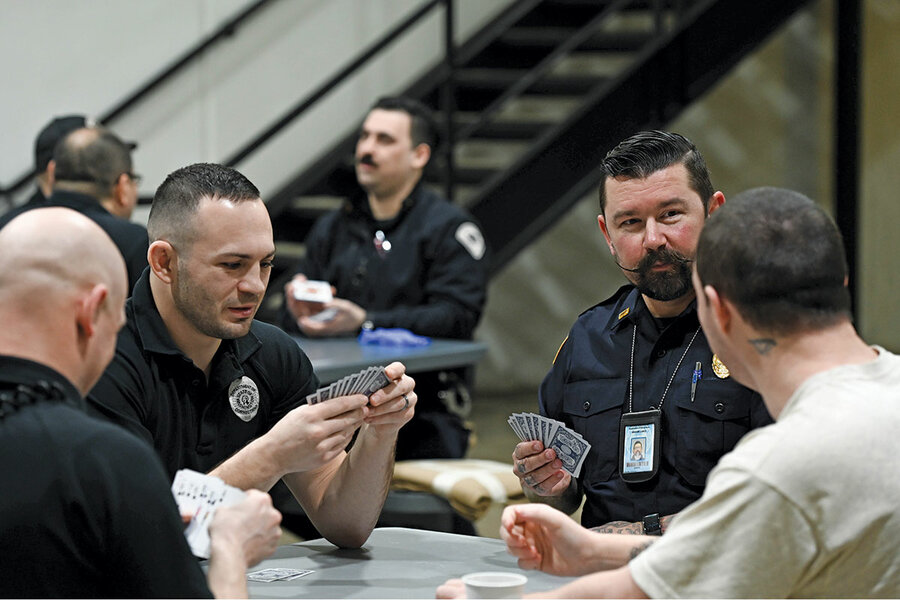
The principle of dynamic security means correctional officers also must have more complex social duties besides safety and security, including actively observing and engaging with the prison population, understanding individuals’ unique needs, calculating flight risks, and developing individualized treatment plans.
Washington state’s Lt. Lance Graham works within restricted housing and solitary confinement units, an environment he says lacks empathy and connection with those incarcerated. “We never had the opportunity to connect with the people in our care.”
But when visiting Norway’s isolation units, he saw their staff was much more engaged with the prison population – and was much happier.
“This program really promotes staff wellness, changing the relationship that you have with the people in your care,” says Lieutenant Graham. “So you’re not going to have as many instances of fight or flight syndrome in your daily work. You reach common ground and talk like normal folks.”
“If you actually want to change the prison environment, invest in staff,” says Dr. Andersen. “They’re there all the time. They’re doing the work.”
Who is trying the Norwegian model?
Amend, a nonprofit from the University of California, San Francisco, partnered with four states – California, South Dakota, Oregon, and Washington – to introduce resources inspired by Norwegian principles and sponsor educational trips to Norway for U.S. correctional leaders.
At California’s San Quentin, Governor Newsom hopes to emphasize inmate job training for high-paying trades such as plumbers, electricians, or truck drivers. His budget proposal allocates $380 million to repurpose a factory into a center for innovation focused on providing social services and breaking cycles of crime. Mr. Newsom aims to complete the project before he leaves office in 2025.
In Washington state, prison staff began developing supportive working relationships with the incarcerated in their care by developing individual rehabilitation plans.
“Basically, we find out as a person, what their goals and interests are and then we work with them on that, which had never really been happening a lot in restricted housing,” says Lieutenant Graham. “So it’s brought massive changes to the state.”
In North Dakota, former Director of Corrections Leann Bertsch says after revamping the training and responsibilities of prison officers, interactions between staff and inmates felt respectful and calmer.
“Instead of getting as many grievances from the resident population, I started getting what we call positive behavior reports on our staff. … I think it really helped shift the culture to one that’s more restorative versus punitive,” says Ms. Bertsch.
The Pennsylvania Department of Corrections collaborated with the Norwegian Correctional Services to pilot Little Scandinavia, a transformed housing unit operated at half the regular capacity to allow for individual cells. The on-duty officers at Little Scandinavia have reported enjoying their work much more now and there haven’t been any reports of violence since its opening in May 2022, says Dr. Andersen.
Norway receives much attention for its low rate of recidivism, but some experts disagree on the measure as a rate of success. “[Recidivism] is not just a product of the correctional system. It has everything to do with your social safety net, your network, your support structure, and your job opportunities,” said Dr. Andersen.
Also, the physical dimensions and layouts of prisons differ drastically between the U.S. and Norway. Instead of large, centralized prisons in the U.S., Norway utilizes a system of small, community-based correctional facilities that focus on rehabilitation and reintegration into society.
While 8% of prisons in the U.S. are private prisons, according to the National Institute of Corrections, all Norwegian prisons fall under the public sector, and some collaborate with nongovernmental and volunteer organizations to provide services to people.
[…]
 The Most Revolutionary Act
Excellent approach!
LikeLike
I’ve been studying the Norwegian system for about five years now, snowhawk72. They don’t even call them prisons, they call them rehabilitation centers, and one of the first things they do is to do thorough medical and psychological assessments to ensure criminal behavior isn’t do to physical (eg head injury) or mental health problems.
LikeLike
Forgot to respond to this, but better late than never …
We have a similar system in Sweden, but it’s a good example of something not working. The prison system is basically an all inclusive holiday in. The inmates get money, education, activities. The food quality and variation is way better than found at schools, hospitals and at elderly care centers. (Often, these old people has to pay for the food themselves, depending on the care type …) Despite that, the inmates sometime complain about the food and even starts hunger strikes. When that happen, some early comments among public are: “Why don’t you swap the food with the old people then …?” “Why complain? You could have avoided your situation, but many of the elders can’t …”
LikeLike
The prison food is also more expensive than the other mentioned, obviously …
LikeLike
I think the main concern in Norway was to reduce the rate of reoffending, which has clearly happened, mainly because now offenders go straight into well-paying jobs on their release. Here in New Zealand, a lot of reoffending occurs because former offenders can’t get into good jobs. There’s also an effort in Norway to identify and treat people with untreated mental and physical illness. Both the US and New Zealand have very poor if any mental health or drug abuse/alcohol treatment. In the US, the vast majority of the mentally ill end up homeless on the street or warehoused in prisons. Keeping people locked up is far more expensive than timely outpatient mental health and substance abuse treatment.
LikeLike