
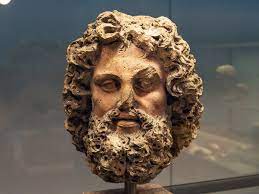
 Etruscan God Tinia
Episode 7 Etruscan Gods and Goddesses
The Mysterious Etruscans
Dr Steven L Tuck (2016)
Film Review
The personalities of Etruscan gods were less confrontational and more collaborative than those of the Greeks and Romans. It was typical of Etruscan gods to
- act collectively for the overall benefit of humanity.
- possess complex identities involving multiple responsibilities.
- appear as amorphous beings prior to to the 6th century BC (when trade between Etruscan cities and Greek colonies intensified), after which most assumed a human appearance like the Greek gods. Some never took on a fully human shape.
In contrast to the 12 Indo-European gods in the the Greek and Roman pantheon, there were nine Etruscan gods.
-
- Tinia (derrived from “tini,” meaning Etruscan) – chief Etruscan god. Like the Greco-Roman Zeus/Jupiter he controlled the sky and weather. Depicted as a massive bearded man dispatching thunderbolts (to symbolize decision making), Tini was also the god of boundaries and the underworld. According to Tuck he is most similar to the Odin, the king of the Norse gods, as well as the god of weather and victory in war. Unlike the impulsively violent Zeus/Jupiter, Tinia always sought consultation from the other gods in council, before using force.**
- Uni – Tinia’s consort and queen of the gods. More like Ishtar than Hera/Juno, Uni was the god of love, fertility and nurturing the young. Her marriage to Tinia was stable, peaceful and mutually supportive (totally unlike the tumultuous marriage between Zeus/Jupiter and Hera/Juno).
- Menvra (comparable to Greek/Roman god Minerva/Athena) – third most powerful god, a virgin who carried a spear and could also shoot thunderbolts. Goddess of war and wisdom. Menvra also nurtures children.
- Ablu – Etruscan equivalent of the Greek/Roman god Apollo.
- Turan (means “female ruler”) – the oldest Etruscan god (still had wings). Also involved in nurturing infants and small children. Possibly equivalent of Aphrodite/Venus but less flighty.
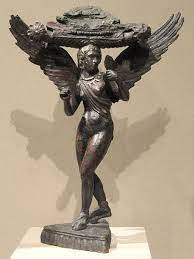 Etruscan god Turan
 - Usul – god of the sun, female when sun rising and male when sun setting.
- Apulu – Etruscan god modeled on the Greek god Apollo after 600 BC
- Veltha – male/female god of vegetation, seas and crops.
- Terms – messenger god like Hermes/Mercury.
* It was also Odin’s role to welcome newly deceased warriors to the underworld. According to Tuck, some elements of Etruscan culture were transmitted to the Vikings via Celts who colonized northern Italy.
Film can be viewed free with a library card on Kanopy.
 The Most Revolutionary Act
Pingback: Etruscan Gods and Goddesses: Similarities and Differences with Greece and Rome | The Most Revolutionary Act | Vermont Folk Troth