

Etruscan funeral procession
Episode 6 Etruscan Burial and Mourning
The Mysterious Etruscans
Dr Steven L Tuck (2016)
Film Review
Tombs of Etruscan elites are decorated with detailed carved depictions of their burial ceremonies. In addition to lying in state and funeral processions, these often involved athletic games, dancers, sacrifices and community-wide ritual meals.
During the processions, priests often dressed as underworld demons* while family members, joined by professional mourners, carried possessions to be buried with the deceased and led the animals to be sacrificed.
The late 4th century saw a marked increase in military and demon imagery in tombs, as the Etruscan continuously lost battles, first to the Greek city of Syracuse and subsequently to the Romans. The Romans began a protracted war against the Etrurian League in 476 BC and by 396 BC had conquered the city of Veii, the only city powerful enough to lead the other 11 city-states militarily.
While only priests engaged in funeral dancing, the funeral games were open to all serious athletes. Animal sacrifice was performed above the tomb to enable the blood to seep into the burial chamber and carry the deceased to the afterlife. Banquets from the meat of the sacrificed animal were shared with the wider community.
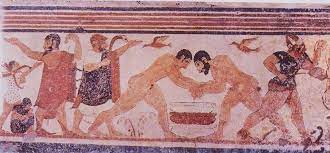 Etruscan funeral games
The painted frescoes in Etruscan tombs feature Greek-style figures, with the head appearing in profile with frontal eyes. The skin tone also follows the Greek convention, with white for women and red for men. Etruscan tombs also display Greek-style human sculptures, in terra cotta, rather than marble, to allow for greater detail in facial expression and hand movements.

Greek profile with frontal eyes
Occasionally the deceased was cremated and the remains stored in elegant ceramic and terra cotta urns. Towards the end of independent Etruscan rule, individualized death masks were fabricated for the deceased, a tradition borrowed by the Romans.
From the third century on (with the decline of the Etruscan aristocracy), women are less prominent in tomb decorations. According to Tuck, women tended to be more esteemed in dynastic monarchies owing to their ability to produce heirs.
*According to the Roman historian Livy.
Film can be viewed free with a library card on Kanopy.
https://www.kanopy.com/en/pukeariki/watch/video/239710/239617
 The Most Revolutionary Act