
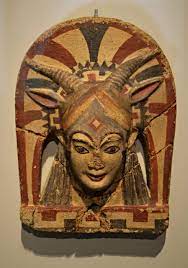
 Etruscan goddess Vamp (origin of English words vamp and vampire)
Episode 5 The Etruscan Afterlife
The Mysterious Etruscans
Dr Steven L Tuck (2016)
Film Review
Most details about Etruscan civilization come from the writings of Roman historians, including Cicero and the emperor Claudius.
Like the Sumerians (as portrayed in the epic of Gigamesh), the Etruscans believed the deceased voyaged across the sea to an island paradise. In early civilization, it was fairly typical for the deceased to cross rivers to reach Paradise. In the Bible, four rivers surround the Garden of Eden. Five rivers, including the River Styx, border the Greek afterlife.
Etruscans traveled to their afterlife on the back of a hippocampus, aea monster with a horse’s head and neck and a fish’s body. They were guided by an winged Etruscan deity known as Vamp (origin of the English words vamp and vampire).
The Etruscans’ afterlife featured, dancing, music, athletic games, feasting, flowers that bloomed year-round and weather that was never rainy or cold. There were no buildings, crops, roads, government, religion or crafts in the Etruscan afterlife.
The Greek philosopher Pythagoras, who founded a famous school in the Greek colony of Cronton in southern Italy, described the Etruscan afterlife as a place of “ideal peace and harmony.” According to Tuck, as the Etruscans adopted aspects of the Greek underworld, it lost if color and was filled with mists.
Hate (Hades) and Persepne (Persephone), the Greek king and queen of Hades, appear in Etruscan mythology after the fourth century. Likewise serpents and demons appear in afterlife depictions in Etruscan tombs. This seems to reflect an increased atmosphere of chaos and pessimism stemming from continual military attacks from Greece and Rome.*
After the fourth century BC, Keru waits at the entrance to the afterlife, along with Vamp. He and various monsters and demons holding snakes try to block admittance to people who don’t belong there.**
In some depictions, the Etruscan Scylla (an attractive woman with a dolphin tail with vicious dogs sprouting from her waist) also guards the afterlife entrance.
*Etruria’s military downfall began in 474 BC, when they allied with Athens to declare war on Syracuse. This led to reprisal attacks on numerous Etruscan cities. In 350 BC they also lost a battle against the Celts in Italy’s northern Po Valley.
**This may stem from Hades’ kidnapping (in Greek mythology) of Persephone and dragging her to the underworld before her time.
Film can be viewed free with a library card on Kanopy.
https://www.kanopy.com/en/pukeariki/watch/video/239710/239619
 The Most Revolutionary Act
Pingback: The Etruscan Origin of the Words “Vamp” and “Vampire | The Most Revolutionary Act | Vermont Folk Troth