
 Episode 4 Etruscan Cities of the Dead
The Mysterious Etruscans
Dr Steven L Tuck (2016)
Film Review
Because all the important Etruscan cities are buried under more recent Roman cities, most of the information about Etruscan culture comes from their elaborate tombs.
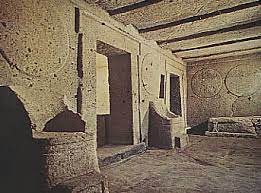
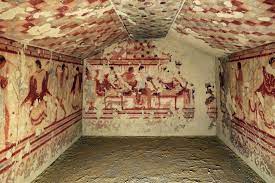
It was common for Etruscans to bury their dead in extended families, constructing a an entire necropolis (“city of the dead”) for them. It’s common to find an entire underground city in an Etruscan tomb, consisting of roads, drains and individual houses with roof beams and support joists carved out of stone, as well as elaborate multicolored frescoes.
 Most of the necropoleis feature Aolic (early Near East) architecture introduced to the Italy via the Phoenicians and the Greek colony of Syracuse (modern day Sicily).
The tombs show a level of women’s equality not found elsewhere in the Mediterranean, with married couples laid out together in paired beds or lounging together on a dining couch.*
Other tombs feature shields and armor (initially reflected a protracted war with Greece and later with Rome) stone-carved chairs with footstools similar to those adopted by Roman priests and magistrates. Tuck believes these tombs reflect the rise of “citizen soldiers” and elected governments starting in the 6th century BC. As increasing trade spread economic wealth throughout the Mediterranean, Etruscan cities overthrew their kings and tyrants to become more democratic and egalitarian. Later tombs reflect the replacement of elegant individual villas with communal townhouses.
One quarter to one third of Etruscan tombs identify female heads of households.
Some necropoleis depicted entire city blocks and detailed carved reliefs and ornately painted frescoes of everyday Etruscan life. life.
*The Greeks were amazed that Etruscan men and women seemed to enjoy spending time together.
**In 474, The Etruscans attacked the Greek colony of Cumae. Supported by Syracuse, the Greeks prevailed and the Etruscans lost all their colonies south of the Tiber River.
*in 348 BC, the Etruscans were defeated at Capua, resulting in the Roman occupation of southern Etruria.
Film can be viewed free with a library card on Kanopy.
https://www.kanopy.com/en/pukeariki/watch/video/239710/239615
 The Most Revolutionary Act