
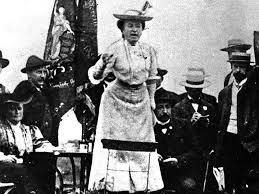
 Episode 9: Rosa Luxemburg: A Revolutionary Martyr
The Rise of Communism from Marx to Lenin
Dr Vejas Gabriel Liulevius (2019)
Film Review
“The most revolutionary act is a clear view of the world as it really is.” – Rosa Luxemburg
Kaiser Wilhelm was overthrown two days before the November 11 armistice, following a major naval mutiny. The Germany monarchy was replaced by a parliamentary republic (Weimar Republic). This was a very positive sign for Lenin, who believed that without revolution in Germany, the Bolshevik revolution would collapse.
Rosa Luxemburg was a Polish-German socialist in the Russian part of Poland, a very turbulent society that experienced recurrent popular uprisings in its struggle to achieve independence from Germany and Russia.
She believed socialism had to come about from spontaneous popular revolt and totally rejected the imposition of communism on workers by a vanguard elite. She first learned about Marxism while attending university in Switzerland, where she earned a doctorate in law and political economy. With her lover, she founded the Social Democracy of Poland, which was divided over whether to fight for Polish independence or world revolution. After her expulsion from the Second International (for her instance that internationalism should take precedence over nationalist struggles*), she moved to Germany to work with the world’s most advanced socialist movement.
She was famous for her battles with Lenin and other socialist leaders over her opposition to “democratic centralism,” which she warned would lead to despotism. Aiming to be the female Marx, in 1913 she published the Accumulation of Capital. As head of the left wing of the German Social Democratic Party (SPD), she called for mass worker strikes in achieving the downfall of capitalism.
She was first arrested after hurrying back to Warsaw to play some role in Russia’s 1905 revolution. On her release from prison, she returned to Germany to teach at the newly founded SPD school. She spent another two months in a German prison in 1907 on a charge of inciting violence.
She split with the German SPD in 1914 when they voted to support Germany’s war with Russia and Western Europe and formed the International Group with her lover Karl Liebknect. While she and Liebknecht were in prison for their antiwar activities, their followers founded the Spartacus League. On house arrest following her release, she was sentenced to three years in prison for her role in founding a revolutionary shop steward movement.
After the October revolution, she expressed grave reservations about the Bolsheviki coup in Russia. As Germany itself moved towards revolution, there were briefly two rival governments, the German Democratic (Weimar) Republic run by Philip Schneidermann and the radical socialist government run by Liebknecht from the Kaiser’s former palace. His government organized workers councils and Red armies while Schneidemann hired fanatical veterans as sniper, who named themselves the Freikorps. Renaming themselves the Communist Party (KDP), the Spartacus League organized a Red Army to do battle with the mercenaries.
Luxemburg herself remained extremely critical of the Bolshevik terrorism carried out by the Russian secret police and favored holding elections prior to establishing a communist government in Germany. On January 15, 1919 the Freikorps kidnapped and murdered Luxemburg and Liebknecht, ultimately crushing Germany’s revolution by May 1919.
Deep divisions between the SDP and KDP persisted, preventing the two arms of Germany’s socialist movement from uniting against the Nazis.
*Marx opposed colonial efforts to achieve independence.
Film can be viewed free with a library card on Kanopy.
https://www.kanopy.com/en/pukeariki/watch/video/11239598/11239621
 The Most Revolutionary Act
Pingback: Who Was Rosa Luxemburg? | Worldtruth