
 Episode 8: World War I as a Revolutionary Opportunity
The Rise of Communism from Marx to Lenin
Dr Vejas Gabriel Liulevius (2019)
Film Review
According to Liulevius, it took the “breakdown of civilization.” (ie World War I) to bring socialists into government for the first time. The Second International, founded in 1889, was committed to preventing war. However the first world war would irreparably fracture the socialist movement because too many members were patriots. Only Russian socialists declined to fund the war. In contrast German socialists, who really hated Russia, thought conquering the Russians would enable them to set Russian workers free.
In 1912, the German Social Democratic (SDP) party voted to support the German government if they declared war. In Italy, socialist Mussolini was imprisoned for his campaign opposing Italy’s imperialist war in Libya.
Lenin denounced the decision by the Russian SDP to support the war and dropped his SDP membership to become a communist. In contrast, Mussolini dropped his opposition to war and enlisted in the Italian army in 1915.
In Germany, Rosa Luxemburg and her partner Karl Liebknecht split from the German SDP over the war issue and organized the Spartacus League. Luxemburg was in jail at the time for urging German soldiers to resist conscription.
In 1915, two dozen antiwar socialists (including Trotsky and Lenin) met in Switzerland and made plans to dissolve the Second International. A Menshevik before the war, Trotsky fled to Switzerland, France, Spain to escape arrest before ending up in New York.
In February 1917, Russia had a second revolution instigated by women marching to demand bread for their children. Russian troops sent to disperse the march ended up joining it. After another massive round of strikes, Nicholas II abdicated and the Duma formed a provisional government. The latter was slow to implement reforms, arguing the need for properly elected representatives before undertaking major political initiatives.
There followed a period of dual power between the Petrograd central soviet and the Duma.
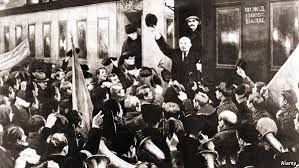
Lenin’s fellow exile Alexander Parvus approached German security forces about organizing a special train for Lenin and 31 fellow revolutionaries to transit Germany to return to Russia. German security cleared all the platforms of the stations Lenin’s train tranited, and both police and army officers were forbidden to board to check passports and identification papers.
The journey took Lenin and his Bolshevik comrades across the Baltic Sea to Finland (then part of Russia), where they boarded a second train to Petrograd. On being greeted by a rapturous crowd of Bolsheviks, he gave a short speech promising them peace (an end to their war with Germany*) and land.
*The Russian capitol St Petersburg was renamed Petrograd at start of World War I because it sounded less German.
*Russia had mobilized 12 million men for the war between Germany/Turkey and the other European powers. Owing to Russia’s limited industrial capacity, many were sent to the front without rifles.
 The Most Revolutionary Act
Pingback: Who Was Rosa Luxemburg? | Worldtruth