
Internationalist 360°
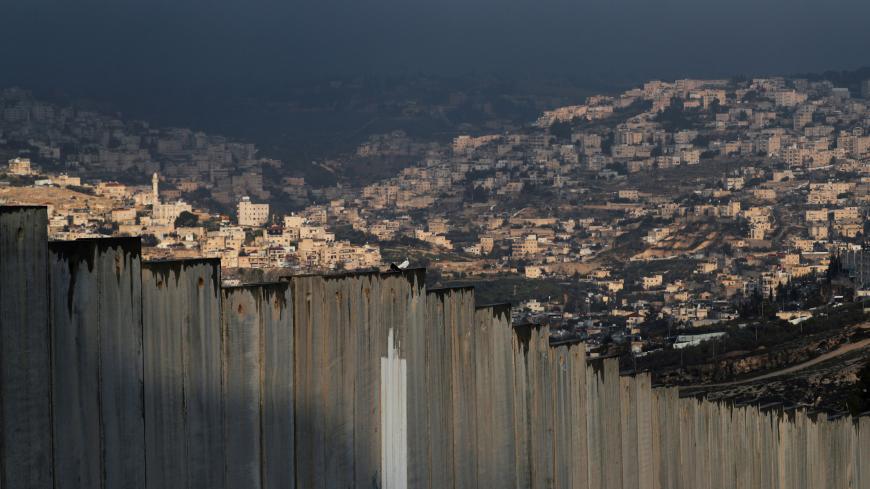
A general view shows the Israeli barrier and, behind it, East Jerusalem neighborhoods, Jan. 29, 2020. REUTERS/Ammar Awad
The ‘two states’ idea remains as a barrier to building an anti-apartheid movement, as is our duty under international law to dismantle a racist regime, just as was done in South Africa.
The persistent myth of a ‘two-state’ solution for Israeli-occupied Palestine is a cruel, 75-year-old lie which has provided cover for the construction of a monstrous and genocidal apartheid regime. It blinds the international community to both the current reality and to the way forward.
UN resolutions on Palestine are badly outdated, frozen in a time where the ‘two states’ myth was more plausible and locked into a wording acceptable to the colony’s chief sponsors. Yet the only practical way forward, today, is the South African road: dismantling the apartheid regime.
That road is obscured by the ‘two states’ myth, as two former Israeli leaders have observed. Former Israeli Prime Minister Ehud Olmert (2007) recognised that “if the day comes when the [idea of a] two-state solution collapses and we face a South African-style struggle for equal voting rights”, then we will face an “apartheid-like struggle … [and] the State of Israel is finished” (McCarthy, 2007). Similarly, in 2017, another former Israeli PM, Ehud Barak, warned that the regime was “on a slippery slope” towards apartheid (Kaplan, 2017).
Although the idea of ‘two states’ is embedded in UNSC resolutions – beginning with UNSC Resolution 242 of 1967 – that fact only highlights the failure of international resolutions to recognise changing realities. The Israelis have breached their obligations under Resolution 242 and there are now multiple independent reports branding the Israeli regime an apartheid state (CCHS, 2022) and therefore a crime against humanity, which the international community has a responsibility to dismantle (Falk and Tilley, 2017). Those reports are not yet recognised at the UN because key sponsors of the Israeli regime maintain veto power.
[…]
It is argued here that the “two-state solution” and the idea of a “return to 1967 borders” is misleading and obscures the current reality and the likely future of Palestine, for these reasons:
• The ‘two-state’ notion holds a fig leaf over the reality of a single apartheid regime;
• All the conditions set up by the UNSC (res. 242 and its successors) for a “return to 1967 borders” have been destroyed by the Israeli regime;
• The apartheid Israeli regime must be dismantled, because a predatory, ethnic cleansing regime cannot co-exist with an independent Palestine.
Yet, as Washington and the Israelis understand very well, the distraction of ‘two states’ hides apartheid and prevents the construction of a broad anti-apartheid movement.
Any remaining possibility of ‘two states’ was finally destroyed by the constant Israeli theft of Palestinian land and the refusal to vacate annexed Lebanese and Syrian land. The idea of a “return to 1967 borders” simply hides the reality of an illegitimate apartheid regime.
A fig leaf to cover apartheid
[…]
The founders of the Zionist colony wanted all of historic Palestine, or as much as they could seize. Zionist pioneer, the Austrian Theodor Herzl, said the Jewish colony would be part of “a rampart of Europe against Asia, an outpost of civilization as opposed to barbarism. We should as a neutral State remain in contact with all Europe, which would have to guarantee our existence” (Herzl 1896).
The majority view of a UN report on the ‘Future Government of Palestine’ (which did not include any Palestinians) formed the basis of UNGA resolution 181, which recommended the creation of an Arab state, a Jewish state and a ‘Special Regime’ of international status for Jerusalem (UNGA,1947). The population of Palestine in 1946 was 65% Arab and 33% Jewish, but the committee recommended that the area for the Jewish state be 55.5% of the total area of Palestine.
Resolution 181 passed on 29 November 1947 with 33 votes in favour, 13 against and 10 abstentions (Hammond 2010; UNGA 1947), and the British and the UN left the Zionist groups to carry out their ethnic cleansing (Pappe 2006). Contrary to popular myth, the UN did not “create” an Israeli state; UN members simply stood back and allowed the Zionists to seize land and purge entire populations.
In 1947-48, David Ben Gurion and his disciples were very clear that in creating their entity they would destroy entire villages, wipe out all resistance and expel the Arab populations “beyond the borders of the state” (Pappe 2006: Ch.4). Ben Gurion believed 80-90% of the British mandatory territory was needed, and in 1947 declared that ‘only a state with at least 80% Jews’ would be ‘a viable and stable [Jewish] state’. His plans called for the killing of Palestinian political leaders, senior officials, inciters and financial supporters, the damaging of transport, water wells, mills, villages, clubs and cafes and expulsion of remaining Arab populations (Pappe 2006: xii-xiii, 26, 28, 48).
In 1988, as the first Intifada (uprising) was raging, Palestine Liberation Organisation (PLO) leader Yasser Arafat announced the PLO had accepted UN Resolutions 242 and 338, which seemed to grant “Israel” (actually “every state in the area”) an opportunity to “secure and recognised boundaries”, effectively recognising an Israeli state, so long as it withdrew its occupation of Arab lands (Damen 2022).
The Oslo Accords of the 1990s, based on resolution 242 (UNIP, 1993: Art 1), raised hopes, but what followed showed that the Israelis had used these agreements as a cover for the expansion of illegal “settlements” in the occupied territories (Damen 2022). The Palestinian Authority (PA), set up as a temporary body, pending the establishment of a Palestinian state (PASSIA, 2014: 4-5), then became effectively a municipality of the Israeli regime.
Yet the annexation of Palestinian land on the West Bank and in East Jerusalem actually increased under the Oslo regime (Damen 2022). Despite Israeli PM Rabin’s claim to ‘freeze’ the ‘settlements’, they grew due to a burst of investment in infrastructure (Helm, 1993; Ogram, 1995; Ofran, 2020). Palestinians actually lost more land after recognition of the expanding Israeli regime and the creation of the PA.
[…]
International law? Conditions for a ‘return to 1967 borders’ have been destroyed by the Israelis
International law (Res. 242 and its successors) is often cited to justify the right of the Israeli regime to exist, ignoring the Israeli breaches of its obligations to withdraw from occupied land and ignoring the fact that they have never defined borders. All conditions set up by Res 242 (1967) for a “return to 1967 borders” have been systematically destroyed by successive Israeli regimes, with the support of their Anglo-American and European sponsors.
After the Zionist surprise attack on Arab states in 1967, and the occupation of the Palestinian West Bank, East Jerusalem, the Syrian Golan, parts of South Lebanon and the Egyptian Sinai, UN resolution 242 (1967) was passed with Israeli support because, while it called for an Israeli withdrawal from occupied territories, it also called on the Arab states to recognize an Israeli regime, under certain conditions.
The relevant text of UNSC resolution 242 called for:
“(i) Withdrawal of Israeli armed forces from territories occupied in the recent conflict;
“(ii) Termination of all claims or states of belligerency and respect for and acknowledgment of the sovereignty, territorial integrity and political independence of every State in the area and their right to live in peace within secure and recognized boundaries free from threats or acts of force” (UNSC, 1967).
Since that time, the Zionist entity (as it is called by the many Arab and Muslim states which do not recognise this entity as a state) only withdrew from the Egyptian Sinai (after a bilateral peace deal), then invaded Lebanon to destroy the PLO. Even after the Israelis were expelled from Lebanon (in 2000 and 2006) by the resistance group Hezbollah, they held onto some Lebanese lands, the Syrian Golan, and then proceeded to consolidate their annexation of large parts of the West Bank and East Jerusalem.
The Israeli regime has violated the conditions of Res 242 so severely that it is arguable their suggested “right to live in peace within secure and recognised boundaries” has been abrogated; they never even tried to declared borders on their several frontier extensions. They similarly ignored UNGA Resolution 194 (1948) to allow Palestinian refugees a right to return. More importantly, the international branding of the Israeli state as an apartheid regime threatens to remove any state ‘rights’, other than the duty to dismantle apartheid (Falk and Tilley, 2017).
Though there was some internal debate, the Israelis never intended to vacate the lands they occupied in 1967. The liberal side debated whether they should permanently seize between 40% and 80% of the West Bank, while the openly fascist faction, led by Likud and Netanyahu, always wanted it all. The latter argument is often referred to as the ‘Yinon Plan’ (Yinon, 1982), a reiteration of older Zionist ambitions to create a ‘Greater Israel’, from “from the Brook of Egypt [the Nile River] to the Euphrates” (Herzl 1960: 711). This implies annexation of much more Syrian territory, beyond the Golan.
[…]
Via https://libya360.wordpress.com/2023/11/03/palestine-beyond-the-two-states-myth/
 The Most Revolutionary Act
Pingback: Palestine: Beyond the ‘Two States’ Myth | Worldtruth
Pingback: American-Israeli Anthropologist: “We Are All Being Palestinized” | Worldtruth