
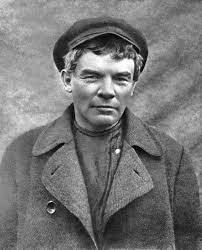
 Lenin disguised with a wig to escape the secret police
Episode 6 The Making of Lenin
The Rise of Communism from Marx to Lenin
Dr Vejas Gabriel Liulevius (2019)
Film Review
Lenin was born Vladimir Ilyanov Ilyich to a middle class family in 1870. His father was a hard working school inspector who ultimately achieved the status of lower nobility. However following an older brother’s execution (as a terrorist) while a student in St Petersburg, the family was totally ostracized socially.
Lenin became a Marxist in 1889. Despite radical activities that led to his expulsion from Khazan Imperial University, he completed a law degree and worked as a public defender (in St Petersburg) while secretly participating in radical politics. Liulevius describes him as a disciplined and obsessively driven scholar and organizer, who spent most of his time studying, writing and annotating a number of international newspapers. Unlike his Marxist colleagues, he rarely smoked or drank and exercised daily “to be “eady for the revolution.”
Under continual secret police surveillance for his involvement with the Russian Social Democratic Party, in 1895 he traveled to Switzerland to meet with the socialist leader-in-exile Plekahanov.* He would be arrested later that year for his political activities and sent to Siberia. There he met and married a teacher and fellow revolutionary and wrote The Development of Capitalism in Russia. They went into exile following their release, with a brief stay in Munich and London before ending up in Switzerland.
There he worked with Plekanov on the Iskra (The Spark), the radical newspaper they smuggled into Russia. While in Switzerland, Lenin wrote What is to Be Done, which advocates for a new party that is more exclusive and less bureaucratic than the SPD. Lenin believed this elite vanguard was essential to lead workers into revolution. Without a vanguard, he argued, they were too likely to settle for short term gains rather than dismantling capitalism.
The new party he proposed would employ democratic centralism. In other words, it would allow massive debate until the central leadership made a decision. At that point, it would require total compliance. According to Liulevius, Lenin borrowed these ideas from 19th century Russian Nihilists and Narodniks, rather than Marx.
Lenin went on to force a major split in the Russian Social Democratic Party (SPD). Even though his supporters comprised only a minority of the SPD, he ingeniously named them the Bolsheviks (meaning majority) and his opponents the Mensheviks (meaning minority). The main difference between the two was that Bolsheviks no longer believed a society had to industrialize before true revolution was possible. Lenin also successfully portrayed the Mensheviks as sectarian splitters to distract from his own factional tactics.
In 1912 Bolshevik-Menshevik divide became permanent.
At a time when the czar had 20,000 secret police operating internationally, the Bolsheviks were hunted, arrested, with 17 executed prior to the October revolution. According to Liulevius, the Bolsheviks’ understandable paranoia had a major effect on their behavior. At one point, four out of five of the central committee members were police infiltrators. The czarist police were also extremely skilled at psychological operations, publishing the fraudulent anti-Semitic Protocols of the Elders of Zion just prior to World War I.
Lenin perfected his theory of revolution to include temporary land reform in a effort to win over the peasants, who strongly favored the non-Marxist Socialist Revolutionary party.
Film can be viewed free with a library card on Kanopy.
 The Most Revolutionary Act