
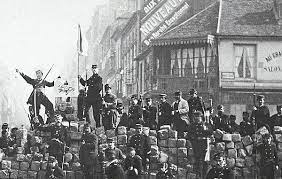
 Episode 3 The 1871 Commune as a Model of Revolt
The Rise of Communism from Marx to Lenin
Dr Vejas Gabriel Liulevius (2019)
Film Review
According to Liulevius, the main trigger for the revolution leading to the 1871 Paris Commune was the 1870 war Emperor Louis Bonaparte (Napoleon’s nephew) declared on Prussia.
Prussia defeated France handily, capturing Bonaparte and his entire army and imprisoning them in Prussia. In the emperor’s absence, the Third French Republic was declared in September 1870. This Prussian government laid siege to France’s provisional government for four months, forcing the residents of Paris to eat cats, rat salami and even zoo elephants. When the French provisional government ultimately surrendered in January 1871, the Prussians demanded all of Alsace and a third of Lorraine as reparations.
In February 1871, a new National Assembly was convened as 30,000 Prussians marched down the Paris Champs Elysées. When the provisional president sought to disarm the voluntary citizen-led National Guard, the latter (concerned the president would restore the monarchy), chased off the French army, instigating a riot in which the mob killed two military officers.
When the terrified the provisional government pulled out of Paris and moved to Versailles 11 miles away, rich Parisians followed them, and the national guard installed themselves in charge of Paris. Both sides seized hostages, and nearly 299 communard hostages were shot. Meanwhile pétroleuses (women arsonists) set fire to major buildings to slow the advance of French troops.
In all 20,000 Parisians were killed, 36,000 Parisians were arrested and 7,000 were deported to French colonies in the South Pacific. The French army lost 750 troops.
Although only a handful of the rebels were Marxist, the global elite blamed him for the revolt and he became famous overnight.
In 1872, Marx moved the First International to New York (mainly to escape the influence of Bakunists and European socialists who disagree with him), where it withered and collapsed in 1876.
His years after 1876 were extremely grim and he suffered from depression. His wife died in 1881 and he himself in 1883. Engels, who lived to 1895, willed his wealth to Marx’s two daughters, who eventually committed suicide.
Film can be viewed free with a library card on Kanopy.
https://www.kanopy.com/en/pukeariki/watch/video/11239598/11239607
 The Most Revolutionary Act