

The Taliban government in Afghanistan – the nation that until recently produced 90% of the world’s heroin – has drastically reduced opium cultivation across the country. Western sources estimate an up to 99% reduction in some provinces. This raises serious questions about the seriousness of U.S. drug eradication efforts in the country over the past 20 years. And, as global heroin supplies dry up, experts tell MintPress News that they fear this could spark the growing use of fentanyl – a drug dozens of times stronger than heroin that already kills more than 100,000 Americans yearly.
THE TALIBAN DOES WHAT THE US DID NOT
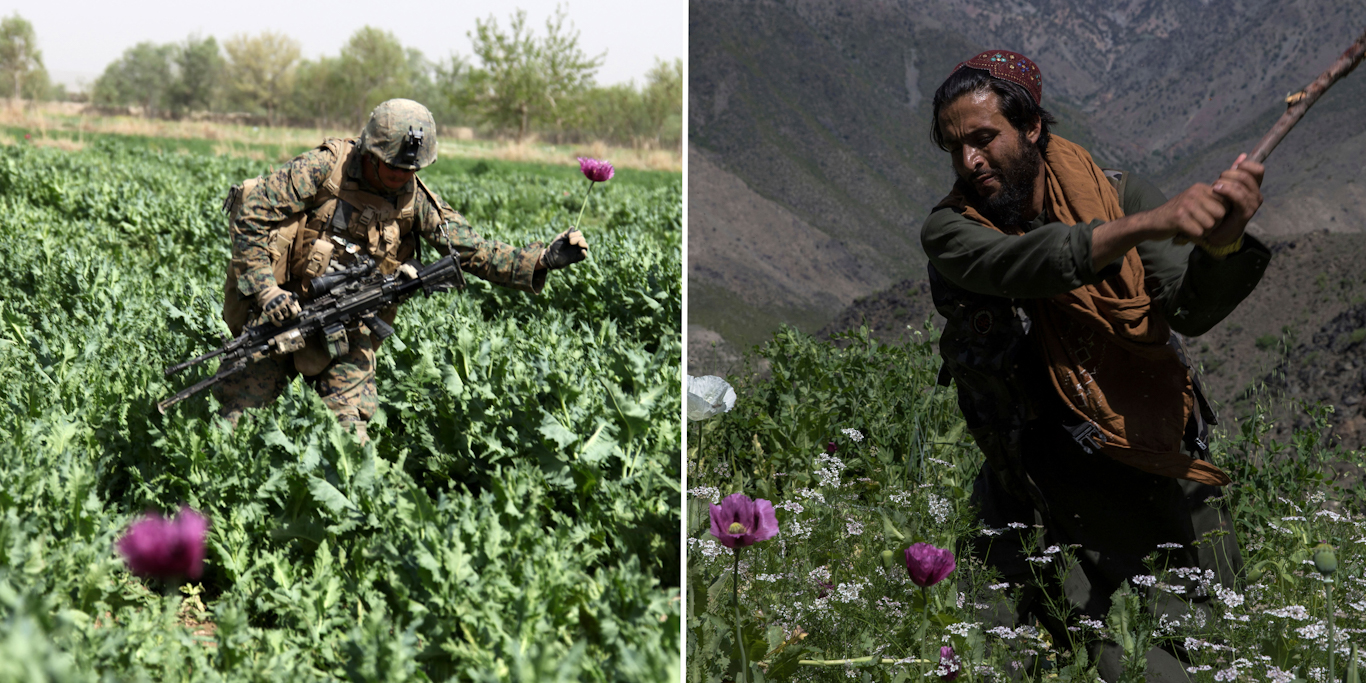
It has already been called “the most successful counter-narcotics effort in human history.” Armed with little more than sticks, teams of counter-narcotics brigades travel the country, cutting down Afghanistan’s poppy fields.
In April of last year, the ruling Taliban government announced the prohibition of poppy farming, citing both their strong religious beliefs and the extremely harmful social costs that heroin and other opioids – derived from the sap of the poppy plant – have wrought across Afghanistan.
It has not been all bluster. New research from geospatial data company Alcis suggests that poppy production has already plummeted by around 80% since last year. Indeed, satellite imagery shows that in Helmand Province, the area that produces more than half of the crop, poppy production has dropped by a staggering 99%. Just 12 months ago, poppy fields were dominant. But Alcis estimates that there are now less than 1,000 hectares of poppy growing in Helmand.
Instead, farmers are planting wheat, helping stave off the worst of a famine that U.S. sanctions helped create. Afghanistan is still in a perilous state, however, with the United Nations warning that six million people are close to starvation.
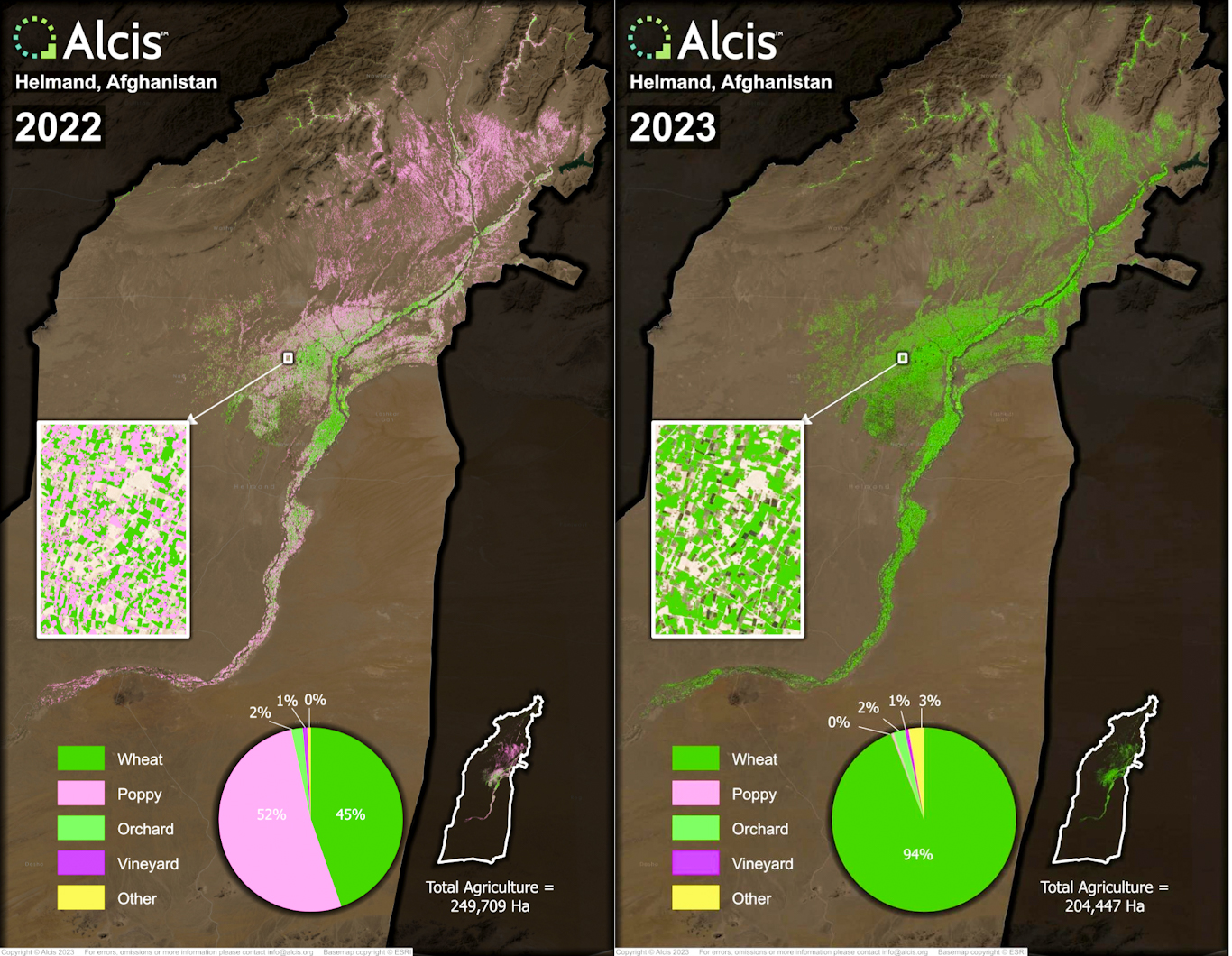
The Taliban waited until 2022 to impose the long-awaited ban in order not to interfere with the growing season. Doing so would have provoked unrest among the rural population by eradicating a crop that farmers had spent months growing. Between 2020 and late 2022, the price of opium in local markets rose by as much as 700%. Yet given the Taliban’s insistence – and their efficiency at eradication – few have been tempted to plant poppies.
The poppy ban has been matched by a similar campaign against the methamphetamine industry, with the government targeting the ephedra crop and shutting down ephedrine labs across the country.
A LOOMING CATASTROPHE
Afghanistan produces almost 90% of the world’s heroin. Therefore, the eradication of the opium crop will have profound worldwide consequences on drug use. Experts MintPress spoke to warned that a dearth of heroin would likely produce a huge spike in the use of synthetic opioids such as fentanyl, a drug the Center for Disease Control estimates is 50 times stronger and is responsible for taking the lives of more than 100,000 Americans each year.
“It is important to consider past periods of heroin shortages and the impact these have had on the European drug market,” the European Monitoring Center for Drugs and Drug Addiction (EMCDDA) told MintPress, adding:
Experience in the E.U. with previous periods of reduced heroin supply suggests that this can lead to changes in patterns of drug supply and use. This can include further an increase in rates of polysubstance use among heroin users. Additional risks to existing users may be posed by the substitution of heroin with more harmful synthetic opioids, including fentanyl and its derivatives and new potent benzimidazole opioids.”
In other words, if heroin is no longer available, users will switch to far deadlier synthetic forms of the drug. A 2022 United Nations report came to a similar conclusion, noting that the crackdown on heroin production could lead to the “replacement of heroin or opium by other substances…such as fentanyl and its analogs.”
“It does have that danger in the macro sense, that if you take all that heroin off the market, people are going to go to other products,” Matthew Hoh told MintPress. Hoh is a former State Department official who resigned from his post in Zabul Province, Afghanistan, in 2009. “But the response should not be reinvade Afghanistan, reoccupy it and put the drug lords back in power, which is basically what people are implying when they bemoan the consequence of the Taliban stopping the drug trade,” Hoh added; “Most of the people who are speaking this way and worrying out loud about it are people who want to find a reason for the U.S. to go and affect regime change in Afghanistan.”
There certainly has been plenty of hand-wringing from American sources. “Foreign Policy,” wrote about “how the Taliban’s ‘war on drugs’ could backfire;” U.S. government-funded “Radio Free Europe/Radio Liberty” claimed that the Taliban were turning a “blind eye to opium production,” despite the official ban. And the United States Institute of Peace, an institution created by Congress that is “dedicated to the proposition that a world without violent conflict is possible,” stated emphatically that “the Taliban’s successful opium ban is bad for Afghans and the world”.
This looming catastrophe, however, will not hit immediately. Significant stockpiles of drugs along trafficking routes still exist. As the EMCDDA told MintPress:
It can take over 12 months before the opium harvest appears on the European retail drug market as heroin – and so it is too early to predict, at this stage, the future impact of the cultivation ban on heroin availability in Europe. Nonetheless, if the ban on opium cultivation is enforced and sustained, it could have a significant impact on heroin availability in Europe during 2024 or 2025.”
Yet there is little indication that the Taliban are anything but serious about eradicating the crop, indicating that a heroin crunch is indeed coming.
A similar attempt by the Taliban to eliminate the drug occurred in 2000, the last full year that they were in power. It was extraordinarily successful, with opium reduction dropping from 4,600 tons to just 185 tons. At that time, it took around 18 months for the consequences to be felt in the West. In the United Kingdom, average heroin purity fell from 55% to 34%, while in the Baltic States of Estonia, Latvia and Lithuania, heroin was largely replaced by fentanyl. However, as soon as the United States invaded in 2001, poppy cultivation shot back up to previous levels and the supply chain recommenced.
US COMPLICITY IN THE AFGHAN DRUG TRADE
The Taliban’s successful campaign to eradicate drug production has cast a shadow of doubt over the effectiveness of American-led endeavors to achieve the same outcome. “It prompts the question, ‘What were we actually accomplishing there?!’” remarked Hoh, underscoring:
This undermines one of the fundamental premises behind the wars: the alleged association between the Taliban and the drug trade – a concept of a narco-terror nexus. However, this notion was fallacious. The reality was that Afghanistan was responsible for a staggering 80-90% of the world’s illicit opiate supply. The primary controllers of this trade were the Afghan government and military, entities we upheld in power.”
Hoh clarified that he never personally witnessed or received any reports of direct involvement by U.S. troops or officials in narcotics trafficking. Instead, he contended that there existed a “conscious and deliberate turning away from the unfolding events” during his tenure in Afghanistan.’
Suzanna Reiss, an academic at the University of Hawaii at Manoa and the author of “We Sell Drugs: The Alchemy of U.S. Empire,” demonstrated an even more cynical perspective on American counter-narcotics endeavors as she conveyed to MintPress:
The U.S. has never really been focused on reducing the drug trade in Afghanistan (or elsewhere for that matter). All the lofty rhetoric aside, the U.S. has been happy to work with drug traffickers if the move would advance certain geopolitical interests (and indeed, did so, or at least turned a knowingly blind eye, when groups like the Northern Alliance relied on drugs to fund their political movement against the regime.).”
Afghanistan’s transformation into a preeminent narco-state owes a significant debt to Washington’s actions. Poppy cultivation in the 1970s was relatively limited. However, the tide changed in 1979 with the inception of Operation Cyclone, a massive infusion of funds to Afghan Mujahideen factions aimed at exhausting the Soviet military and terminating its presence in Afghanistan. The U.S. directed billions toward the insurgents, yet their financial needs persisted. Consequently, the Mujahideen delved into the illicit drug trade. By the culmination of Operation Cyclone, Afghanistan’s opium production had soared twentyfold. Professor Alfred McCoy, acclaimed author of “The Politics of Heroin: CIA Complicity in the Global Drug Trade,” shared with MintPress that approximately 75% of the planet’s illegal opium output was now sourced from Afghanistan, a substantial portion of the proceeds funneling to U.S.-backed rebel factions.
UNRAVELING THE OPIOID CRISIS: AN IMPENDING DISASTER
The opioid crisis is the worst addiction epidemic in U.S. history. Earlier this year, Department of Homeland Security Secretary Alejandro Mayorkas described the American fentanyl problem as “the single greatest challenge we face as a country.” Nearly 110,000 Americans died from drug overdoses in 2021, fentanyl being by far the leading cause. Between 2015 and 2021, the National Institute of Health recorded a nearly 7.5-fold increase in overdose deaths. Medical journal The Lancet predicts that 1.2 million Americans will die from opioid overdoses by 2029.
U.S. officials blame Mexican cartels for smuggling the synthetic painkiller across the southern border and China for producing the chemicals necessary to make the drug.
White Americans are more likely to misuse these types of drugs than other races. Adults aged 35-44 experience the highest rates of deaths, although deaths among younger people are surging. Rural America has been particularly hard hit; a 2017 study by the National Farmers Union and the American Farm Bureau Federation found that 74% of farmers have been directly impacted by the opioid epidemic. West Virginia and Tennessee are the states most badly hit.
[…]
 The Most Revolutionary Act
Pingback: Taliban’s Massively Successful Opium Eradication Raises Serious Questions about US Drug Policy | Worldtruth