
Episode 21 Later Mughal Emperors
A History of India
Michael Fisher (2016)
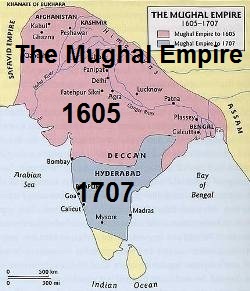
During the 16th and 17th century, the Mughal empire expanded across India to become the richest, most powerful empire to that point in history.
Emperor Jahangir
In 1605, Jahangir was recognized as the official heir to his father Akbar’s throne. The former prided himself on his knowledge of arts, natural science, theology and archery. He squandered much of his inheritance on wives, political allies, court scholars, alcohol and opium. He was the spiritual leader of his officials, initiating them into a cult in which they wore his portrait on their chest portrait on their chest or turban. It had the ability to ward off illness, even if they were hundreds of miles away.
Mughal wealth stemmed mainly from trade with European countries, which used gold and silver they mined in the New World and used to purchase India textiles. Mughal India was also impacted by New World crops, such a corn, chili peppers, tomatoes, potatoes and tobacco.
He granted rajput (Hindu) generals major authority but appointed no Hindus to central government and only a few Hindu provincial rulers. At the same time, he had five Hindu wives (his mother was Hindu), in addition to 14 Muslim wives.
He was especially devoted to his last wife Nur Jahan (a Muslim from Qandahar in Afghanistan) even though she bore him no children. In the last 10 years of his life she played a prominent part in public life as long term alcoholism had destroyed his mental functioning. During this period she ruled with absolute authority and had gold coins struck with her image.
Emperor Shah Jahan
After Jahangir died in 1627, his son Shah Jahan assumed the throne and after killing all his rivals (his brothers)a. Unlike his father and grandfather, he followed strict Sunni practice, including five daily prayers, Ramadan and Sharia law, while respecting the Persian Shi’ism of his favorite wife Muntaz Mahal. He authored five books on Sufi mysticism, as well as translating sacred Hindu texts into Persian.
He ruled for three decades and is best known for his jeweled gold peacock throne, the Taj Mahal and Shahjahanabad, the capitol city he built to Delhi.
His wife Muntuz Mahal died giving birth of her 14th child, and he built the Taf Mahal as a mausoleum in her memory. It has a white marble exterior (which was normally reserved for shrines) with inlaid precious tones and elegant Koranic calligraphy covering the walls.
His third great monument Shahjahanabad, which was called the Red Fort because of its red sandstone walls. In addition to ornamental perfumed water canals, the city supplied drinking water to residents via hydraulically driven Persian water wheels and disposed of wet human waste via an advanced sewage system. Dried waste was used to fertilize market gardens.
Shah Jahan levied heavy taxes to fund numerous unsiccessful military expeditions to Central Asia, resulting in frequent public uprisings.
He ruled for three decades until being imprisoned by his son Aranzev for the last eight years of his life.
Film can be viewed free with a library card on Kanopy.
 The Most Revolutionary Act